Physical AI and Humanoid Robots: What Major Breakthroughs Mean for Our Daily Lives
The intersection of artificial intelligence and physical hardware has officially moved past the realm of science fiction and laboratory demonstrations. Today, physical AI and advanced humanoid robotics represent one of the fastest-accelerating technological shifts in human history. With venture capital and corporate R&D pouring billions of dollars into the sector, companies are no longer just building machines that can walk or mimic human posture—they are deploying platforms capable of autonomous decision-making in dynamic, unpredictable environments.
Also read:
Agentic AI wealth management: How Real-Time Data Is Changing Finance in 2026
Major milestones achieved by platforms like Tesla’s Optimus Gen 3, Figure’s enterprise models, Boston Dynamics’ electric Atlas, and affordable units from companies like Unitree showcase a profound evolution. This wave is not driven solely by mechanics, but by a software revolution: Vision-Language-Action (VLA) models and imitation learning policies that act as the cognitive “brain” for multi-morphology hardware. Understanding what these breakthroughs mean requires looking closely at where technology stands today, how it is transforming industries, and what everyday life will look like as bipedal robots step out of factories and into our communities.
The Convergence of Physical AI and Bipedal Mechanics
For decades, robotics was limited by hard-coded programming. If a robotic arm encountered an object slightly out of alignment, or if a factory floor layout changed by a few centimeters, the machine would fail. The breakthrough that changed everything is Physical AI.
Physical AI marries massive transformer-based foundation models with physical embodiment. Instead of writing custom code for every single step a robot takes, engineers use imitation learning, diffusion policies, and massive training datasets (such as the Open X-Embodiment dataset) to teach robots how to interact with the world through video demonstrations and natural language prompts.
The Cognitive Leap: Models like OpenVLA and proprietary systems developed by startups and tech giants allow robots to interpret commands in plain language and generalize those commands to novel tasks they have never explicitly been programmed to perform.
Dexterous Manipulation: Multi-joint hands equipped with advanced tactile feedback sensors now allow robots to handle delicate objects, sort electronic components, and fold laundry—tasks that previously required human-level manual dexterity.
Sim-to-Real Transfer: Advanced physics simulators like NVIDIA Isaac Sim enable millions of hours of trial-and-error training to happen inside virtual environments before a single physical robot ever boots up, drastically accelerating safety and reliability.
From Factory Pilots to Real-World Deployments
The primary catalyst pushing humanoids into the mainstream is a severe global labor shortage in manufacturing, logistics, and supply chain operations. Fully loaded labor costs in industrialized nations have made automation an economic imperative rather than a luxury.
Major industrial players are aggressively integrating humanoids into live production workflows:
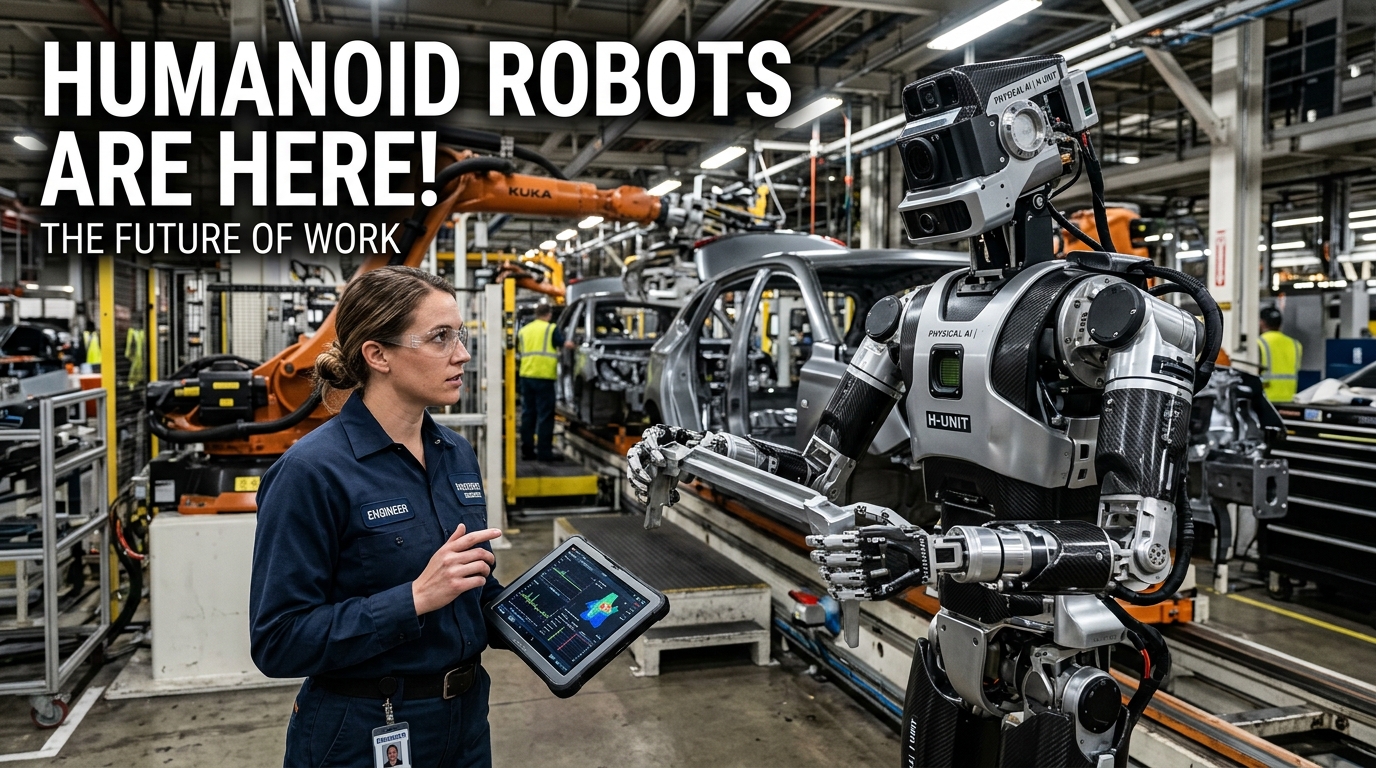
Automotive Manufacturing: Figure’s humanoid platforms have completed extensive multi-month production cycles at facilities like BMW’s Spartanburg plant, handling logistics sequencing and parts transport before scaling to other plants like BMW Leipzig. Meanwhile, Tesla has embedded over a thousand Optimus units across its own automotive manufacturing plants.
Logistics and Warehousing: Companies like Agility Robotics have logged thousands of operational hours with their bipedal Digit platform moving totes and managing inventory inside commercial distribution centers.
Global Market Diversification: While North American firms focus heavily on high-end enterprise solutions, Chinese manufacturers like Unitree and UBTECH have driven mass production forward, scaling unit shipments significantly and dropping entry-level research robot prices to historic lows.
What This Means for Our Daily Lives
As humanoid robots transition from controlled industrial shop floors to commercial services and eventually residential environments, the impact on everyday human life will be profound.
Redefining the Workplace
Humanoid robots are taking over the “3-D” jobs—dull, dirty, and dangerous tasks. On factory floors and construction sites, bipedal platforms shoulder heavy lifting, tolerate extreme temperatures, and handle repetitive material sorting. This shift does not necessarily mean total displacement; instead, it creates a hybrid workforce where human workers transition into supervisory, programming, and maintenance roles.
Transforming Healthcare and Elder Care
With aging populations in many developed nations creating immense pressure on healthcare systems, humanoid assistants are poised to become vital care companions. While fully autonomous surgical systems remain constrained by strict regulatory frameworks, service humanoids equipped with natural language understanding can assist nurses with patient mobility, medication delivery, and routine monitoring, helping alleviate chronic staffing shortages in hospitals and nursing homes.
Domestic Integration and Consumer Robotics
The long-term vision for companies like 1X (with platforms like NEO) and Tesla is the consumer home market. While domestic humanoids are still in early rollout and pre-order phases, the eventual goal is a general-purpose helper capable of cleaning, cooking preparation, and organizing living spaces. As unit economics improve and safety certifications mature, owning a domestic robot helper will shift from speculative fiction to a standard household utility over the next decade.
Economic and Ethical Challenges Ahead
Despite rapid technological strides, major hurdles remain before physical AI becomes ubiquitous:
The Energy and Battery Constraint: Running high-power computers, actuators, and dynamic balancing systems requires immense electrical draw. Most humanoids currently max out at 2 to 4 hours of active operation before requiring a recharge or battery swap.
Safety and Trust: Operating bipedal machines around unprotected humans demands absolute safety guarantees. Edge cases, long-tail system failures, and unpredictable human behavior mean that liability frameworks and fail-safe protocols are still heavily debated by regulators.
Economic Inequality and Labor Shifts: As productivity surges through automation, society must grapple with structural shifts in employment, retraining programs, and income distribution to ensure that the economic benefits of physical AI are distributed equitably.
Frequently Asked Questions
Are humanoid robots already working in real factories?
Yes. Major automotive and logistics companies, including BMW and Tesla, have actively deployed humanoid robots on live production and logistics lines to handle parts sequencing, tote movement, and basic assembly tasks.
How do humanoid robots understand what to do?
They rely on Physical AI and Vision-Language-Action (VLA) foundation models. Instead of traditional hard-coded instructions, robots are trained on vast amounts of movement data and can interpret spoken or typed natural language prompts to execute complex physical tasks.
When will humanoid robots be available for home use?
While early consumer-focused humanoids are entering preliminary delivery and pre-order phases, reliable, general-purpose household robots capable of complex domestic chores are still undergoing rigorous safety testing and will take several years to reach widespread consumer adoption.
How much do humanoid robots cost?
Prices vary widely based on capability. Research and light-industrial platforms can start around sixteen thousand dollars, while enterprise-grade, highly dexterous commercial humanoids deployed under corporate contracts often cost upwards of two hundred thousand dollars.
Conclusion
Physical AI and humanoid robots represent the convergence of software intelligence and mechanical form, marking a pivotal chapter in technological evolution. By solving complex challenges in mobility, dexterity, and real-time reasoning, these machines are stepping out of research labs and into the active workforce. While engineering hurdles like battery density and safety validation remain, the trajectory is clear: humanoid robots are reshaping our economic landscape and laying the groundwork for a future where intelligent machines work alongside humans to solve our most pressing labor and productivity challenges.