
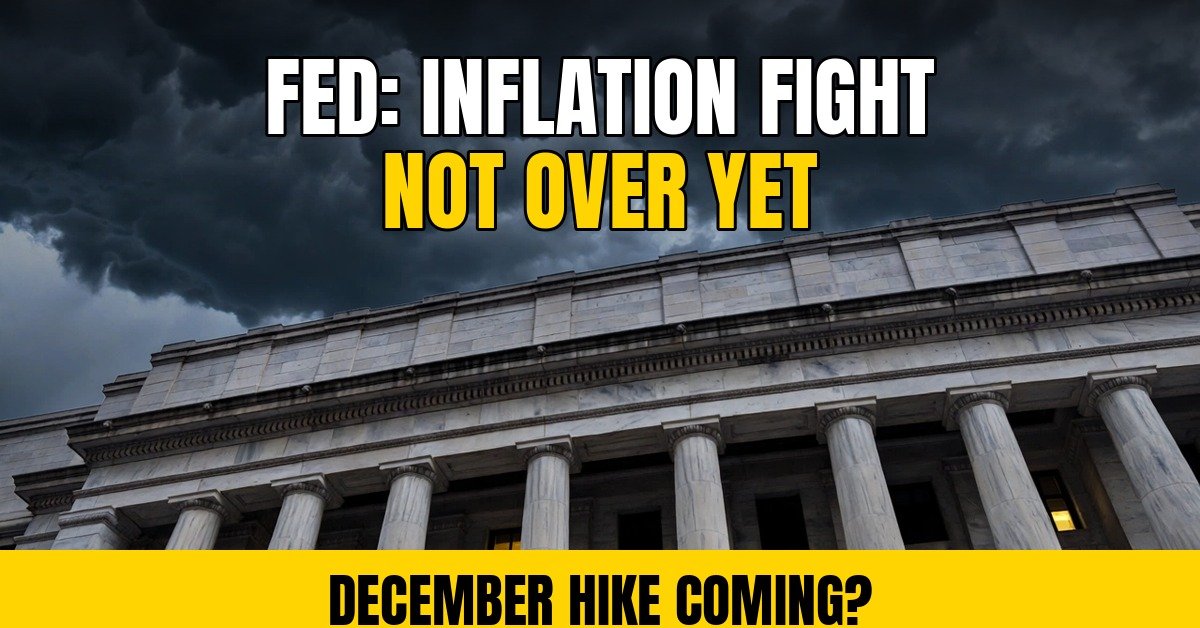
Fed Williams inflation warning landed on Monday with a blunt message: the fight is not over, and another rate rise is coming. New York Federal Reserve President John Williams said persistently high inflation continues to point the US central bank toward tighter monetary policy, with markets now expecting a quarter-point increase at the December 8-9 meeting.
“We must take actions over time that will ensure that we get inflation back to our 2% goal in a timely manner and on a sustained basis,” Williams said in remarks prepared for delivery to an event at the University of Mount Saint Vincent in New York City. “There is still work to do to get that done.”
Williams said inflation is “too high” and that it must be lowered back to the Fed’s target “in a timely manner and on a sustained basis.” He noted that he will continue to assess incoming data to decide what action the central bank should take at its December meeting.
Financial markets broadly expect the Fed to raise its policy rate by a quarter of a percentage point next month from the current 3.75%-4.00% range, with more increases to come next year. The Fed last raised rates in September as part of an effort to curb inflation, which has been above the 2% target for more than five years. Central bank officials worry that, if this situation persists, the public could lose confidence that inflation will return to that level.
Fed Williams Inflation Outlook: 3.5% This Year, 2% by 2028
In his remarks, Williams said that he expects inflation to end the year at 3.5% and to moderate to just above 2% next year before easing to the target in 2028. He also noted that risks to inflation continue to be skewed to the upside.
Williams noted that among the key drivers of high price pressures, energy prices remain elevated and the outlook on that front is uncertain. He added that “although the effects of tariffs, geopolitical conflicts, and the AI surge are showing up in prices of certain categories of goods, there is little evidence of these spilling over significantly into broader and more persistent inflation.”
That is a careful distinction, and the Fed Williams inflation picture depends on it holding. Tariffs and the AI boom are pushing up prices in specific corners of the economy — certain goods, certain supply chains — but Williams is saying the data does not yet show those pressures spreading into the kind of broad, sticky inflation that would force the Fed’s hand even harder. The risk, though, is that they could. That is why he stressed that the risks to inflation remain tilted upward.
The Fed Williams inflation message is also a timeline. Inflation at 3.5% by year-end, just above 2% next year, back to target in 2028 — that is a slow glide path, not a quick fix. It means rates stay higher for longer, and it means the December rise is a step on a longer road, not a one-off.
A strong economy — and a December decision
Williams also said the economy is showing strength and resilience and should grow by 2.75% in both 2026 and 2027. He added that the job market has been showing stability, and the current 4.1% unemployment rate should fall to around 4% next year.
A growing economy with a stable job market gives the Fed room to keep tightening. When unemployment is low and growth is steady, the central bank can raise rates to fight inflation without the same fear of tipping the economy into recession. That is the backdrop for the December decision: an economy strong enough to absorb another quarter-point rise.
Williams was speaking the same day as a sharp stock market rally, triggered by chipmaker Nvidia’s announcement that it was reinstating Jensen Huang as CEO, after President Donald Trump urged it to do so. Investors’ reaction highlighted the importance of AI companies in driving the markets. Some observers had wondered in recent days whether sharp stock losses might deter the Fed from raising rates.
Williams did not take the bait. His remarks kept the focus on inflation and the data, not on the market’s mood swings. The Fed Williams inflation stance stayed fixed on the numbers: a rally and a rate warning arrived on the same day, and the Fed president treated them as separate stories — one about a single company’s leadership, the other about the price of everything.
What December means for borrowers
If the Fed follows through in December, borrowing gets more expensive again. The policy rate sits at 3.75%-4.00% now, and a quarter-point rise would take it to 4.00%-4.25%. That feeds into mortgages, car loans, credit cards and business borrowing — slowly, but steadily.
For households, the Fed Williams inflation outlook means the December meeting is the one to watch. A rate rise in December, with more to come next year, means the cost of carrying a balance or taking out a loan stays high through 2027. For the Fed, that is the price of getting inflation back to 2% — and Williams made clear on Monday that the central bank is willing to pay it.
The question now is the data. Williams said he will keep assessing incoming numbers before the December 8-9 meeting. A hot inflation print between now and then would lock in the rise. A cool one would give the doves on the committee something to argue with. Either way, the Fed Williams inflation message leaves little doubt about which way the central bank is leaning: up.
Five years above target is a long time. The Fed Williams inflation record is clear: the goal is 2%, and the work continues. Williams is telling the public the Fed has not forgotten the goal, and it is not done working toward it.
Sources and Resources
- Reuters: Fed has ‘work to do’ to lower inflation, Williams says — https://www.reuters.com/business/fed-has-work-do-lower-inflation-williams-says-2026-11-23/
- WorldReachDaily homepage: worldreachdaily.com — https://worldreachdaily.com
Frequently Asked Questions
What did Fed Williams say about inflation?
Fed Williams inflation remarks on Monday said persistently high inflation still points the US central bank toward tighter policy. Williams said inflation is “too high” and added: “There is still work to do” to get it back to the Fed’s 2% goal in a timely manner and on a sustained basis.
Will the Fed raise rates in December?
Markets broadly expect a quarter-point rise at the December 8-9 meeting, taking the policy rate from the current 3.75%-4.00% range higher, with more increases to come next year. Williams said he will keep assessing incoming data before deciding.
What is Williams’ inflation forecast?
Williams expects inflation to end the year at 3.5% and to moderate to just above 2% next year before easing to the 2% target in 2028. He noted that risks to inflation continue to be skewed to the upside.
How is the US economy doing, according to Williams?
Williams said the economy is showing strength and resilience and should grow by 2.75% in both 2026 and 2027. The job market is stable, and the current 4.1% unemployment rate should fall to around 4% next year.
Are tariffs causing broader inflation?
Williams said tariffs, geopolitical conflicts and the AI surge are showing up in prices of certain categories of goods, but there is “little evidence of these spilling over significantly into broader and more persistent inflation.” Energy prices remain elevated and the outlook there is uncertain.
Conclusion
Fed Williams inflation warning leaves the December picture clear: the central bank is leaning toward another quarter-point rise, with more to follow next year, because inflation is still too high and the economy is strong enough to take it. Williams expects inflation to end the year at 3.5% and reach the 2% target only in 2028. The fight is not over — and the Fed just told everyone it intends to finish it.