
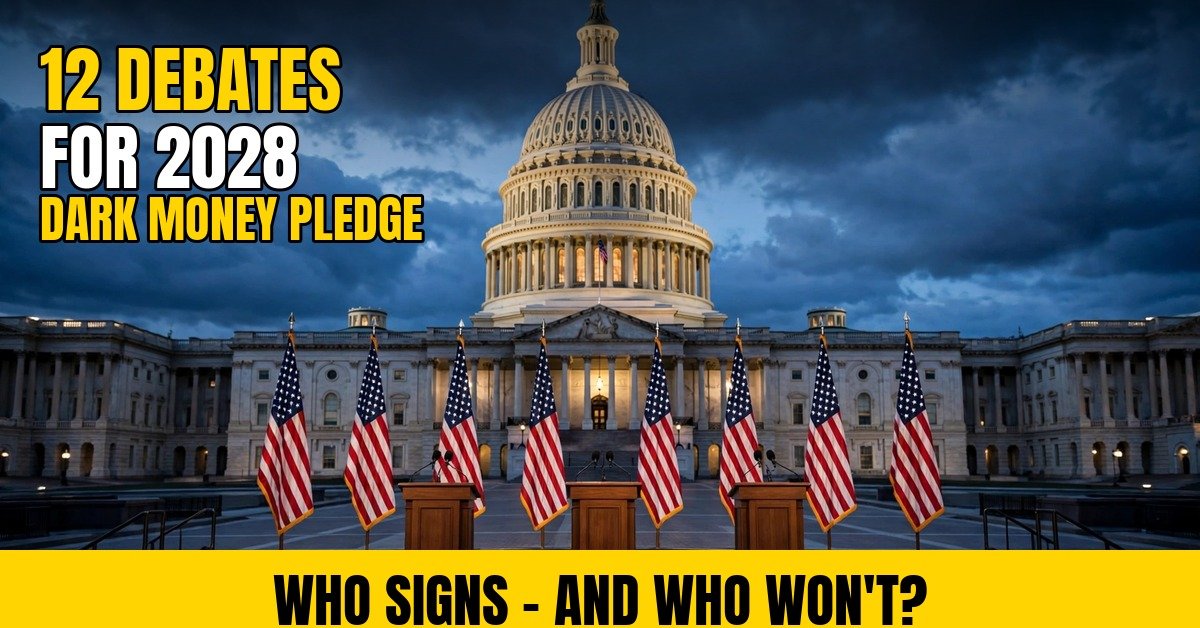
The DNC 2028 debates are set — twelve of them, starting in June 2027, with a new rule that could reshape how Democrats run for president. Candidates who want a spot on the stage will have to sign a pledge denouncing super PAC and so-called dark money spending in the primary, a win for progressives who have spent years pushing the party to crack down on big money in politics.
The Democratic National Committee announced the plan on Monday, and it adds another twist to a 2028 primary that is already expected to be crowded and competitive. Democrats are coming off historic wins in the midterms, and the party is now building the machinery for an open nominating contest — its first since 2020 — with the White House as the prize.
The first two debates will take place in June and July 2027, and the final debate is planned for March 2028. Under the framework, there will be five debates in 2027 and seven in 2028. The DNC also held 12 debates for the 2020 primary, the last time Democrats had an open nominating contest.
“Democrats are on offense after our historic victories in the midterms, and the DNC is keeping our foot on the gas as we head into the 2028 cycle,” DNC Chairman Ken Martin said in a statement. “The fair and transparent process and experienced leadership team we’re announcing today will keep our party united, strengthen our eventual nominee, and put Democrats in position to take back the White House.”
DNC 2028 Debates: The Dark Money Pledge
The biggest change in the DNC 2028 debates is what the party is calling its Fair Campaign Practices Pledge. Under the pledge, candidates who want to join DNC debates must designate a representative who can complain to the committee about spending by a 501(c)(4) nonprofit — a type of group that does not have to disclose its donors — or a super PAC, which can raise and spend unlimited amounts of money from individuals and corporations.
If the DNC agrees that the spending violates the pledge, it will ask candidates to provide a statement to the DNC denouncing the spending. The DNC will publish a tracker of complaints — and denunciations — on its website.
The pledge is a response to longtime calls by progressives to ban super PAC spending in Democratic primaries. The DNC has acknowledged it does not have the legal authority to do that — and there is nothing that prevents a super PAC from continuing to spend after candidates denounce its spending.
That gap drew quick skepticism. “What happens when everyone denounces the spending but their aligned superpac spends anyway?” asked Rob Flaherty, deputy campaign manager for Kamala Harris’ 2024 presidential campaign, in a post on X.
Ammar Moussa, a spokesperson for Maryland Gov. Wes Moore, a potential 2028 candidate, hinted at the longtime Democratic counterargument to restricting super PACs — that individual campaigns cannot eschew big money while their opponents benefit from it. “I love when Dems virtue signal so hard to the point they want to cost us elections,” Moussa wrote on X.
Martin, who took over as DNC chair in February 2025, has long promised to reduce the influence of big money in primaries. The pledge is the answer he landed on: not a ban the party cannot enforce, but a public pressure campaign with names attached.
Sen. Bernie Sanders, a Vermont independent who has long called for prohibiting super PAC spending in primaries, backed the move. He reiterated his call in a letter to Democratic congressional leaders in August, after a super PAC associated with the American Israel Public Affairs Committee spent more than $30 million in the Democratic primary for Senate in Michigan against the eventual winner, Sen.-elect Abdul El-Sayed. Sanders, in an X post responding to the news, called the pledge “excellent” and urged Democrats to implement it for House and Senate primaries too. The DNC 2028 debates pledge, in his view, is a start — not the finish.
Sanders is among the prominent Democrats backing the new debate plan, according to an initial list of supporters provided by a DNC official. The group also includes Rep. Greg Casar of Texas, chair of the Congressional Progressive Caucus, as well as Sen. Andy Kim of New Jersey, Sen. Elizabeth Warren of Massachusetts, Rep. Jason Crow of Colorado and former DNC Chair Jaime Harrison.
How the DNC 2028 debates will work
The DNC 2028 debates will be run by a newly named 2028 Debate Planning Committee, led by Minyon Moore, the DNC’s senior advisor for debates, and Roger Lau, the committee’s executive director. The debate committee also includes former staff for recent presidential campaigns.
The early debates may occur over two consecutive nights “in order to accommodate a potentially large field of candidates,” the DNC said. If that happens, each night’s lineup will be decided at random, with the total number of participants across both nights limited to 20 candidates.
The DNC will announce dates, locations, media partners and qualification criteria — including polling and fundraising thresholds — in January. Those cut lines will matter as much as the debate count with a field expected to run deep.
The DNC 2028 debates are all DNC-sponsored events, and candidates can be disqualified from them for a number of reasons. One of them is if candidates participate in an unsanctioned primary, a scenario that is most relevant in New Hampshire. The state has a law saying it must hold the nation’s first primary, and Secretary of State David Scanlan, a Republican, has said he plans to continue honoring it.
For now, the DNC 2028 debates calendar is the easy part. Twelve debates, five in 2027 and seven in 2028, first two in June and July 2027, last one in March 2028. The harder question is whether the pledge changes anything. A candidate can denounce a super PAC on Monday and benefit from its ads on Tuesday, and the DNC’s tracker will record both.
Either way, the DNC 2028 debates now have a shape, a schedule, and a condition for entry that no Democratic primary has had before. The candidates have until June 2027 to decide whether to sign.
Sources and Resources
- CNN: DNC plans to hold 12 debates for 2028 primary – with a new rule for Democrats who want in — https://www.cnn.com/2026/11/23/politics/democrats-2028-debates-dnc-rules-dark-money-pledge?cid=external-feeds_iluminar_meta
- WorldReachDaily homepage: worldreachdaily.com — https://worldreachdaily.com
Frequently Asked Questions
How many debates will the DNC hold for the 2028 primary?
The DNC 2028 debates will number 12 in total — five in 2027 and seven in 2028. The first two take place in June and July 2027, and the final debate is planned for March 2028. The DNC also held 12 debates for the 2020 primary.
What is the DNC’s dark money pledge?
The Fair Campaign Practices Pledge requires candidates who want to join DNC debates to denounce super PAC and dark money spending in the primary. Candidates designate a representative to complain about spending by 501(c)(4) nonprofits or super PACs, and the DNC publishes a tracker of complaints and denunciations on its website.
Can the DNC actually ban super PAC spending?
No. The DNC has acknowledged it does not have the legal authority to ban super PAC spending in primaries, and nothing prevents a super PAC from continuing to spend after candidates denounce it. The pledge relies on public pressure, not enforcement.
Who is running the DNC 2028 debates?
The DNC 2028 debates will be run by a 2028 Debate Planning Committee led by Minyon Moore, the DNC’s senior advisor for debates, and Roger Lau, the committee’s executive director. The committee also includes former staff for recent presidential campaigns.
When will the DNC announce debate dates and qualification rules?
The DNC plans to announce more details — including dates, locations and media partners — in January. It will also announce qualification criteria then, including polling and fundraising thresholds candidates must meet to take part.
Conclusion
The DNC 2028 debates will run to twelve, starting June 2027, with a dark money pledge attached that every candidate must sign to get on stage. It is the party’s answer to years of progressive pressure on big money in primaries — a public tracker and a required denunciation, not a ban it cannot enforce. Whether the pledge has teeth or just makes for good television, the race for 2028 now has its calendar, and the first debate is nineteen months away.