
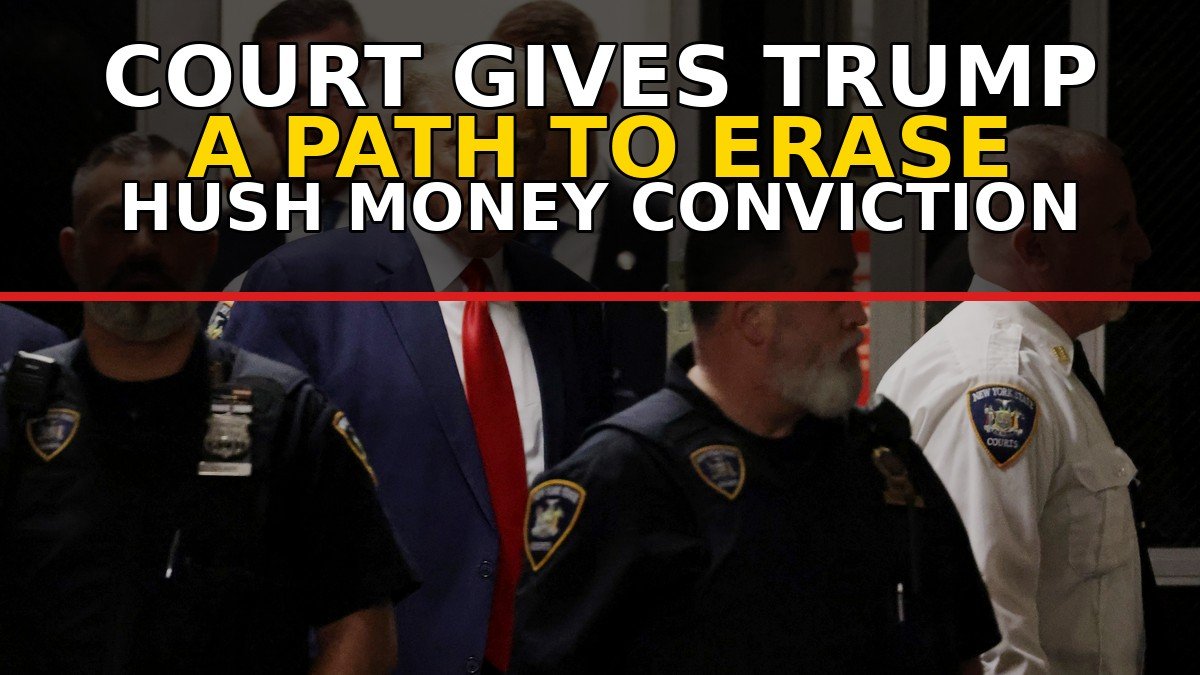
President Donald Trump has been handed a fresh chance to move the appeal of his Trump hush money conviction into federal court, a step that could bring the question of whether the verdict stands before federal judges — and, eventually, the Supreme Court — far sooner than the usual state appeals process would allow.
CNN reported that the three-judge panel ruled on Monday. The decision also follows the Justice Department’s bid to remove two Minnesota federal judges, another case testing the limits of federal court jurisdiction.
On Monday, a three-judge panel of the 2nd US Circuit Court of Appeals ruled that Trump can try again to persuade a district court judge that his appeal on 34 state counts of falsifying business records belongs in federal court. The panel said the late Judge Alvin Hellerstein, who had rejected Trump’s removal argument three times, was wrong to rule that a case cannot be moved to federal court after a conviction, and wrong to find that Trump’s lawyers had failed to show “good cause” to ask him to reconsider.
How the Trump Hush Money Conviction Could Reach Federal Court
Trump was convicted in May 2024 on 34 counts of falsifying business records, tied to reimbursements for hush money payments made to silence adult film star Stormy Daniels before the 2016 presidential election. His lawyers argue the appeal should be heard by federal judges because it turns on questions of federal election law and on the Supreme Court’s presidential immunity decision, which was handed down weeks after the conviction.
That immunity ruling, issued in July 2024, limited the use of evidence about a president’s official conduct in a case about unofficial conduct. Trump’s legal team says it did not know how heavily the Manhattan District Attorney’s office would rely on federal election law at trial, or how the immunity decision would shape the case — and that this amounts to good cause for a second look at removal.
The case has not yet been assigned to a new judge. Hellerstein, who handled the matter for years, died last month, and whoever takes over will approach the legal questions with fresh eyes. If the new district judge agrees the case should move to federal court, the Second Circuit would then be likely to consider the case on its merits. Any further appeal would go to the Supreme Court, which would be interpreting its own immunity ruling.
That route matters because it would fast-track the decision. Without it, the Supreme Court would not hear the case until every level of state appeal had been exhausted, a process that could take years. In the meantime, the three-judge panel said the state-court appeal proceedings should pause.
What Trump’s Team and Prosecutors Said
Earlier this month, Trump’s lawyer argued before a state appellate court panel that the verdict should be overturned. That court has not yet ruled. A spokesman for Trump’s legal team celebrated Monday’s decision, saying the president “appreciates the Second Circuit’s prompt and correct ruling” and arguing that the Supreme Court’s immunity decision, the Federal Constitution and “other established legal precedent mandate that the Witch Hunt perpetrated by the Manhattan DA be removed to federal court, and immediately overturned and dismissed.”
A spokesperson for the Manhattan District Attorney’s Office declined to comment.
At a hearing last week, Steven Wu, chief of appeals for the District Attorney’s office, argued the case is not about Trump’s social media posts or his conversations with Hope Hicks, the former White House communications adviser who testified at trial. “The defendant is not being prosecuted here for publishing his tweets. He’s not being prosecuted for speaking with Ms. Hicks in the White House,” Wu said. The case, he said, is about falsifying business records to commit or conceal another crime — which could have involved violating state or federal election law, tax laws, or falsifying bank business records.
The panel that ruled on Monday was made up of two judges nominated by Democrats and one nominated by a Republican. It found that Hellerstein had erred on two points: first, in holding that removal is not available once a federal officer defendant has been convicted; and second, in finding that Trump’s lawyers had failed to show good cause for reconsideration.
Why This Ruling Matters
The decision does not erase the Trump hush money conviction. It gives Trump another hearing on where the appeal should be fought — and that question could decide how quickly, and by whom, the verdict is ultimately judged. A federal forum would put the immunity question, and the role federal election law played at trial, directly before federal judges, with the Supreme Court as the final stop.
For now, the state appeal is on hold, the case awaits a new district judge, and a conviction that has shadowed Trump’s return to the White House moves one step closer to a federal courtroom.