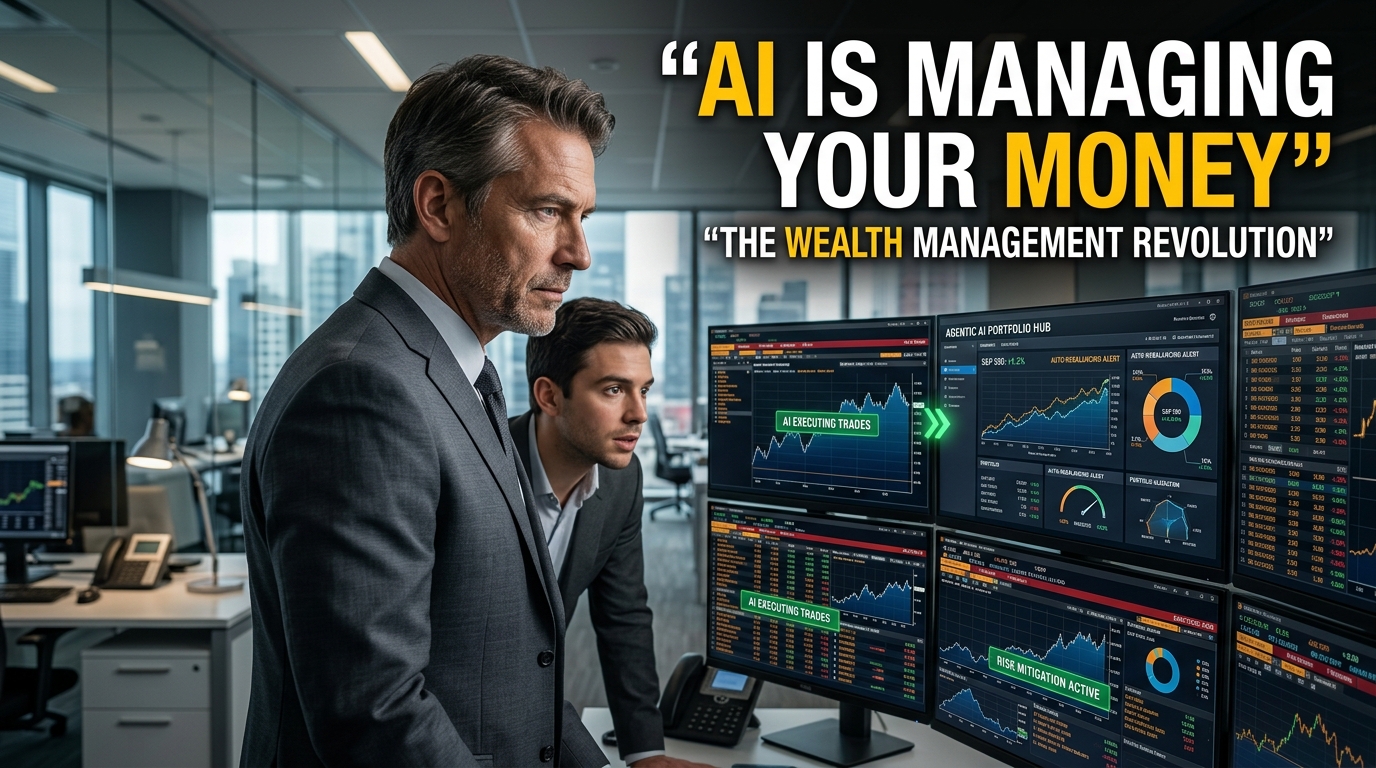
Agentic AI wealth management is no longer a futuristic concept; it is the core infrastructure redefining global personal finance and financial advisory services. The global financial landscape has entered a definitive paradigm shift. For years, financial technology relied on passive tools: static budgeting apps, historical spreadsheets, and conversational chatbots that could only answer basic queries. Today, the conversation has moved entirely from generative text to autonomous digital systems capable of executing multi-step workflows, monitoring markets on a millisecond-by-millisecond basis, and taking direct action on behalf of users.
Combined with hyper-connected real-time data feeds, modern financial technology is completely changing how individuals and institutions approach money.
Also read:
Reform UK Foreign Donations Scandal: Channel 4 Sting Exposes Plot to Evade Electoral Laws
The Rise of Agentic AI: From Chatbots to Autonomous Digital Employees
Traditional fintech applications required users to do the heavy lifting. Individuals had to look up their spending habits, calculate tax liabilities, manually rebalance portfolios, or schedule transfers. Generative AI tools introduced in previous years acted as text-based copilots, writing summaries or giving general advice, but they lacked execution capabilities.
In 2026, autonomous systems act as digital employees. These systems possess reasoning loops, access to secure Application Programming Interfaces (APIs), and the authority to execute financial operations under predefined user-centric guardrails.
Autonomous Multi-Step Workflows: Instead of simply suggesting a savings plan, an intelligent agent can evaluate a user’s checking account surplus, analyze current high-yield savings rates, move funds automatically, and execute recurring investments without human prompting.
Proactive Interventions: Rather than waiting for a monthly review, agentic systems continuously scan for financial vulnerabilities—such as hidden subscription price hikes or suboptimal cash allocations—and resolve them instantly.
Democratizing High-End Advisory: High-net-worth individuals have long relied on family offices and private bankers to manage complex tax strategies, estate planning, and private market allocations. Agentic workflows now bring these ultra-personalized services to everyday retail investors at a fraction of the cost.
The Power of Real-Time Data Integration
Autonomous intelligence is only as good as the data feeding it. In the past, portfolio tracking suffered from fragmentation. Bank balances, retirement accounts, real estate valuations, and crypto assets lived in isolated silos, updating on delayed cycles.
The widespread adoption of universal open banking standards and unified data layers has changed this completely. AI agents now operate on continuous, real-time data streams that include:
Live Macroeconomic Indicators: Instant tracking of shifting interest rate expectations, inflation prints, and regulatory amendments.
Dynamic Tax Code Adjustments: Real-time computation of tax-loss harvesting opportunities based on live intraday asset price fluctuations.
Holistic Asset Visibility: Multi-asset consolidation platforms that aggregate liquid stocks, bonds, and alternative assets—such as private equity and real estate holdings—into a single, unified analytical dashboard.
Transforming Wealth Management for Institutions and Advisors
For wealth management firms, registered investment advisors (RIAs), and private banks, the integration of real-time data and agentic agents has fundamentally restructured daily operations. Advisors are pivoting away from administrative burdens and spending up to 90% of their time on high-value client relationship management.
Institutional platforms now utilize governed AI infrastructure that sits directly on top of trusted compliance documents and regulatory frameworks. When a market shock occurs, an advisor’s digital agent fleet can instantly stress-test every client portfolio, draft customized risk mitigation strategies, and prepare audit-ready explanations before the market even closes. This capability fulfills evolving regulatory expectations that demand evidence-based fiduciary care rather than generic intent.
Frequently Asked Questions
What is the difference between generative AI chatbots and Agentic AI in finance?
Generative AI chatbots are reactive; they answer questions, draft emails, or summarize documents based on text prompts. Agentic AI is proactive and autonomous. It possesses the ability to plan, use tools, interact with external financial systems, and execute multi-step workflows (such as portfolio rebalancing or bill negotiation) without requiring constant human supervision.
How does real-time data improve personal finance apps?
Real-time data eliminates reporting lags, allowing automated systems to react instantly to market volatility, interest rate adjustments, or unexpected cash flow changes. This enables features like automated intraday tax-loss harvesting and instant micro-budget adjustments.
Is Agentic AI safe to use for managing money?
Modern financial agentic platforms operate under strict guardrails, role-based access controls, and “human-in-the-loop” verification for high-stakes transactions. They use encrypted, jurisdiction-compliant frameworks to ensure data privacy and prevent unauthorized asset transfers.
Will AI replace human financial advisors?
AI will not replace human advisors, but it will replace advisors who do not use AI. By handling administrative workloads, compliance checks, and data crunching, AI frees up human advisors to focus on emotional coaching, complex family dynamics, and bespoke strategic planning.
The intersection of advanced technology and real-time data has effectively closed the gap between institutional power and individual financial management. As these autonomous systems mature, the definition of wealth management is shifting from managing static assets to orchestrating dynamic, living financial ecosystems. For consumers and financial institutions alike, embracing this technological wave is no longer an optional luxury—it is the baseline requirement for financial resilience in a fast-moving digital economy.
Official News Links & Trust Resources