
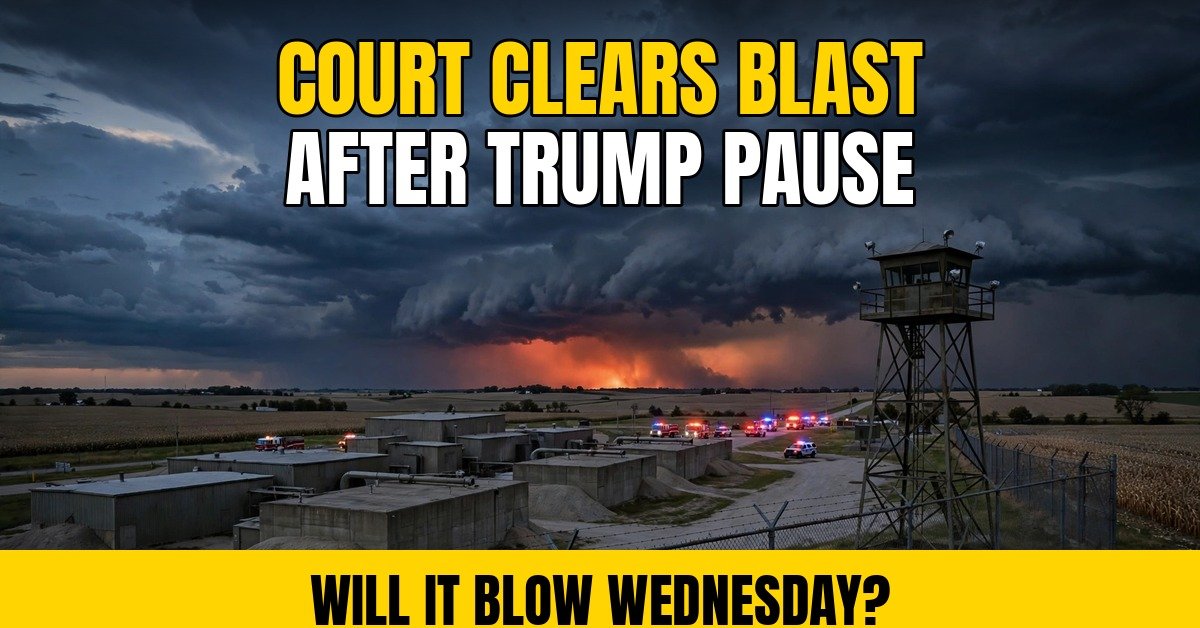
The Iowa lead azide detonation is back on — for now. A federal appeals court lifted its temporary hold on the Army’s plan to blow up 68 barrels of degraded explosive at the Iowa Army Ammunition Plant, clearing the way for a controlled blast now planned for Wednesday. The ruling came hours after President Donald Trump ordered the Army to pause the operation until the court could weigh in.
It is the latest turn in a standoff that has pitted public safety against environmental fears in rural Iowa. The Army says the stockpile has become so unstable that leaving it alone is the bigger danger. Residents and environmental groups say setting off nearly 10,000 pounds of toxic explosive near their homes is not a risk they signed up for.
Trump stepped into the middle of it on Monday with a post on Truth Social, saying he had ordered the Army to hold off until the Eighth Circuit Court of Appeals could rule. His order was conditional: it was subject to governor-elect Rob Sand agreeing to the operation. Sand, who posted on X over the weekend that “no good options exist” for dealing with the stockpile, did not immediately respond to a request for comment on Trump’s order.
Then the court moved. The Eighth Circuit lifted the temporary stay it had issued on Thursday, freezing the Army’s environmental permit after environmental groups sued to stop the blast. With the hold gone, the path is clear for the controlled detonation to go ahead on Wednesday — unless a new legal challenge lands first.
Iowa Lead Azide Detonation: What the Army Plans to Blow Up
The Iowa lead azide detonation involves 68 barrels of degraded lead azide, an explosive chemical used in military munitions. The Army said last week it would detonate the stockpile — nearly 10,000 pounds, or 4,500 kilograms — at the Iowa Army Ammunition Plant on November 20. After public outcry, the Army postponed the blast.
Lead azide is a primary explosive, the kind used to set off larger charges. When it is fresh and handled properly, it is a standard part of munitions manufacturing. When it degrades, it becomes dangerously unpredictable. The US Environmental Protection Agency said the compound has become so unstable that it poses a risk of an uncontrolled explosion — and that moving it somewhere else would be risky too.
That is the core of the Army’s case. In a court filing late on Saturday, the Justice Department said a controlled detonation was necessary “to protect the public from the more significant threat from an uncontrolled explosion.” In other words, the choice is not between a blast and no blast. It is between a blast the Army controls and one nobody controls.
The EPA sharpened the warning on Saturday, saying there is an immediate risk the lead azide could explode because temperatures are expected to drop below 30 degrees Fahrenheit — minus 1 degree Celsius — in Iowa this week. Cold, the agency said, makes the degraded compound even more volatile.
A week of reversals
The Iowa lead azide detonation has changed shape almost daily. The Army announced the November 20 blast last week, then postponed it after residents and local officials pushed back. Environmental groups went to court, and on Thursday the Eighth Circuit froze the Army’s environmental permit, halting the operation for the moment.
By the weekend, the federal government was arguing in court that delay itself was dangerous. The Justice Department’s Saturday filing framed the controlled blast as the safer option, and the EPA’s warning about the cold snap added a deadline no one had planned for.
Trump’s Monday order added a political layer. By making the pause conditional on the court ruling — and on Sand’s agreement — the president put the decision back in the hands of the judges and the incoming governor. Sand, a Democrat who won the governor’s race this month, had already signaled his unease, writing that “no good options exist” to deal with the stockpile.
The court’s decision to lift the hold resolves the legal question for now, but it does not resolve the underlying argument. Environmental groups sued because they believe a blast of this size, releasing lead compounds into the air and soil, carries its own health risks. The Army and the EPA argue those risks are smaller than the risk of the stockpile going off on its own.
What happens on Wednesday
If the plan holds, the Iowa lead azide detonation will go ahead on Wednesday under controlled conditions at the ammunition plant. The Army has not publicly detailed the exact safety perimeter or the timing, and local officials are expected to issue guidance to nearby residents before the blast.
The Wednesday date matters because the cold snap the EPA warned about is already arriving. Every day the stockpile sits in freezing temperatures, the agency says, the chance of an uncontrolled explosion grows. That urgency is why the government pushed the court to move fast — and why the court lifting the hold changes the timeline from “on hold” to “this week.”
Still, nothing about this story has stayed settled for long. A fresh legal challenge could still land before Wednesday, and Sand’s position — his agreement was one of Trump’s conditions — remains unclear. For the people who live near the plant, the questions are simpler: when exactly will it happen, how far will the effects reach, and who is watching to make sure it goes as planned.
The court has cleared the way. The Army has its window. Wednesday will tell whether the Iowa lead azide detonation goes ahead as planned — or takes yet another turn.
Sources and Resources
- Reuters: Trump orders US Army to pause lead azide detonation in Iowa — https://www.reuters.com/world/us/trump-orders-us-army-pause-lead-azide-detonation-iowa-2026-11-23/
- WorldReachDaily homepage: worldreachdaily.com — https://worldreachdaily.com
Frequently Asked Questions
What is the Iowa lead azide detonation?
The Iowa lead azide detonation is the Army’s plan to blow up 68 barrels of degraded lead azide — nearly 10,000 pounds of explosive chemical — at the Iowa Army Ammunition Plant. The stockpile has become dangerously unstable, and the Army says a controlled blast is safer than leaving it in place.
Why did Trump order the Army to pause the detonation?
Trump ordered the pause on Monday until the Eighth Circuit Court of Appeals could rule on the matter. His order was also subject to governor-elect Rob Sand agreeing to the operation. The court has since lifted its temporary hold, clearing the way for the blast.
Why is the lead azide dangerous?
The EPA says the degraded compound has become dangerously unstable and poses a risk of an uncontrolled explosion. Moving it is also risky. The agency warned the danger is immediate because temperatures in Iowa are expected to drop below 30 degrees Fahrenheit this week.
When will the Iowa lead azide detonation happen?
The controlled detonation is now planned for Wednesday, after the appeals court lifted its temporary hold. The Army had originally planned the blast for November 20 but postponed it after public outcry.
What did the court decide?
The Eighth Circuit temporarily halted the detonation on Thursday by freezing the Army’s environmental permit after environmental groups sued. It has now lifted that hold, clearing the way for the controlled blast to proceed.
Conclusion
The Iowa lead azide detonation is cleared to go ahead on Wednesday after a week of reversals — a court stay, an EPA warning about freezing temperatures, a pause ordered by Trump, and now a ruling that lifts the hold. The Army says a controlled blast is the only safe way to deal with a stockpile that could explode on its own. Residents near the plant will be watching Wednesday closely to see if the plan holds, and whether the blast the government has argued for is really the safest option left.