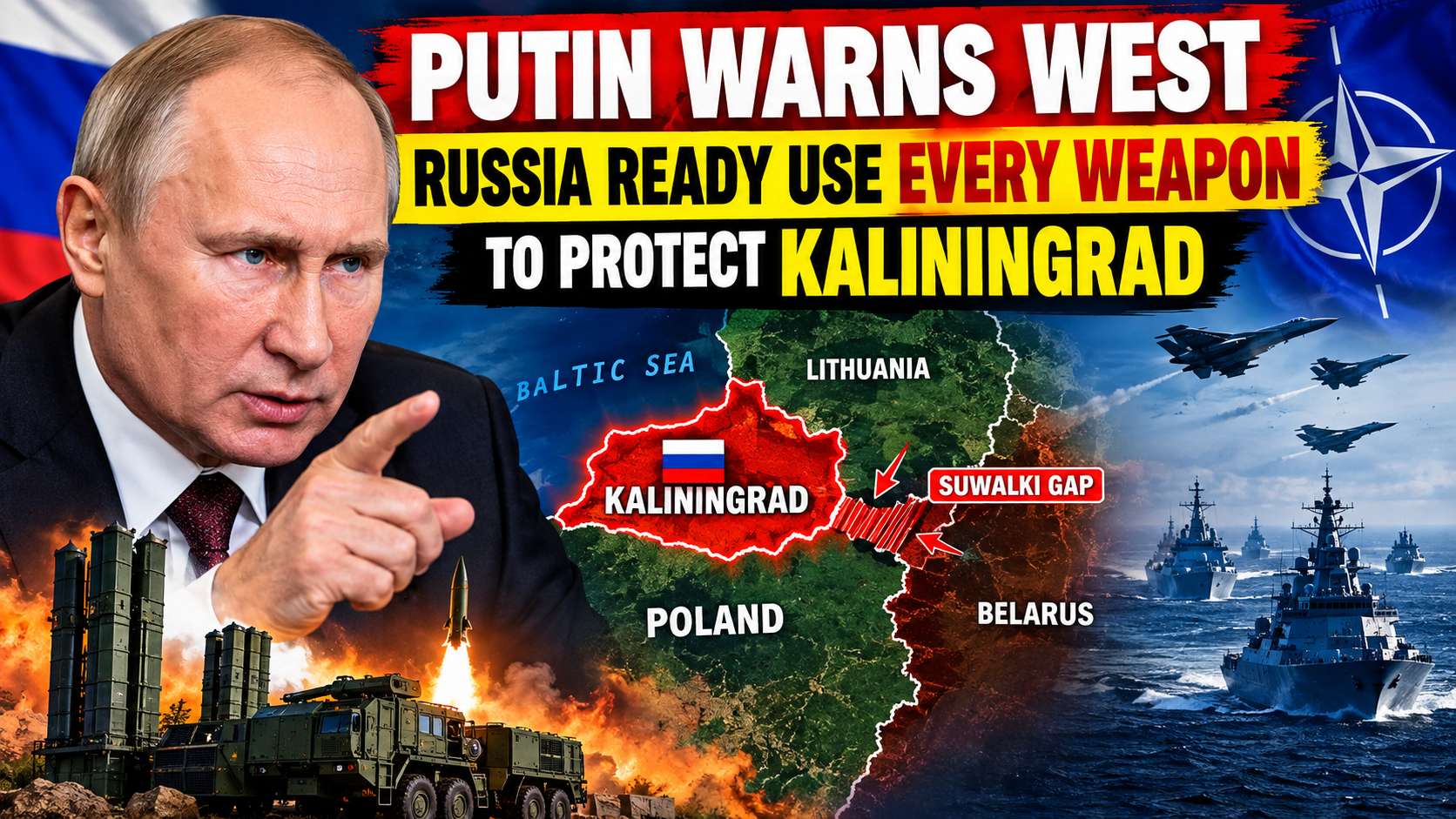
Putin Warns West Russia Ready Use Every Weapon Protect Kaliningrad Threat
As geopolitical friction over the Baltic region reaches unprecedented levels, Putin warns West Russia ready use every weapon protect Kaliningrad against any prospective naval, air, or land blockades by NATO member states. Speaking at the Valdai Discussion Club in Moscow, Russian President Vladimir Putin signaled that any direct military aggression or isolation attempt targeting Russia’s westernmost enclave would trigger an immediate military response using Moscow’s full strategic and tactical arsenal.
The explicit warning follows a series of diplomatic exchanges, military exercises in Northern Europe, and allegations from Russian embassies across Europe that Western allies are evaluating maritime isolation scenarios around the Baltic Sea. By explicitly framing Kaliningrad’s territorial security as an existential red line under Russia’s nuclear deterrence doctrine, Moscow has elevated the strategic significance of the Suwalki Gap and the Baltic maritime corridor into a potential flashpoint for direct NATO-Russia confrontation.
Also Read:
US Stock Market Today: Big Tech Saves the Nasdaq While the Dow Bleeds
1. Geopolitical Context: The Kaliningrad Strategic Exclave
Kaliningrad, formerly Königsberg, became part of the Soviet Union following the 1945 Potsdam Conference and remained a constituent region of the Russian Federation after the collapse of the USSR. Nestled between Poland to the south and Lithuania to the north and east, the 8,600-square-mile exclave has no direct land connection to mainland Russia.
                                [ Mainland Russia ]
                                         |
                                         v
                         [ Belarus Transit Corridor ]
                                         |
                        ( Vulnerable Suwalki Gap )
                                         |
                 +-----------------------+-----------------------+
                 |                                               |
                 v                                               v
       [ Lithuania (North/East) ]                     [ Poland (South) ]
                 |                                               |
                 +-----------------------+-----------------------+
                                         |
                                         v
                            [ Kaliningrad Oblast ]
                         (Headquarters: Baltic Fleet)
                                         |
                                         v
                             [ Baltic Sea Sea-Lanes ]
                       (Monitored by NATO Member States)
Its strategic importance to Moscow cannot be overstated:
Home to the Baltic Fleet: Kaliningrad hosts the headquarters of the Russian Navy’s Baltic Fleet at Baltiysk, providing year-round ice-free maritime access.
Advanced A2/AD Bubble: The region is heavily fortified with Iskander-M short-range ballistic missile systems, S-400 anti-aircraft batteries, and Bastion coastal defense arrays, creating a multi-layered Anti-Access/Area Denial (A2/AD) umbrella covering parts of Poland, Germany, and Scandinavia.
The Suwalki Gap Chokepoint: A narrow 65-kilometer land corridor connecting Poland and Lithuania. In a crisis, military planners fear Russia and Belarus could close this gap, physically severing the Baltic States from the rest of NATO.
2. Escalation Dynamics: Allegations of Blockades and Deterrence
The crisis deepened after Russian diplomatic missions in the United Kingdom, Ireland, and Belgium published formal statements warning that NATO was evaluating “air and naval blockade” operations targeting Kaliningrad transit routes. European leaders and NATO representatives dismissed these accusations, reasserting that Western military presence along the eastern flank remains entirely defensive.
“If it comes to a direct attack on the Russian Federation – in this case, we are referring to Kaliningrad… the question of deploying all the weapons at our country’s disposal will, of course, inevitably and immediately be on the agenda,” President Vladimir Putin declared during his Valdai address.
Under updated provisions of Russia’s nuclear doctrine, an attack on Russian sovereign territory—or an operational blockade that threatens the basic functioning of state sovereign institutions—fulfills the threshold for launching non-conventional strike capabilities.
3. Comparative Strategic Posture: Russia vs. NATO in the Baltic Region
The convergence of NATO expansion—following the accession of Finland and Sweden—and intensified Russian defensive posture has effectively transformed the Baltic Sea into a highly militarized arena.
| Operational Sphere | Russian Military Posture in Kaliningrad | NATO Counter-Strategy & Capabilities |
| Maritime Domain | Baltic Fleet deployments, submarine ops, and anti-ship missile units. | Enhanced Baltic Air Policing, naval patrols, and joint amphibious drills. |
| Air & Missile Defense | S-400, S-300V4, and Iskander-M dual-capable nuclear systems. | Patriot PAC-3 batteries deployed in Poland and Lithuania. |
| Logistics & Transit | Reliance on rail transit via Lithuania and sea lanes from St. Petersburg. | EU Sanctions enforcement on military/dual-use transit goods. |
| Electronic Warfare | High-powered jamming nodes affecting regional GPS/GNSS networks. | Allied cyber defense monitoring and resilient navigational arrays. |
4. International Law and Transit Protocols
The legal baseline governing Kaliningrad transit involves a complex mix of bilateral agreements, European Union sanctions frameworks, and international law of the sea.
  1945 Potsdam Accord       1990 Final Settlement       2002 EU-Russia Transit        2026 Escalation
+---------------------+    +---------------------+    +-------------------------+    +------------------------+
| Sovereign transfer  | -> | German border       | -> | Special Rail & Passenger| -> | Nuclear warnings over  |
| of Königsberg region|    | definitive limits   |    | Transit Permit Agreements|    | alleged naval blockade |
| to Soviet Union |    | established        |    | established           |    | proposals              |
+---------------------+    +---------------------+    +-------------------------+    +------------------------+
Under Article 2(4) of the United Nations Charter, states are prohibited from using force or threat of force against the territorial integrity of any nation. However, European Commission guidance restricts the transit of sanctioned dual-use military components across EU territory via road or rail.
When sanctions enforcement tightens, Moscow routinely interprets regulatory delays as a de facto economic blockade, whereas Brussels maintains these steps are lawful administrative enforcement actions rather than acts of war.
5. Strategic Risk Assessment: Scenario Pathways
Military strategists evaluate three prospective escalation pathways regarding Kaliningrad friction:
Hybrid Infrastructure Friction: Continued electronic warfare, GPS spoofing, and regulatory disputes over transit permits, remaining below the threshold of kinetic conflict.
Accidental Maritime Interdiction: Unplanned encounters between Russian naval escorts and NATO maritime surveillance assets in international waters leading to localized air or sea engagements.
Existential Blockade Scenario: A total severance of civilian supply lines forcing Moscow to enforce a sea supply bridge by military force, triggering the full weight of NATO Article 5 and Russian nuclear deterrence doctrines.
Strategic Conclusion
President Putin’s explicit rhetoric underscores that Moscow considers Kaliningrad an indispensable component of its national security perimeter. While Western diplomats reassert that NATO seeks stabilization rather than confrontation, the potential for miscalculation around the Baltic corridor requires careful crisis-management channels between Moscow and Allied military commands.
Frequently Asked Questions (FAQs)
What is the significance of Kaliningrad to Russia?
Kaliningrad is a Russian exclave situated between Poland and Lithuania on the Baltic Sea. It serves as the strategic headquarters for Russia’s Baltic Fleet and provides a crucial warm-water maritime portal and advanced military deployment base.
Why did President Putin issue a warning regarding Kaliningrad?
President Putin warned that any attempt by NATO or European powers to impose an air or naval blockade on Kaliningrad would be treated as a direct attack on Russian territory, triggering a full military response using all available weapons, including nuclear capabilities.
What is the Suwalki Gap?
The Suwalki Gap is a narrow strip of land along the Polish-Lithuanian border that separates Kaliningrad from Belarus. It is considered one of NATO’s most vulnerable geographic chokepoints during a conflict.
Is Kaliningrad currently under a blockade?
No. While European Union sanctions restrict the land transit of specific military and dual-use goods through EU territory, civilian cargo and transit routes remain operational, though subject to strict regulatory inspections.
Disclaimer
This article is an independent geopolitical analysis compiled from official diplomatic readouts, public statements from the Valdai Discussion Club, and international security databases. It is intended strictly for analytical, educational, and news reporting purposes.