
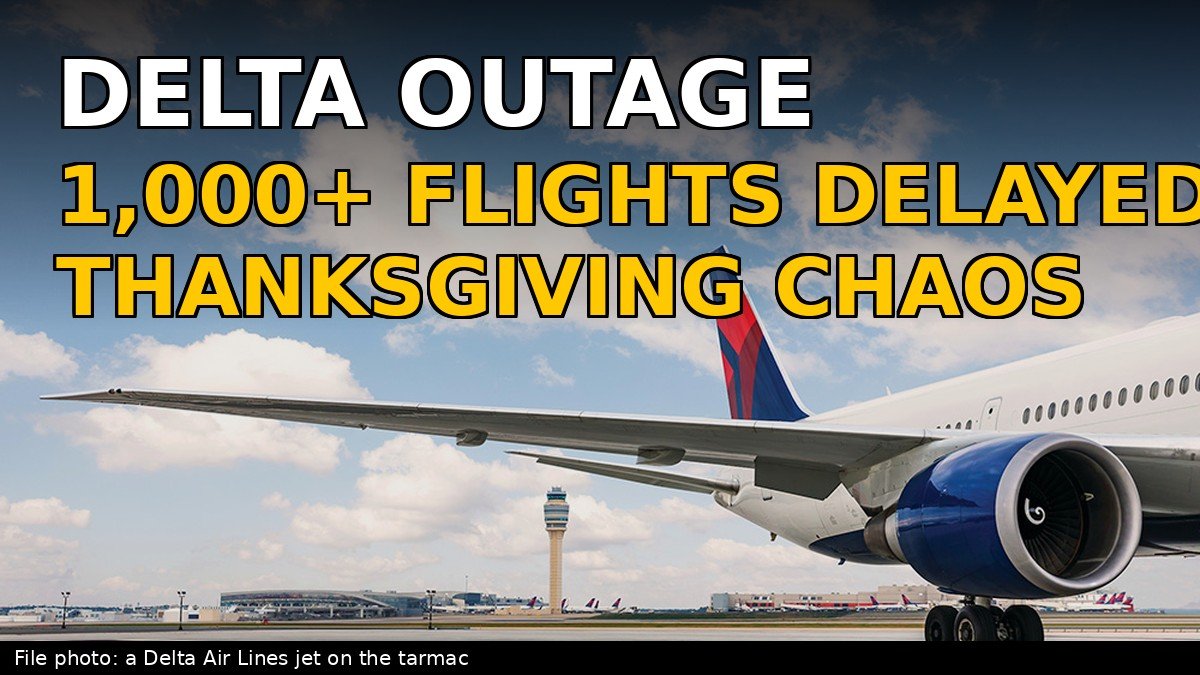
A Delta system failure delays flights across the United States on Sunday, leaving more than 1,000 departures held up at the start of the busiest travel week of the year. The airline’s automated weight-and-balance system — the software that works out how much a plane weighs and where its load sits before it can safely take off — stopped working, forcing crews to calculate the figures by hand while technicians raced to restore it.
By Sunday afternoon, more than 1,000 Delta flights had been delayed, and by the evening the count had climbed to roughly 1,600 to 2,000, or about half of the airline’s schedule for the day, according to FlightAware data. More than 40 flights were cancelled. Delta, which had about 5,000 flights scheduled for Sunday, said about 70 percent of the day’s disruptions were caused by the technology failure, with the rest down to bad weather and air traffic slowdowns in New York and the Northeast.
The timing could hardly have been worse. Thanksgiving week is the busiest travel period in the United States, with airports packed and flights typically full. Passengers who had planned to fly out on Sunday found themselves waiting in terminals across the country, many of them unsure when — or whether — they would get away.
Delta System Failure Delays Flights: What Went Wrong on Sunday
The problem was with the system that tracks aircraft-loading information used to calculate a plane’s final weight with passengers, fuel and bags on board. Delta told employees in an internal message that its IT teams were working to resolve a “database issue” affecting that system, according to the Wall Street Journal. The airline has not said what caused the database problem, but it confirmed the outage was not the result of a hack.
Without the automated calculations, no Delta plane could legally depart until its weight and balance had been worked out another way. For much of the day, the airline relied on manual workarounds to get flights off the ground safely — a slower process that quickly built up delays at every airport Delta serves.
By about 3:30 p.m. ET on Sunday, Delta said the automated system was working again. Even so, flights were still far from back to normal, and the airline said it was focused on completing the rest of the day’s schedule. Delta said it hoped to have all its delayed flights in the air by the end of Sunday.
Atlanta Hit Hardest as FAA Halts Inbound Flights
The disruption was felt most sharply at Hartsfield-Jackson Atlanta International Airport, Delta’s home hub and the busiest airport in the world. On Sunday morning, the Federal Aviation Administration issued an approximately hour-long ground stop on flights heading into Atlanta, then downgraded it to a ground delay programme at about 8:40 a.m. ET. The delay programme was lifted by about 12:46 p.m. ET.
By midday, FlightAware showed 835 delayed flights at Atlanta airport alone, with 54 percent of departures delayed and about half of arriving flights held up. The FAA said the outage was specific to Delta and unrelated to its own air traffic systems, a point it also made on X.
The ripple effects spread well beyond Georgia. At Los Angeles International Airport, at least 55 flights were delayed with one cancellation on Sunday morning, while San Francisco International Airport recorded another 25 delays. Nationwide, FlightAware’s Misery Map recorded 828 delays and 18 cancellations across all carriers between 6 a.m. and 10 a.m. alone.
What Delta Is Doing for Stranded Passengers
Delta apologised for the delays on Sunday afternoon and said it was rebooking customers, providing meals and hotel rooms where needed, and offering refunds if a flight was cancelled. Passengers whose flights were delayed were urged to check the status of their flight before travelling to the airport and to keep the airline’s app and contact details close at hand.
Travellers with flexible tickets may find it easier to rebook, and Delta’s travel waiver allows affected passengers to change their plans without the usual penalties. Anyone whose flight was cancelled should check their rights to refunds or rebooking, which vary by airline and by the terms of the ticket.
A Second Technology Failure in Nine Days
Sunday’s meltdown came just over a week after a separate technology failure brought American air travel to a standstill. On Friday, November 13, a failure in the communications systems linking air traffic control centres triggered a nationwide ground stop that lasted about five hours, cancelling nearly 5,000 flights and delaying more than 10,000. Our earlier report covered that disruption in full.
The two failures were different — the first hit the FAA’s air traffic control communications, the second hit Delta’s own weight-and-balance software — but together they have put the fragility of the systems behind American air travel in sharp focus at the worst possible moment. Aviation experts have warned for years that the infrastructure needs serious investment, and two major failures in nine days have given those warnings new force.
What Happens Next for Thanksgiving Travellers
The Thanksgiving rush is only just beginning. Los Angeles World Airports is projecting nearly 2.6 million passengers — an average of 215,000 travellers a day — to pass through LAX over the 12-day holiday period, up 5 percent from last year, with traffic expected to peak on Sunday, November 29.
For passengers flying Delta in the coming days, the advice is the same as it was on Sunday: check flight status before leaving home, allow extra time at the airport, and be ready for schedules to take time to settle. A plane that should have flown on Sunday may have spent the night in the wrong city, and crews bound by strict rules on working hours may be out of position. Rebuilding a national flight schedule from that position is slow, complicated work — and this time, it has to happen while the busiest week of the year is already under way.