
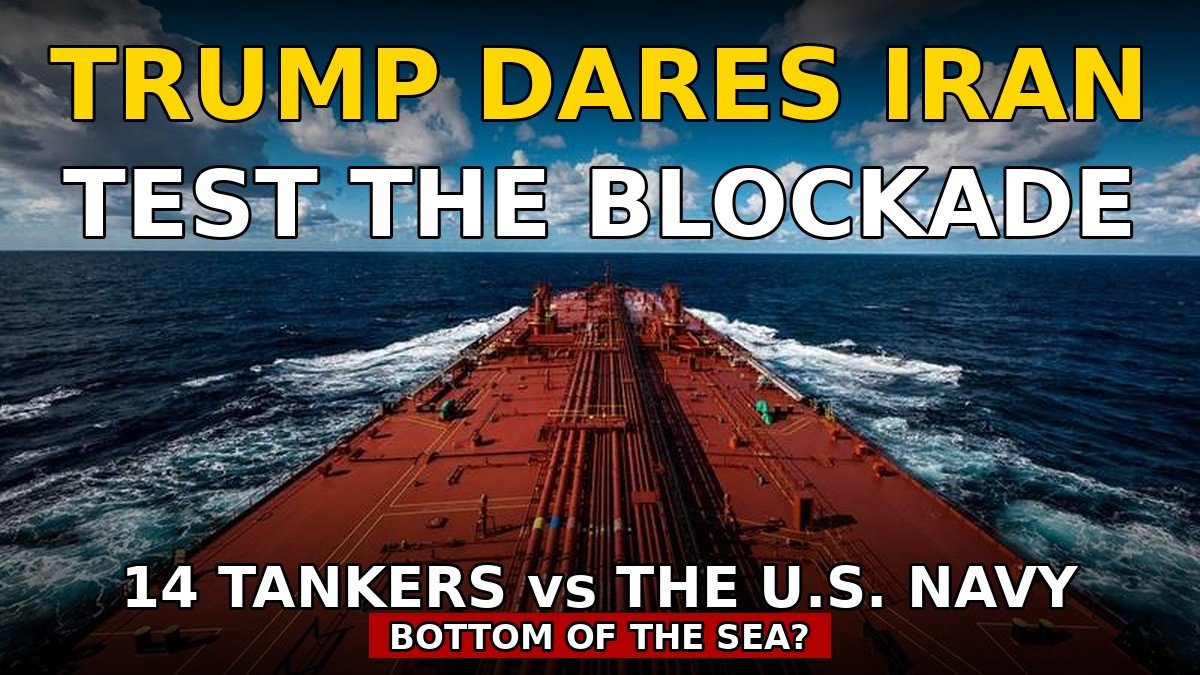
The Trump Iran blockade standoff took a sharper turn on Sunday, as President Donald Trump dared Tehran to test the American naval blockade of its ports — warning that any Iranian tankers that tried to break through would end up on the ocean floor.
“I hope they do, they’ll all be at the bottom of the sea like the rest of the navy,” Trump told Fox News chief foreign correspondent Trey Yingst when asked whether Iran would attempt to breach the blockade, which was first imposed in April.
The warning came as reports indicated Iran was preparing a convoy of tankers to breach the blockade from Kharg Island, a critical oil export hub that handles most of the country’s crude shipments. According to the reports, 14 tankers had been positioned at the island, with crews assigned and Iranian flags raised ahead of a possible attempt to run the blockade toward the Gulf of Oman.
Trump Iran Blockade: ‘They’ll All Be at the Bottom of the Sea’
Trump’s blunt message leaves little room for doubt about how Washington would respond. The president has spent months tightening the economic screws on Tehran, betting that the blockade — backed by the full weight of the US Navy — will force the regime to the negotiating table or break its finances first.
Maritime security experts warned the vessels could face US naval forces right across the Indian Ocean, while the Institute for the Study of War cautioned that an attempted breakout could trigger a wider war.
“Attempting to run the blockade would expose Iran to significant risk that ranges from the destruction of a tanker fleet at minimum to possibly resuming a larger-scale conflict with the United States, or both,” the institute said in an update, adding that “Iran’s willingness to accept these risks demonstrates the degree to which the regime views the current economic situation as both dire and unsustainable.”
Iran’s Reported 14-Tanker Convoy at Kharg Island
The reported operation would involve tankers sailing from Kharg Island toward the Gulf of Oman. The assessment followed a November 20 report by Hamshahri, a Tehran municipality-affiliated outlet, claiming Iran had positioned 14 tankers at the island to breach the blockade.
The Institute for the Study of War also warned Iran could attempt to break the blockade within days, as mounting economic pressure leaves Tehran with few options.
“Iran’s deteriorating economic situation is increasingly dire, which is forcing Iranian officials to reckon with the necessity of breaking the US blockade,” the institute said.
The stakes are enormous for Tehran. Oil exports are the lifeblood of the Iranian economy, and the blockade has steadily choked off the revenues the regime depends on. With few options left, a dramatic breakout attempt — even one with long odds — may look more attractive to Iranian leaders than quietly watching their economy collapse.
Experts Divided: Propaganda or a Real Breakout Attempt?
Not everyone is convinced the convoy is real. Charlie Brown, a senior adviser to United Against Nuclear Iran and a maritime sanctions enforcement expert, dismissed the reported operation as “propaganda” and said the plan was unlikely to succeed if it was ever attempted.
“This supposed plan by the Iranians to suddenly deploy 14 vessels to try to breach the blockade in a convoy — it’s farcical,” Brown told Fox News Digital on Sunday.
“The blockade is enforced not merely as a line that is crossed, but the ability of the United States Navy to enforce this blockade extends across the entire Indian Ocean and beyond.”
Brown also disputed reports that the tankers were loaded and preparing to depart, citing satellite monitoring of Kharg Island.
“We carefully watched Kharg Island loading by satellite imagery, and there’s really no indication that there’s been any significant loading there in quite some time.”
He argued the reported operation was an attempt to project defiance rather than a viable strategy — “another one of a series of similar propaganda statements that don’t turn out to be true and are easily debunked.”
Brown also noted that coordinating a 14-vessel convoy would pose major logistical challenges, requiring lead and trailing ships, coordinated communications and procedures for responding to US military orders. Civilian crews could face significant danger if they refused orders to stop, he warned.
“They would obviously be going into an area of great risk, and they would have to decide whether to comply with the instructions to stop or face action,” Brown said.
How the US Navy Would Enforce the Blockade
According to Brown, US forces would likely contact the tankers by radio from Navy ships or aircraft and order them to stop. Refusal could trigger an escalated military response. He said the Navy could transfer responsibility between regional commands, making it difficult for Iranian tankers to escape by sailing farther into the Indian Ocean.
“If ships try to get out of the area that is managed by the US Navy’s 5th Fleet, the US Navy’s 7th Fleet is the next area command that has responsibility over the Indian Ocean,” he said.
“And they have ships and aircraft that are there right now, and they’ll just take up the mission.”
“There’s an administrative boundary, a geographic boundary between the 5th Fleet and the 7th Fleet, between CENTCOM and INDOPACOM,” Brown said. “But the US Navy is a global Navy, and they’re able to handle these transfers of responsibility when a target or ship of interest crosses that boundary.”
He added that US forces have the ships, aircraft and procedures to intercept multiple vessels at once, while the open waters of the Indian Ocean offer more room to manoeuvre than the narrow Strait of Hormuz.
“It’s a mission of the United States, not merely a mission in CENTCOM,” Brown said. “So they have the forces in place.”
“So if they do try to make an attempt with multiple ships, I’m quite confident all or most — probably all — would be interdicted,” he added.
The region has already seen violence at sea in recent days. Two tankers were hit in the Strait of Hormuz over the weekend, as hawks in Washington pressed Trump to resume strikes on Iran — a reminder of how quickly a standoff at sea can turn into open conflict.
Gulf of Oman Incident Adds to Tensions
The potential confrontation comes amid rising maritime tensions. The United Kingdom Maritime Trade Operations (UKMTO) reported Sunday that a tanker was involved in an incident with military forces in the Gulf of Oman but did not identify the vessel or connect it to the reported Iranian convoy.
“UKMTO has received a report of an incident involving a tanker and military forces in the Gulf of Oman,” the agency said in an advisory. “Vessels are advised to consider the latest maritime security information and maintain awareness of the evolving operational environment.”
In a November 18 advisory, US Central Command (CENTCOM) warned that ships receiving Iranian cargo through ship-to-ship transfers could face interception or seizure, extending the blockade beyond vessels departing Iranian ports, Reuters reported.
What Happens Next
For now, the world is watching Kharg Island. If the 14 tankers sail, they will sail into the teeth of the most powerful navy on earth — and into a president who has said, in public, exactly what will happen to them. If they stay put, the episode will join a long list of Iranian threats that never materialised.
Either way, the Trump Iran blockade has become the sharpest test yet of whether economic strangulation can force Tehran to bend — or whether desperation will push it to gamble its fleet, and possibly much more, on a single run through the blockade.
Source: Fox News — Trump dares Iran to breach US port blockade as Tehran reportedly readies 14 oil tankers