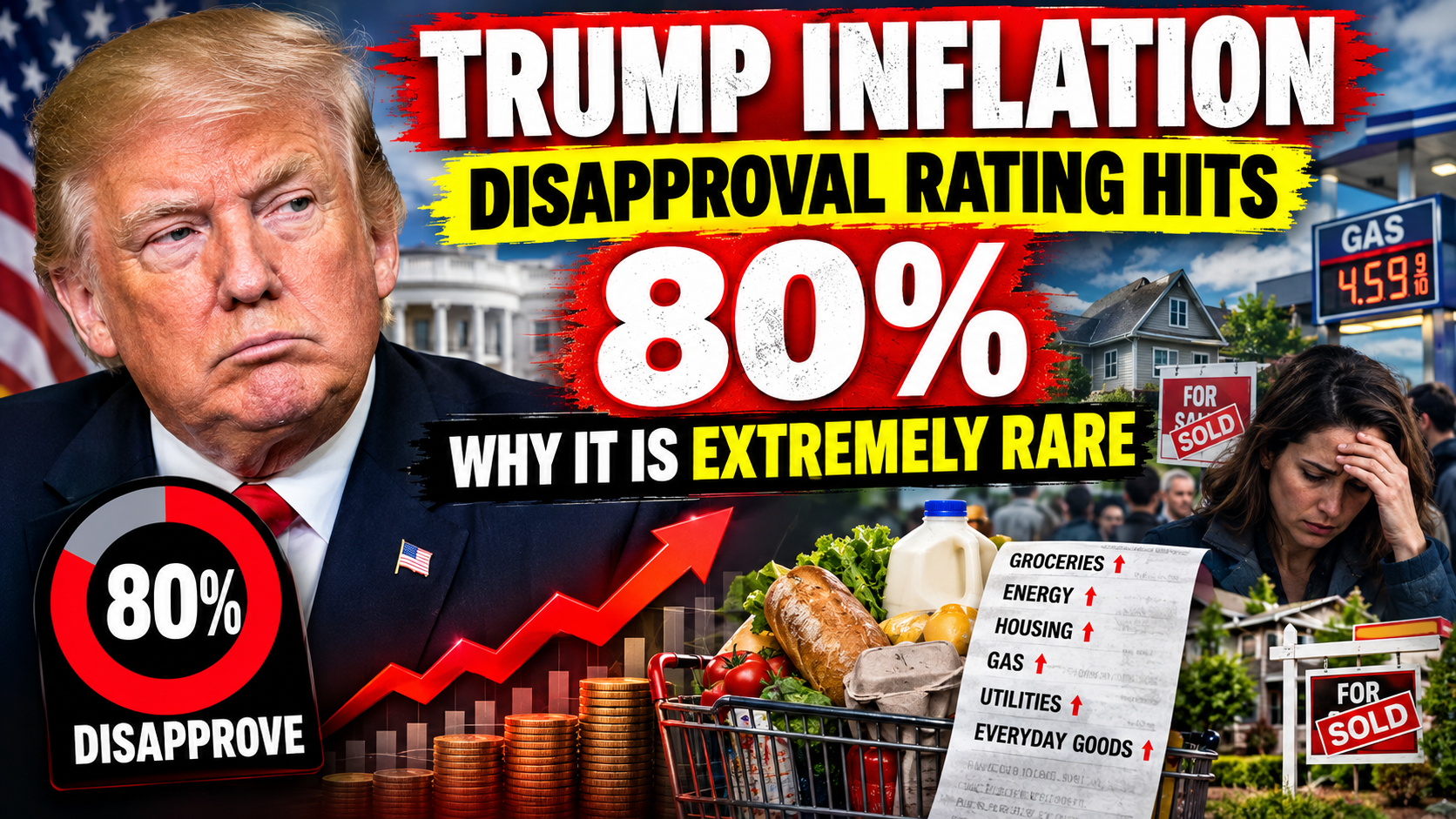
Trump Inflation Disapproval Rating Hits 80%: Why It Is Extremely Rare
The latest Trump inflation disapproval rating reaching nearly 8 in 10 Americans (80%) represents an extremely rare political and macroeconomic milestone. In modern American political history, presidential approval on core economic metrics rarely breaches the 75% disapproval threshold—even during periods of severe stagflation or sudden financial crises.
Because public perception of the economy is typically heavily filtered through partisan identity, presidents usually maintain a “partisan floor” of support from their own political base. However, as persistent price pressures on essentials like groceries, energy, housing, and consumer goods continue to erode real household income, public frustration has transcended traditional party lines.
Also Read:
Putin Warns West Russia Ready Use Every Weapon Protect Kaliningrad Threat
                    [ Inflationary Pressures ]
                     (Groceries, Energy, Goods)
                                 │
                                 ▼
                     [ Real Wage Contraction ]
                  (Nominal Wages < CPI Growth)
                                 │
                                 ▼
           ┌─────────────────────┴─────────────────────┐
           ▼                                           ▼
 [ Independent Voters ]                     [ Working-Class Base ]
 (85%+ Disapproval)                        (Widespread Dissatisfaction)
           │                                           │
           └─────────────────────┬─────────────────────┘
                                 ▼
             [ Trump Inflation Disapproval Rating: ~80% ]
1. Historical Context: Comparing Presidential Economic Disapproval
To understand why an 80% disapproval rating on inflation is extraordinary, it is necessary to examine historical presidential polling data during previous economic crises. Historically, voters assign direct responsibility for cost-of-living fluctuations to the sitting chief executive, regardless of global commodity cycles or monetary policy lags.
  1979–1980 Stagflation       1991–1992 Recession       2022 Inflation Peak          2026 Price Shock
+-----------------------+   +-------------------+   ---------------------+    +------------------------+
| Jimmy Carter          |   | George H.W. Bush  |   | Joe Biden          |    | Donald Trump           |
| Disapproval: 71%      |   | Disapproval: 68%  |   | Disapproval: 69%   |    | Disapproval: ~80%      |
| High Oil Shock / CPI  |   | Jobless Recovery  |   | Post-Pandemic CPI  |    | Tariff & Energy Surge  |
+-----------------------+   +-------------------+   +--------------------+    +------------------------+
Even during peak inflationary periods under prior administrations, presidential disapproval on price stability remained capped in the high 60s or low 70s due to baseline party loyalty.
| President & Era | Key Economic Trigger | Peak Economic Disapproval | Partisan Floor Retention |
| Jimmy Carter (1980) | Second Oil Shock & 14% CPI | 71% | Moderate base retention |
| George H.W. Bush (1992) | Post-Gulf War economic slowdown | 68% | Strong primary challenger split |
| Joe Biden (2022) | Post-COVID supply chain inflation (9.1% CPI) | 69% | High opposition, base retained |
| Donald Trump (2026) | Tariff spillovers, energy demand & cumulative price gains | ~80% | Significant base erosion |
2. Macroeconomic Drivers: Real Wage Erosion and Purchasing Power
The primary catalyst behind the surge in the Trump inflation disapproval rating is the persistent divergence between nominal wage growth and consumer price inflation. Household welfare is governed by real wage dynamics:
Where:
$W_{\text{real}}$ = Real Purchasing Power
$W_{\text{nominal}}$ = Nominal Wage Growth
$\pi$ = Consumer Price Index ($\text{CPI}$) Inflation Rate
When the rate of inflation ($\pi$) consistently exceeds nominal wage gains ($\Delta W_{\text{nominal}}$), households experience a cumulative contraction in purchasing power.
                                [ Total CPI Inflation ]
                                           │
             ┌─────────────────────────────┴─────────────────────────────┐
             ▼                                                           ▼
  [ Upstream Supply Pressures ]                               [ Energy & Trade Friction ]
   • Import Tariffs & Import Duties                            • Power Grid Infrastructure Costs
   • Industrial Input Costs                                    • Fuel & Logistics Surcharges
             │                                                           │
             └─────────────────────────────┬─────────────────────────────┘
                                           ▼
                             [ Household Cost-of-Living ]
                             • Groceries & Food Staples
                             • Utility & Electric Bills
                             • Auto & Home Insurance
                                           │
                                           ▼
                        [ Structural Disapproval Shock (~80%) ]
The Cumulative Inflation Effect
Unlike volatility in financial assets, inflation impacts every income bracket daily. Even if annual inflation slows down, the level of prices remains permanently elevated unless sustained deflation occurs. Consumers compare current grocery and utility bills not to last month’s figures, but to baseline prices from previous years, exacerbating public discontent.
3. The Breakdown of the “Partisan Shield”
In modern hyper-polarized political environments, presidential approval ratings typically exhibit high inelasticity. Opposition party voters overwhelmingly disapprove, while co-partisans overwhelmingly approve, creating a predictable equilibrium.
An 80% disapproval figure requires a major breakdown of this partisan shield:
Independent Voters: Disapproval among independent voters on cost-of-living management has reached near-unanimous levels, routinely exceeding 85%.
Working-Class Base Discontent: Working-class cohorts—who spend a disproportionate percentage of disposable income on energy, food, and housing—express elevated levels of economic strain.
Cross-Party Spillovers: When kitchen-table expenses outpace household budgets, partisan alignment yields to immediate financial pressure, causing a subset of the president’s own electoral base to report dissatisfaction.
4. Monetary Policy Dilemmas and Federal Reserve Autonomy
A high Trump inflation disapproval rating creates complicated dynamics for monetary policymakers at the Federal Reserve. Central banks use the benchmark federal funds rate to control inflation by modulating aggregate demand ($AD$):
Where:
$C$ = Consumption
$I$ = Investment
$G$ = Government Spending
$NX$ = Net Exports
If public pressure forces political demands for rapid interest rate cuts while structural inflation risks remain active, the central bank risks unanchoring long-term inflation expectations. Conversely, maintaining restrictive interest rates ($r > r^*$) risks cooling labor markets further while doing little to lower structural costs like utility grid expansions or global supply chain adjustments.
Structural Summary
An 80% disapproval rating on inflation is a rare event in modern American political history. It demonstrates that when cost-of-living pressures directly erode real purchasing power across essential goods, voters hold the sitting administration accountable regardless of traditional party loyalty.
Frequently Asked Questions (FAQs)
Why is an 80% disapproval rating on inflation considered so rare?
An 80% disapproval rating is extremely rare because modern presidential approval ratings are usually protected by strong partisan loyalty. Reaching 80% disapproval indicates that a significant portion of the president’s own party and an overwhelming majority of independents disapprove of their handling of the issue.
How does the Trump inflation disapproval rating compare to Joe Biden’s?
At the peak of post-pandemic inflation in 2022, Joe Biden’s economic disapproval hovered around 68% to 69%. The current disapproval level surpasses those marks due to cumulative price increases over multiple years and ongoing cost surges in key sectors.
What main factors are driving public anger over inflation?
Public anger is primarily driven by elevated costs for daily necessities, including groceries, residential electricity, auto insurance, and housing, alongside the erosion of real inflation-adjusted wages.
Can a president directly lower inflation?
While a president can alter trade tariffs, regulatory frameworks, and fiscal spending, overall inflation is primarily managed by the Federal Reserve through interest rate policy, alongside global commodity supply dynamics.
Disclaimer
This article is provided strictly for educational, informational, and analytical purposes and does not constitute financial, economic policy, or investment advice. Public opinion polling data and macroeconomic indicators are subject to continuous updates based on economic conditions.