
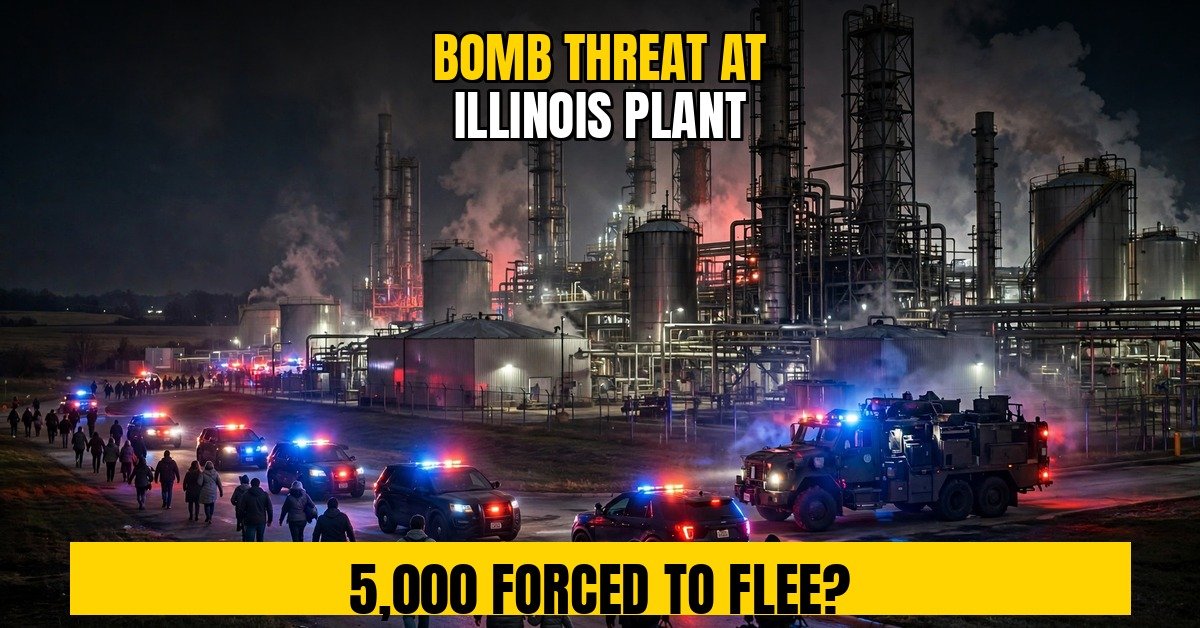
The Illinois plant bomb threat that emptied a square mile of Peoria on Friday night is over — but the questions it raised are not. Police lifted the evacuation order at 1 p.m. on Saturday, November 14, after bomb technicians made a suspicious device safe and officers finished searching the BioUrja ethanol plant. Nobody was hurt. Nobody has been arrested. And nobody in authority will yet call the thing they found a bomb.
That careful wording matters. Peoria Police Chief Brad Dixon spent much of Saturday telling reporters the device was a “credible threat” and leaving it at that, while Peoria Mayor Rita Ali told them flatly, “we know it’s a bomb.” The gap between those two sentences is where this story now sits: a city sent home, a plant picked over room by room, and a criminal investigation hunting for whoever left the device there.
The Illinois plant bomb threat forced more than 5,000 residents and workers to leave their homes and workplaces inside a one-mile radius of the plant. For most of them, the wait lasted the night and into Saturday afternoon. Here is what happened, and what police still won’t say.
The Illinois plant bomb threat: what happened at BioUrja
It started on Friday, November 13, when the BioUrja plant told Peoria police it had received a bomb threat. Officers found a suspicious device close to the plant, and by Friday evening they had decided it was a credible threat. Bomb technicians worked on it through the night and rendered it safe, police said. The plant is a biofuels site run by the BioUrja Group of Houston, Texas, in Peoria, a city of about 110,000 people some 150 miles southwest of Chicago.
The company did not immediately respond to a request for comment. That left police as the main source of information on Saturday, and Dixon was frank about the limits of what they could share. “I can just tell you it was deemed a credible threat,” he told reporters at a briefing. “There’s an extensive criminal investigation going on.” He would not call the device a bomb, he said, because the work of finding out what was inside it was still going on.
The threat, police said, had arrived “electronically”. They have not said who sent it, or how. Officials would not confirm whether the incident is being treated as a terrorist threat or attack, and they would not say whether they have any suspects. The Department of Homeland Security was not involved, Dixon said.
A one-mile evacuation that crossed the river
The evacuation order went out on Friday evening, hours after the Illinois plant bomb threat was first reported. Inside the one-mile zone were parts of Downtown Peoria, much of the city’s South Side and its Warehouse District. The zone crossed the Illinois River into East Peoria, taking in homes and several Caterpillar buildings. Most streets in the area were closed off, and officers went door to door overnight, pointing people towards help.
The scale was what caught Peoria off guard. Dixon said the city had never moved this many people from this many places before. “We displaced people’s lives. We moved people out of their homes. That’s not an easy thing to do,” he said. “This has never happened in my career. I don’t know that Peoria has ever had to deal with moving this many people from this many locations. We had to throw it together in short order. Certainly we could’ve done better, but this is a learning experience.”
People who left because of the Illinois plant bomb threat had somewhere to go. Shelters opened at Manual High School, at 811 S. Griswold St. in Peoria, and at the EastSide Centre in East Peoria. Around 60 to 80 people were sheltering at Manual High School by midday on Saturday, with cots and blankets provided by the American Red Cross. The city set up a phone line for information about the evacuation: (309) 673-4527. Officials stressed that people were urged to leave, not forced — the order was advisory, and officers encouraged everyone inside the radius to stay out of it.
The one-mile figure itself needs explaining. Police did not pick it from the size of the device alone. The BioUrja site holds ethanol and other highly combustible chemicals, and the potential blast radius was worked out from the materials at the plant as well as the device, Dixon said. That is why a single suspicious object could clear a whole square mile of a city.
The search: six hours across 44½ football fields
With the device made safe, the harder job began: checking the plant itself for anything else left behind in the Illinois plant bomb threat. The search started at about 6 a.m. on Saturday, with bomb technicians and BioUrja employees working through the site together. It paused for technical problems at about 9:45 a.m., started again at about 10:15 a.m., and was finished before 1 p.m.
The size of the task explains the time it took. The BioUrja facility covers an area officials put at about 44 and a half football fields — a standard American football field covers roughly 1.3 acres. Search teams had to clear tank after tank, building after building, and there were, as Dixon put it, many areas to search. In the end, they found nothing else connected to the Illinois plant bomb threat. The Peoria Police Department said in a statement on Facebook that nothing “of concern” was found, and the evacuation notice was lifted.
They weren’t working alone. The FBI and the US Bureau of Alcohol, Tobacco, Firearms and Explosives sent personnel, including explosives experts, to help search the site and to help find whoever was behind the device. The Coast Guard closed the nearby stretch of the Illinois River, setting a safety perimeter between mile markers 160 and 164, with no vessels allowed through. That closure ended at 1 p.m. on Saturday, too. “We recognize the importance of the Illinois River to regional and national commerce,” said Capt. Brandy Parker of the Coast Guard. Ryan A. Presley, special agent in charge of the FBI’s Springfield field office, was also at Saturday’s briefing.
Was it a bomb? Police and the mayor chose different words
The sharpest exchange of the day was over a single word — and over how to describe the Illinois plant bomb threat. Dixon would not confirm whether what was found was actually an explosive device, or what kind of device it was. “I’m just going to tell you the wording we use: It was a credible threat,” he said at the press conference. “We dealt with it last night and that process of determining what was in that device is underway currently.”
Mayor Ali had already used plainer language. She had told reporters “we know it’s a bomb,” and when WCBU asked her on Saturday afternoon whether she stood by that, she didn’t back away. “Words do matter. Bomb is my interpretation. People don’t necessarily understand the word ‘device’ as it relates to this situation or the seriousness of it. I prefer to make things clear from my standpoint and chose to use that wording,” she said. “Law enforcement is correct in not labeling it as a bomb until the contents have been fully examined to determine if the ‘device’ contains explosives. Mine are lay terms.”
That split is normal in the first days after a scare like this. Police protect the investigation by saying less, while elected officials try to tell residents plainly how seriously to take it. What it means for the public is simple: treat the device as dangerous until the lab work says otherwise, and don’t expect a final answer on what it was until that examination is done. Dixon would not discuss security at BioUrja, or say why the plant might have been targeted. There was no BioUrja representative at the press conference.
What happens next
The Illinois plant bomb threat is now a criminal investigation. FBI and ATF investigators are working on who made the threat and who left the device, and police have not said whether they have suspects. No arrests have been made. The device itself is still being examined, and that examination will decide what charges, if any, follow — and whether officials ever call it a bomb in public.
For the people who were moved out, the immediate question is simpler: what would happen if it happened again? Dixon’s own answer suggested Peoria will be reviewing how the evacuation was run. The city pulled the operation together in hours, and the chief’s admission that “certainly we could’ve done better” was unusually direct. Expect that review to cover how the alert went out, how shelters were staffed, and how the river closure and the road closures were coordinated.
Frequently Asked Questions
What happened in the Illinois plant bomb threat?
Police found a suspicious device near the BioUrja ethanol plant in Peoria, Illinois, on Friday, November 13, after the plant reported a bomb threat. Officers called it a credible threat, evacuated more than 5,000 people within a one-mile radius, and bomb technicians made the device safe on Friday night. The evacuation order was lifted at 1 p.m. on Saturday, November 14.
Where is the BioUrja plant?
The BioUrja Renewables ethanol plant at the centre of the Illinois plant bomb threat sits in Peoria, Illinois, a city of about 110,000 people around 150 miles southwest of Chicago. The one-mile evacuation zone covered parts of Downtown Peoria, the South Side and the Warehouse District, and stretched across the Illinois River into East Peoria.
Was anyone hurt?
No. Police reported no injuries, and no arrests had been made by Saturday afternoon. Around 60 to 80 people spent part of Saturday sheltering at Manual High School in Peoria, with help from the American Red Cross.
Was the device actually a bomb?
Police haven’t said so yet. Peoria Police Chief Brad Dixon called it a “credible threat” and said the examination of what was inside the device was still underway. Mayor Rita Ali has called it a bomb in plain terms, while accepting that police are right not to use that word until the contents are fully examined.
Who is investigating the Illinois plant bomb threat?
Peoria police are leading the criminal investigation, with help from the FBI and the Bureau of Alcohol, Tobacco, Firearms and Explosives. The Coast Guard handled the closure of the Illinois River near the plant. Officials have not named any suspects.
Conclusion
By Saturday afternoon, Peoria was back to normal on the surface: streets reopened, the river moving again, and more than 5,000 people allowed home. The Illinois plant bomb threat ended the way everyone hoped it would — with a device made safe, a plant searched and cleared, and nobody hurt. What it leaves behind is an investigation with no named suspect, a device still being examined, and a city that now knows it can be emptied at a few hours’ notice. The next answers will come from the lab and from the investigators, not from a press conference. Until then, the words that matter most are the chief’s: it was a credible threat, and the investigation goes on.
Sources and Resources
This article is based on the Reuters report of November 14, 2026, on the Illinois plant bomb threat, “Law enforcement searches Illinois plant after ‘credible threat’ of explosive device,” as carried by USA TODAY, with additional reporting from WCBU Peoria’s local coverage of the evacuation and the Saturday briefing. See also: more U.S. news from World Reach Daily.
- Reuters, November 14, 2026: “Law enforcement searches Illinois plant after ‘credible threat’ of explosive device”
- USA TODAY, November 14, 2026: “Illinois plant searched, evacuation lifted after explosive device found” (Reuters report)
- WCBU Peoria, November 14, 2026: “Peoria evacuation order lifted after bomb search finishes at BioUrja plant”