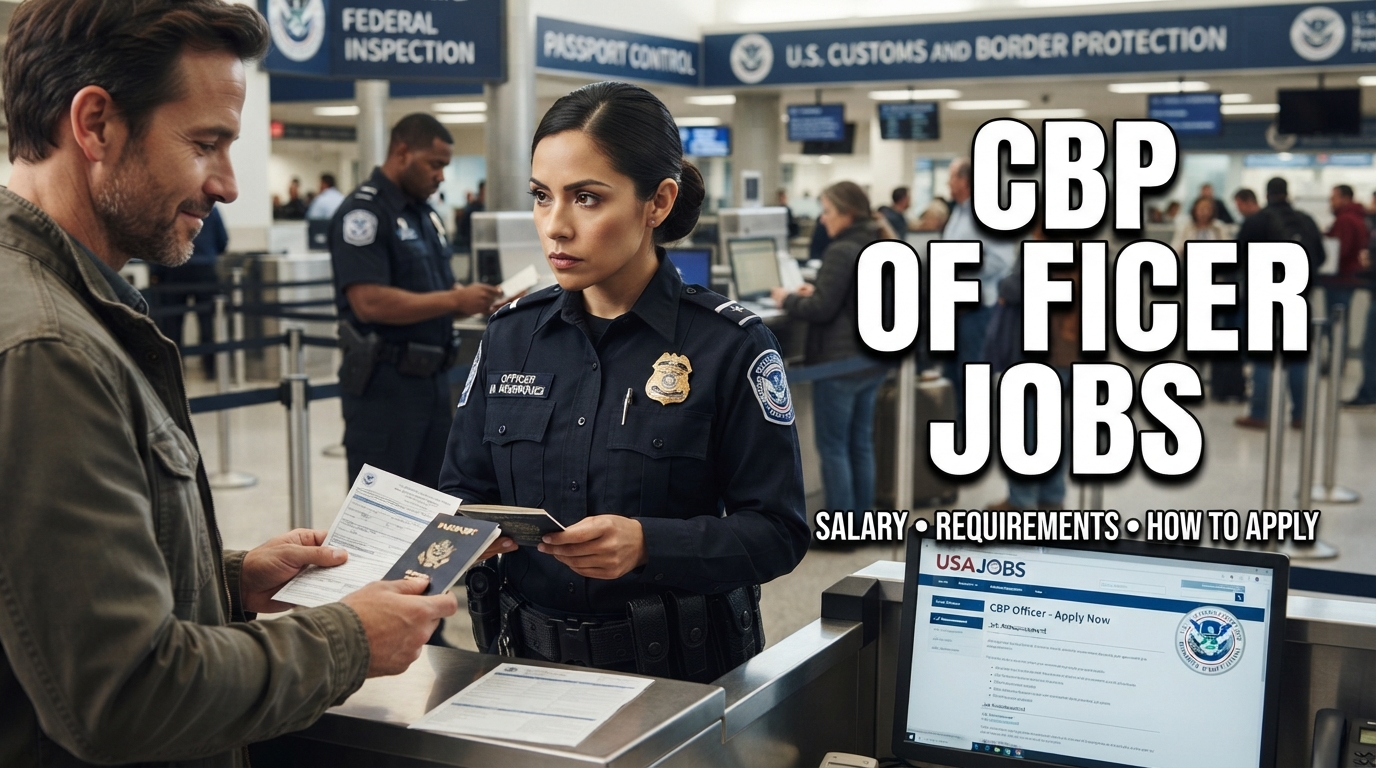
Complete Guide to CBP Office of Field Operations Careers: Customs and Border Officer Roles Open to the Public
The Office of Field Operations (OFO) is the largest operational component within U.S. Customs and Border Protection (CBP), operating under the United States Department of Homeland Security (DHS). Tasked with safeguarding America’s borders while facilitating legitimate international travel and global commerce, OFO offers diverse, high-impact law enforcement and administrative positions open to the public across the nation.
Also read:
Declassified Intelligence & 2026 Midterm Election Integrity
Whether you are looking to start a career in federal law enforcement, transition from military service, or pivot from a civilian background, understanding the hiring pathways, duties, compensation, and qualifications for Office of Field Operations roles on USAJOBS is essential for navigating the recruitment process.
1. Overview of the CBP Office of Field Operations (OFO)
The Office of Field Operations serves as America’s frontline defense at international points of entry. Unlike the U.S. Border Patrol, which operates primarily between official crossing points along remote land borders, OFO officers operate directly at official Ports of Entry (POEs).
Operational Scope & Mission
OFO oversees border management across:
328 official land, sea, and air Ports of Entry within the United States.
16 Preclearance locations in foreign countries (including Canada, the Caribbean, Ireland, and the UAE).
International mail facilities and express consignment hubs.
OFO personnel enforce hundreds of federal statutes for over 40 federal agencies, preventing terrorist infiltration, interdicting illegal narcotics, enforcing trade compliance, and protecting domestic agriculture from invasive pests and animal diseases.
2. Key OFO Roles Open to the Public
CBP routinely posts job announcements on USAJOBS aimed at general public applicants, veterans, and recent graduates.
┌────────────────────────────────────────────────────────────────────────┐
│               Office of Field Operations Operational Roles             │
├──────────────────────────────┬─────────────────────────────────────────┤
│  CBP Officer (CBPO)          │  Frontline law enforcement at POEs      │
│  CBP Agriculture Specialist  │  Agricultural & biological defense      │
│  Import Specialist           │  Trade law compliance & tariff audit    │
│  Entry Specialist            │  Cargo tracking & document clearance    │
│  Seized Property Specialist  │  Asset forfeiture & evidence handling   │
└──────────────────────────────┴─────────────────────────────────────────┘
A. Customs and Border Protection Officer (CBPO) – GS-1895 Series
The CBP Officer is the primary law enforcement role within OFO. Officers are armed, uniformed law enforcement personnel with broad statutory authority to question travelers, inspect luggage/conveyances, make arrests, and execute seizures.
Entry Grades: GS-5, GS-7, and GS-9 (open to public postings).
Career Ladder: Automatic promotion potential up to GS-12 (with supervisory/specialized options reaching GS-13 to GS-15).
Primary Responsibilities:
Determining the legal admissibility of foreign visitors and returning U.S. citizens.
Interdicting prohibited drugs, illegal weapons, and counterfeit goods.
Utilizing Non-Intrusive Inspection (NII) technology (X-ray, gamma-ray imaging, radiation detectors).
Operating tactical units like the Special Response Team (SRT) or K-9 handling units.
B. CBP Agriculture Specialist – GS-0401 Series
Agriculture Specialists focus on biological safety and commercial agricultural protection.
Inspecting incoming passenger baggage, commercial vessels, aircraft, and cargo containers for prohibited plants, animal products, and invasive insects.
Working alongside canine units trained to detect illicit fruit, meat, and organic material.
C. Import & Trade Specialists – GS-1101 / GS-1102 Series
Trade specialists manage the economic front line of border operations:
Auditing commercial imports, enforcing intellectual property rights (IPR), preventing forced labor goods from entering U.S. markets, and assessing tariffs and trade duties.
3. Salary, Overtime, and Law Enforcement Benefits
A career as a CBP Officer provides a competitive federal pay scale combined with law enforcement premium pay.
Base Pay & Grade Progression
New hires enter at the GS-5, GS-7, or GS-9 pay grade based on prior work experience or post-secondary education.
| Pay Grade | Base Salary Range (Approx. Excl. Locality) | Typical Target Timeline |
| GS-05 | $41,863 – $54,426 | Year 1 Entry |
| GS-07 | $51,864 – $67,428 | Year 2 |
| GS-09 | $63,431 – $82,459 | Year 3 |
| GS-11 | $76,743 – $99,774 | Year 4 |
| GS-12 | $91,983 – $119,578 | Year 5 (Full Performance Level) |
Note: Salaries are augmented by locality pay rates depending on the geographical duty location (e.g., higher locality rates in New York, Los Angeles, or border transit hubs).
Overtime and Premium Pay Options
Customs Officer Pay Reform Act (COPRA): CBP Officers qualify for premium overtime structure. Fully trained officers are eligible to earn up to $45,000 annually in overtime pay.
Special Pay Differentials: Additional compensation for night shifts, Sunday shifts, and official holiday schedules.
Retirement & Federal Benefits
Special Law Enforcement Retirement (6c Coverage): Primary CBP Officers receive accelerated retirement benefits (20 years of covered service at age 50, or 25 years at any age).
Thrift Savings Plan (TSP): Up to 5% dollar-for-dollar agency matching contributions.
Federal Employees Health Benefits (FEHB) & Life Insurance (FEGLI).
4. Minimum Qualifications and Eligibility Requirements
To qualify for an entry-level CBP Officer position open to the general public, candidates must meet strict civil service and law enforcement criteria:
U.S. Citizenship: Applicants must hold U.S. citizenship at the time of application.
Age Requirement: Candidates must be under 37 years of age at the time of appointment, unless they are eligible veterans’ preference recipients or have prior covered federal law enforcement experience.
Driver’s License: Must possess and maintain a valid, state-issued driver’s license.
Residency Requirement: Must have resided in the U.S. or its territories for at least 3 of the last 5 years preceding application (exceptions apply for military deployed overseas).
Background Security Clearance: Must pass a single-scope background investigation to obtain a Secret or Top Secret security clearance.
Education vs. Experience Substitutions
GS-5 Level: 3 years of general work experience showing ability to deal with people and analyze information, OR a 4-year bachelor’s degree in any field.
GS-7 Level: 1 year of specialized work experience equivalent to GS-5 (e.g., law enforcement, inspection work), OR superior academic achievement in a 4-year degree (GPA 3.0+ or upper 1/3 class ranking), OR 1 full year of graduate-level education.
GS-9 Level: Master’s degree (or equivalent graduate degree like a J.D.), OR 1 year of specialized experience at the GS-7 level.
5. The CBP Officer Hiring Process: Step-by-Step
The hiring path for the Office of Field Operations is rigorous to ensure operational integrity.
USAJOBS Application ──► Entrance Exam ──► Form SF-86 ──► Fitness Test (PFT-1) ──► Medical Exam ──► Structured Interview ──► Polygraph Test ──► Background Checks ──► Academy Selection
USAJOBS Online Application: Submit an formatted two-page federal resume and answer screening questions.
CBP Officer Entrance Exam: Evaluates logical reasoning, arithmetic reasoning, and writing skills.
Background Questionnaire (e-QIP / SF-86): Detailed security submission for security clearance vetting.
Pre-Employment Fitness Test (PFT-1): Measures push-ups, side-step agility, and step-test cardiovascular endurance.
Medical Screening: Ensures vision (uncorrected and corrected thresholds), hearing, and overall physical readiness meet duty standards.
Structured Interview: A scenario-based oral interview conducted by a panel of experienced CBP personnel.
Polygraph Examination: Standard security requirement for all law enforcement applicants.
Drug Testing: Mandatory pre-employment urine analysis under DHS policy.
6. Training at the CBP Field Operations Academy (FOA)
Once selected, candidates report as Officer Trainees to the CBP Field Operations Academy (FOA) located within the Federal Law Enforcement Training Center (FLETC) in Glynco, Georgia.
The 103-Day Basic Academy Curriculum
Trainees undergo 103 instructional days of intensive physical, legal, and operational training:
Classroom Instruction: Immigration law, federal trade regulations, search and seizure protocols, anti-terrorism, and cross-cultural communication.
Firearms Qualification: 77 hours of Marksmanship and tactical training covering the standard-issue duty handgun, Remington 870 shotgun, and Colt M4/A1 carbine.
Tactical & Defensive Tactics: Practical Use of Force scenarios, high-risk vehicle stops, and control techniques.
Emergency Vehicle Operations Course (EVOC): High-speed driving, skid control, and pursuit handling.
Scenario-Based Practical Exercises: More than 200 real-world simulations testing decision-making under stress.
7. How to Search and Apply on USAJOBS
To view current openings and apply directly:
Go to the official USAJOBS portal search for CBP Office of Field Operations postings.
Filter search results by Keyword:
CBP Officer,Customs and Border Protection Officer, orOffice of Field Operations.Set eligibility filters to “Open to the Public” (or “Veterans” if applicable).
Carefully verify job announcements for grade levels (GS-5, GS-7, GS-9) and preferred duty locations.
Ensure your uploaded federal resume adheres strictly to the 2-page limit as mandated by CBP hiring policies.
Frequently Asked Questions (FAQs)
Q1: What is the main difference between a CBP Officer and a Border Patrol Agent?
CBP Officers (Office of Field Operations) work primarily at official Ports of Entry (airports, land border crossings, and seaports) inspecting travelers and cargo. Border Patrol Agents (U.S. Border Patrol) patrol the unofficial land borders between ports of entry to interdict unauthorized entries.
Q2: Are there foreign language requirements for CBP Officers?
Unlike Border Patrol Agents who must learn Spanish, CBP Officers are not universally required to pass a foreign language requirement prior to academy graduation, although foreign language skills are highly beneficial for duty at major international air and land hubs.
Q3: What is the age limit for applying to be a CBP Officer?
Applicants must generally be appointed before reaching their 37th birthday. Veterans receiving veterans’ preference or individuals with prior covered federal law enforcement service may receive age waivers.
Q4: Can I choose my initial duty location as a new CBP Officer?
Yes. During the application process on USAJOBS, preferred duty locations are selected based on agency staffing needs. Some announcements offer recruitment incentives or bonuses for hard-to-fill border ports.
Q5: How long does the pre-employment hiring process take?
The average hiring timeline takes anywhere from 6 to 12 months due to the comprehensive nature of the background security investigation, polygraph exam, medical evaluation, and entrance testing.
Official News & Trust References
Conclusion
A career with the CBP Office of Field Operations offers an unparalleled opportunity to protect national security, combat illegal trade, and serve on the front lines of American law enforcement. With competitive federal salaries, rapid promotion tracks up to GS-12/13, generous overtime structures, and law enforcement retirement benefits, OFO officer roles remain some of the most sought-after civil service positions in the nation. If you meet the qualifications, explore current open-to-the-public vacancies on USAJOBS today to start your application journey.
1 thought on “CBP Office of Field Operations Careers: Officers & Entry Roles Open to the Public”