
Declassified Intelligence and Non-Citizen Voting Claims: How Recent Disclosures Impact 2026 Midterm Election Integrity
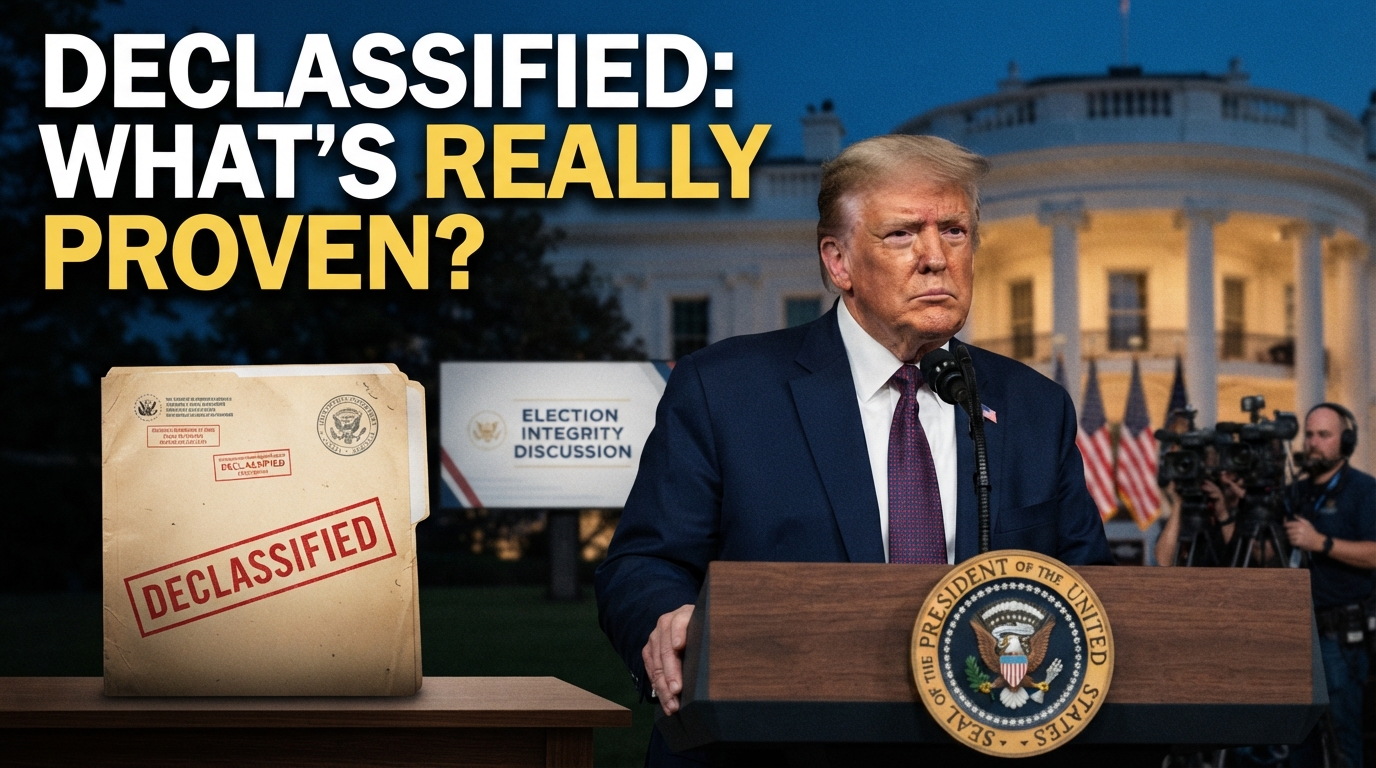
The recent declassification of federal intelligence memos and heightened administrative claims regarding non-citizen voting have placed 2026 midterm election integrity at the center of national debate. Following a primetime address and subsequent releases by a White House task force, democracy experts, election officials, and lawmakers are scrutinizing both the substance of these disclosures and their potential impact on voter participation and public trust.
Also read:
Japan earthquake 5.9 magnitude: Tokyo Shaken, 37 Injured, and Transit Disrupted
Background: The July 2026 Declassification Push
In July 2026, President Donald Trump delivered a primetime address on 2026 midterm election integrity, highlighting newly declassified documents from the Intelligence Community (IC) and the Department of Homeland Security (DHS). The administration framed the release — coordinated by a newly established “Government Transparency Task Force” comprising representatives from the Office of the Director of National Intelligence (ODNI), CIA, NSA, and DHS — as proof of severe vulnerabilities within American voting infrastructure and widespread non-citizen registration.
Key assertions about 2026 midterm election integrity made during the address and subsequent White House press briefings included:
Foreign Acquisition of Voter Files: Allegations that Chinese state-backed entities illicitly acquired 220 million U.S. voter records starting during the 2020 election cycle.
Systemic Infrastructure Vulnerabilities: Claims that internal intelligence documents had long acknowledged structural exposures in electronic voting machinery and state voter registration databases.
Heightened Non-Citizen Voting Estimates: DHS and Census Bureau reports suggesting that hundreds of thousands of non-citizens are currently registered on federal voting rolls.
While supporters argue these disclosures promote transparency and expose long-overlooked threats to 2026 midterm election integrity, nonpartisan election experts and intelligence analysts emphasize that the released documents largely reaffirm previous findings without offering evidence of altered votes or systemic election fraud. The gap between the rhetoric and the documents is where the real story lives.
Fact vs. Rhetoric: Analyzing the Declassified Intelligence
A detailed review of the declassified memos by cybersecurity specialists and voting rights organizations reveals a notable divergence between administrative claims about 2026 midterm election integrity and actual intelligence assessments. Take them one by one:
Chinese Data Compromise: The administration claims China illicitly acquired 220 million voter files to meddle in U.S. elections. The intelligence finding: the records were downloaded from publicly or commercially available state voter files (over 30 states permit public file access). No evidence indicates the data was used to alter votes or manipulate ballots.
Voting Machine Security: The claim is that intelligence memos prove electronic voting machines were exposed to foreign digital manipulation. But declassified 2020 National Intelligence Council assessments noted potential adversary capabilities while confirming no foreign actor altered vote counts, tabulations, or voter registrations. Capability isn’t the same as action.
Non-Citizen Registrations: DHS identified approximately 278,000 non-citizens registered on federal voting rolls. The catch: DHS has not published its methodology, and independent research shows previous database matching tools yielded high false-positive rates due to outdated citizenship records.
Local Registration Incidents: The administration says Michigan and California voter roll errors demonstrate nationwide fraud networks. Law enforcement investigations into past incidents (such as a 2020 Michigan case) found commercial fraud against paymasters rather than unlawful votes cast.
David Becker, Executive Director of the Center for Election Innovation & Research, noted following a White House briefing that the declassified documents provided “nothing here that was news, nothing here that even calls into question past elections.”
Dissecting the Non-Citizen Voting Debate
Central to the administration’s midterm narrative is the contention that non-citizens pose an immediate threat to 2026 midterm election integrity. Federal law (18 U.S.C. § 611) strictly prohibits non-citizens from voting in federal elections, carrying severe penalties including fines, imprisonment, and deportation. The penalties are no joke — that’s worth remembering whenever the estimates are discussed.
The DHS and Census Bureau Data
In late July and early August 2026, DHS released a public analysis asserting that 278,000 non-citizens were registered across federal voter files, followed shortly by a preliminary Census Bureau brief matching 128 million records to claim 24,000 non-citizens voted in 2020 — figures now central to the 2026 midterm election integrity debate. However, demographers and legal scholars point out two major analytical shortcomings:
Outdated Immigration Status Data: State driver’s license and DHS SAVE databases often flag naturalized U.S. citizens as “non-citizens” if their records have not been updated since gaining citizenship. The data lags reality.
Aggressive Name-Matching Protocols: Automated matching across massive datasets frequently creates false matches when individuals share identical names and birth years. Scale produces noise.
Administrative Errors vs. Intentional Fraud
Advocates of stricter voting laws point to administrative glitches as proof of system vulnerability. For example, a software error in New Jersey briefly registered 6,600 non-citizens through motor vehicle agencies. State officials confirmed that fewer than 400 cast ballots before the error was corrected. While critics view this as evidence of systemic risk to 2026 midterm election integrity, election administrators emphasize that post-election audits and routine data maintenance successfully detect and remediate such operational mistakes.
Legislative Push: The SAVE America Act
The administration’s disclosures are closely linked to a legislative push for the Safeguard American Voter Eligibility (SAVE) America Act. Proponents argue that legislative updates are mandatory to protect 2026 midterm election integrity ahead of the midterms. The bill’s framework moves in three directions: federal oversight requirements pushing state voter roll submissions; identity and citizenship rules demanding proof of citizenship plus strict photo ID; and mail-in voting controls curtailing unsolicited mail ballots.
Key provisions under consideration include:
Mandatory Citizenship Documentation: Requiring documentary proof of U.S. citizenship (e.g., passport or birth certificate) at the time of voter registration.
Federal Inspection of State Rolls: Authorizing federal authorities, including DHS, to inspect state voter databases and flag individuals for removal.
Strict Photo ID Standards: Eliminating alternative identification methods currently accepted in over 30 states.
Restricting Mail-In Ballots: Mandating tighter deadlines, strict signature-matching protocols, and limitations on unsolicited mail ballot distribution.
Expert Concerns Ahead of the 2026 Midterms
Voting rights advocates and constitutional scholars express concern that heightened rhetoric around non-citizen voting and foreign infiltration could have significant consequences for 2026 midterm election integrity:
Voter Roll Purges: Rapid efforts to scrub non-citizens based on flawed database matching risk disenfranchising eligible naturalized citizens right before election deadlines.
Voter Intimidation: Concerns that elevated rhetoric surrounding non-citizen voting could lead to aggressive monitoring at polling locations, particularly targeting immigrant communities.
Erosion of Public Confidence: Continual emphasis on unverified vulnerabilities risks diminishing public trust in certified election outcomes regardless of which party wins.
Potential Federal Intervention: Legal observers warn that framing election administration as an urgent national security issue could serve as a pretext for unprecedented federal intervention in state-run elections.
Frequently Asked Questions (FAQs)
Q1: What did the declassified intelligence documents actually prove regarding foreign election interference?
The declassified memos confirm that foreign adversaries (such as China and Russia) actively probe state voter databases and collect public voter data — a finding central to the 2026 midterm election integrity debate. However, the Intelligence Community’s overarching assessments remain unchanged: there is no evidence that any foreign power altered vote tallies, changed voter registrations, or manipulated electronic voting machines in U.S. elections. Probing isn’t the same as succeeding.
Q2: Is non-citizen voting common in U.S. federal elections?
No. Numerous nonpartisan studies, state audits, and federal investigations consistently show that non-citizen voting is exceedingly rare. Because non-citizens risk severe criminal charges and deportation for registering, illegal participation rates remain statistically negligible. The penalties are doing their job.
Q3: How do state election officials verify voter citizenship currently?
States utilize federal databases (such as the DHS SAVE system), state motor vehicle records, social security checks, and sworn voter declarations under penalty of perjury to verify applicant eligibility during registration. These layered checks, not any single database, are what protect 2026 midterm election integrity.
Q4: What is the SAVE America Act?
The SAVE America Act is proposed federal legislation aimed at reshaping 2026 midterm election integrity through stricter federal voter registration requirements, including mandatory documentary proof of citizenship, standardized photo ID laws, and federal oversight of state voter rolls.
Q5: How might these developments impact voters in the upcoming 2026 midterm elections?
Voters may encounter stricter identification requirements at the polls, increased scrutiny during registration, shorter windows for mail-in voting in certain states, and potential delays caused by heightened voter list maintenance. To protect 2026 midterm election integrity — and your own vote — checking your registration early is the smart move.
Conclusion
As November approaches, 2026 midterm election integrity remains a sensitive and highly debated issue at the intersection of national security, federal intelligence, and election administration. While the Trump administration contends that declassified documents justify sweeping federal security reforms and stricter voter verification, nonpartisan analysts and historical intelligence records emphasize that American election systems remain secure. Navigating the midterms will require balancing legitimate cybersecurity safeguards with measures that protect the voting rights of every eligible citizen.
Trusted Sources & Official References
FactCheck.org: FactChecking Trump’s Election Security Speech
The Guardian: Trump’s Continued Distrust in Election Integrity Has Experts Eyeing His Next Move
Just Security: An Initial Readout of Trump’s Election-Interference Speech
Associated Press: Trump Says These Documents Prove Fraud. Here’s What They Really Say
The White House: Official Election Integrity Disclosures
1 thought on “Declassified Intelligence & 2026 Midterm Election Integrity”