Navigating the Spike: Why U.S. 10-Year Treasury Yields Are Nearing Yearly Highs and Straining Equity Markets
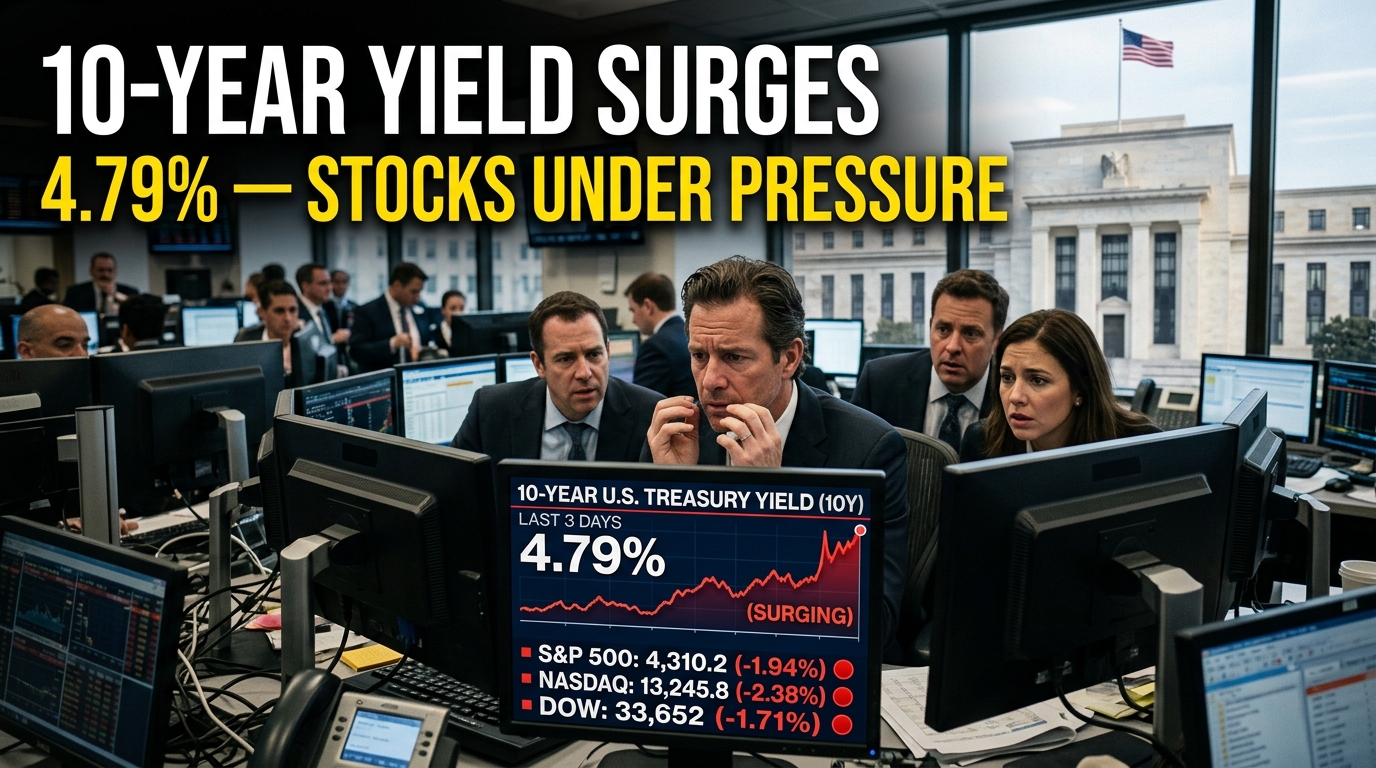
U.S. financial markets have entered a tense phase as the benchmark 10-year Treasury yield climbs back near yearly highs, hovering close to 4.79%. This upward trajectory is driven by a potent mix of persistent inflation risks, robust economic data, and increasingly hawkish signals from the Federal Reserve. As sovereign bond yields push higher, borrowing costs across the economy are scaling upward, placing renewed pressure on risk assets, real estate, and equity markets.
Understanding the mechanics behind this surge is critical for investors, corporate leaders, and consumers trying to navigate an environment where “higher-for-longer” interest rates are transforming from a baseline expectation into a challenging financial reality.
Also read:
UK Airport Chaos: Nats air traffic control failure Grounds Flights at Heathrow and Gatwick
The Catalysts: Why Are Treasury Yields Climbing?
The current surge in long-term borrowing costs is not an isolated event; it is the culmination of several macro-economic pressures converging on the fixed-income market:
Persistent Inflation Risks: Despite aggressive monetary tightening over previous cycles, underlying inflation has proven sticky. Recent consumer and producer price data indicate that price pressures refuse to subside smoothly toward the Federal Reserve’s coveted 2% target. Energy market fluctuations and broader supply-chain friction have added fuel to lingering cost-of-living concerns.
Hawkish Federal Reserve Signals: Central bank communication has turned decidedly more cautious. Federal Reserve leadership has emphasized that policymakers still have “work to do” to anchor price stability, pushing back against aggressive rate-cut bets that Wall Street had previously priced in. Commentary highlighting that financial conditions may not be restrictive enough has forced traders to reprice the entire yield curve.
Heavy Sovereign Issuance and Fiscal Realities: Beyond monetary policy, the sheer volume of U.S. debt issuance required to fund expanding government deficits continues to weigh on the market. An oversupply of long-dated paper demands higher yields to attract sufficient institutional demand.
The Ripple Effects: Pressure on Equity Markets and Borrowing Costs
When the risk-free rate of return on a 10-year U.S. government bond approaches 4.8%, the gravitational pull across the broader financial ecosystem shifts dramatically.
1. Equity Valuation Compression
Stock markets—particularly growth and technology sectors—are highly sensitive to rising discount rates. As bond yields climb, the present value of future corporate cash flows shrinks. Furthermore, higher Treasury yields offer investors a lucrative, safe alternative to equities, triggering capital rotation out of stocks and into fixed-income securities. Volatility has become a defining characteristic of recent trading sessions as equity benchmarks grapple with these higher hurdle rates.
2. Soaring Consumer and Corporate Borrowing Costs
The 10-year Treasury yield serves as the foundational benchmark for a wide array of consumer loans and corporate debt:
Mortgages: 30-year fixed mortgage rates track closely with long-term Treasury movements, locking prospective homebuyers out of the market and freezing housing turnover.
Corporate Debt: Businesses facing higher costs to refinance maturing debt are forced to trim capital expenditures, slow hiring plans, or protect profit margins by raising end-consumer prices.
Outlook: What Lies Ahead for Fixed Income and Stocks?
Market participants are paying microscopic attention to upcoming labor market prints, wage growth metrics, and core inflation reports. If economic data continues to run hot, the Federal Reserve may maintain its restrictive stance well into the future, keeping long-term yields anchored near cycle highs. Conversely, any sharp cooling in economic momentum could provide immediate relief to bondholders and spark a relief rally in beaten-down equity sectors.
Frequently Asked Questions
What is the current yield on the U.S. 10-year Treasury note?
The 10-year U.S. Treasury yield is hovering around 4.79%, remaining near its yearly highs as markets process incoming inflation and monetary policy data.
Why do rising Treasury yields hurt equity markets?
Rising yields increase the “risk-free rate” alternative for investors, making stocks look relatively more expensive. They also raise corporate borrowing costs and compress the present value of future corporate earnings, which typically drives equity valuations lower.
How do 10-year Treasury yields impact mortgage rates?
Long-term mortgage rates generally move in tandem with the 10-year Treasury yield. When the 10-year yield climbs, banks and lenders raise mortgage rates to maintain their profit spreads, making home loans more expensive.
Is the Federal Reserve expected to hike rates further?
While market expectations fluctuate with every data release, recent hawkish commentary from Fed officials has caused traders to price out aggressive rate cuts and leave the door open to prolonged restrictive policy if inflation stays sticky.
Conclusion
The resurgence of U.S. 10-year Treasury yields near yearly highs serves as a stark reminder that the macroeconomic transition to normalized interest rates is fraught with volatility. With inflation proving stubborn and the Federal Reserve committed to its strict mandates, financial conditions will likely remain tight. Investors, businesses, and consumers alike must adapt their strategies to a landscape where capital is no longer cheap, and risk management takes absolute priority.