
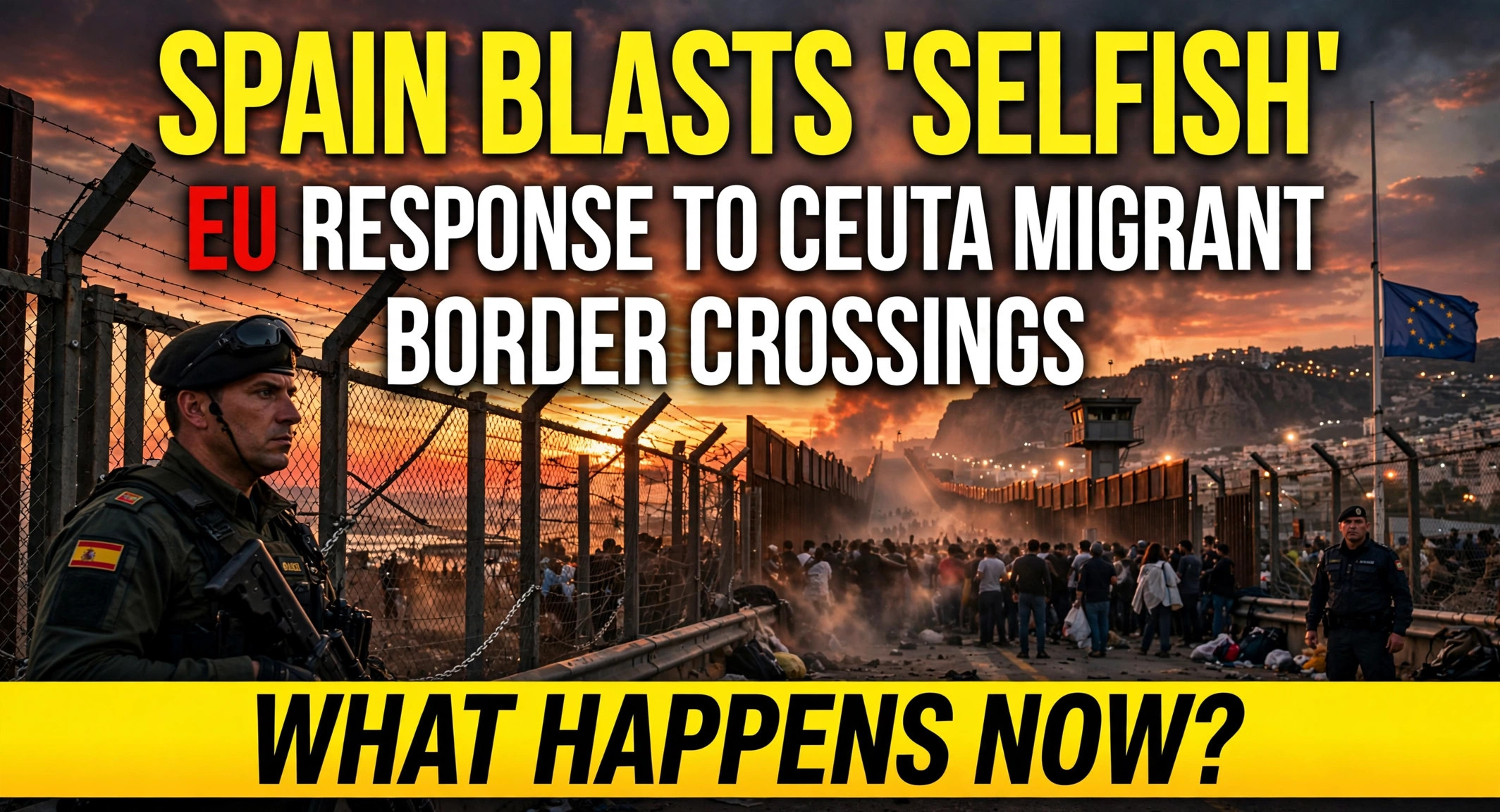
Spain’s ‘Selfish’ Response Row: Sánchez Attacks EU Countries Over the Spain Ceuta Migrant Crossings
Political tensions within the European Union have reached a boiling point following the Spain Ceuta migrant crossings — an unprecedented humanitarian emergency at the border of Spain’s North African enclave. Spanish Prime Minister Pedro Sánchez has launched a fierce critique against several fellow EU member states, labeling their reactions to the crisis as “selfish, polarizing, and unlawful”.
The sharp diplomatic friction erupted after tens of thousands of migrants crossed from Morocco into the Spanish territory within a 24-hour window, triggering deep regional divisions over migration policy, border security, and the core principles of European solidarity.
The Anatomy of the Ceuta Border Crisis
The crisis — the Spain Ceuta migrant crossings — unfolded when tens of thousands of individuals crossed the border into Ceuta, creating one of the most intense unauthorized migration influxes in the bloc’s history. Tragically, the chaotic rush resulted in dozens of fatalities as people attempted dangerous paths across breakwaters and barriers.
While Spanish authorities in Ceuta, working in coordination with Morocco, managed to stabilize the situation swiftly — the vast majority of crossers returning or being processed within days — the political fallout across Europe was immediate. Rather than rallying around Madrid in a show of unified support, several European governments openly criticized Spain’s migration policies. Some right-wing administrations even demanded temporary measures like suspending Spain from the Schengen free-movement zone or imposing stringent security checks on arrivals from the Iberian nation.
- Financial Times: Sánchez hits out at EU leaders over criticism of Spain’s migrant crisis
- European Council Official Press and Briefing Releases
Sánchez Fires Back at Brussels and European Counterparts
In a strongly worded letter to top European Union leadership — including European Commission President Ursula von der Leyen and European Council President António Costa — Sánchez did not mince words. He argued that certain European states used the Spain Ceuta migrant crossings to “attack” Spain, driven by political opportunism, prejudice, and misinformation rather than factual reality.
Accusations of Unlawful Posturing: Sánchez emphasized that calls to restrict Spain’s participation in the Schengen area violate European law and betray the foundational legal duties of mutual assistance.
Defending Border Integrity: Citing data from Frontex, the Spanish administration pointed out that Spain maintains one of the least porous external borders in the EU compared to other Mediterranean nations.
Rejection of Partisan Demagoguery: Senior Spanish officials rebuffed attempts by neighboring leaders to link the sudden surge to domestic immigration amnesties, clarifying that those who crossed illegally had no legal avenue for regularization.
Cracks in the Bloc’s Solidarity Framework
The fierce debate over Ceuta exposes a wider, chronic fracture line inside the European Union over how to handle external border pressures. While a competing letter signed by over twenty European leaders expressed “serious concern” over the security of the border and demanded an urgent meeting of interior ministers, Madrid reads these maneuvers as a lack of genuine solidarity.
Spain’s interior ministry echoed the prime minister’s sentiment, calling the unsympathetic reactions from specific capitals an exhibition of bad faith. As emergency political response teams convene in Brussels to evaluate the situation, the episode — widely reported as the Spain Ceuta migrant crossings — is a stark reminder of how fragile consensus remains on Europe’s migration architecture.
Also Read: How Chinese Warehouse Robots Are Reshaping the UK Retail Sector
Frequently Asked Questions (FAQs)
What sparked the recent crisis in Ceuta?
The Spain Ceuta migrant crossings began when tens of thousands of people crossed from Morocco into the Spanish enclave of Ceuta within a single day, overwhelming local capacities and prompting immediate security concerns.
Why is Prime Minister Pedro Sánchez criticizing other EU countries?
Sánchez criticized several EU nations for what he called a “selfish and illegal” reaction to the Spain Ceuta migrant crossings — including calls to suspend Spain from the Schengen zone instead of offering solidarity.
What action did Italy and other EU states take?
Some nations, including Italy, announced supplementary security checks on non-EU passengers arriving from Spain in response to the Spain Ceuta migrant crossings, while a group of 22 EU leaders formally expressed serious concern over the security breach.
Have the individuals who crossed into Ceuta remained in the territory?
According to EU and Spanish officials, the vast majority of those who crossed during the Spain Ceuta migrant crossings have already returned or been sent back, with none managing to cross onward into mainland Europe.
Conclusion
The diplomatic fallout from the Spain Ceuta migrant crossings highlights the deep challenges facing the European Union’s collective security and migration policies. When faced with localized humanitarian emergencies, the temptation for member states to retreat into national isolationism threatens the union’s foundational values. As Spain pushes for urgent, coordinated ministerial discussions, the bloc must determine whether it can forge a unified, humane, and cooperative strategy — or stay divided by political self-interest.
1 thought on “Spain Blasts ‘Selfish’ EU Response to Ceuta Migrant Border Crossings”