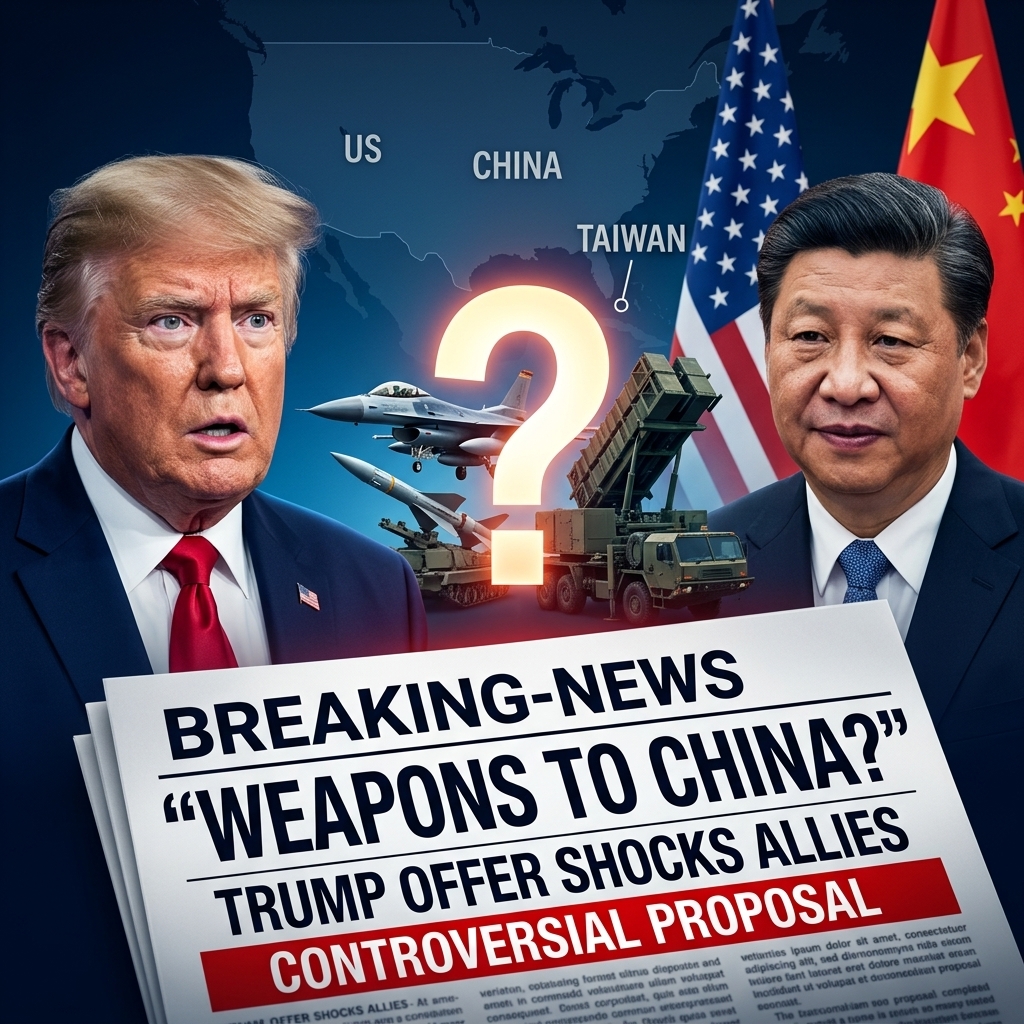
Why a Trump Weapons Offer to China Shocked Foreign Policy Experts
Reports surrounding a potential Trump weapons offer to China sent ripples through international security circles following televised disclosures by US Ambassador to China David Perdue. During an appearance on Fox News Sunday, Perdue stated that Donald Trump floated the idea of Beijing purchasing American military equipment to offset concerns regarding ongoing US defense transfers to Taiwan.
While Trump later pushed back on the assertion—suggesting his diplomat might have mixed up China with Taiwan before observing that selling hardware to Beijing could theoretically be considered—the disclosure triggered instant pushback. To grasp why national security analysts view even the speculative mention of a Trump weapons offer to China as staggering, one must examine federal statutory bans, historical export controls, and balance-of-power dynamics across Asia.
Also Read:
OpenAI Scraps Rollout New Model Safety Concerns: GPT-6.1 Astra Pulled
1. Federal Arms Controls and Post-1989 Statutory Bans
The foremost reason defense scholars met the narrative with disbelief centers on existing US law. Selling advanced military hardware to the People’s Republic of China (PRC) remains explicitly prohibited under federal export control frameworks.
Following the 1989 crackdown in Tiananmen Square, the United States instituted a sweeping defense embargo against Beijing. Under the International Traffic in Arms Regulations (ITAR), China remains designated as a proscribed destination for military goods and services. Authorizing defense transfers to Chinese state entities would necessitate an unprecedented repeal of federal sanctions by Congress—a scenario viewed as politically unviable.
2. Upending the Taiwan Relations Act and Regional Deterrence
Since 1979, American foreign policy in East Asia has hinged upon the legal mandates of the Taiwan Relations Act (TRA). Under the TRA, Washington maintains a statutory obligation to equip Taiwan with defense articles to preserve cross-strait deterrence.
A strategy that pairs arms sales to Taiwan with proposed defense transfers to Beijing creates fundamental strategic friction:
Weakening Defensive Postures: Transferring military technology to the People’s Liberation Army (PLA) directly counteracts effort to bolster Taiwan’s regional defenses.
Muddling Alliance Commitments: Key regional partners—including Japan, South Korea, Australia, and the Philippines—rely on American military leadership to balance Chinese expansion. Offering defense hardware to Beijing creates deep uncertainty among long-standing treaty partners.
Equating Allies with Rivals: Treating defense exports as transactional commodities fails to distinguish between core strategic partners and major global competitors.
3. Vulnerabilities Related to Reverse-Engineering and Countermeasures
American tactical advantage depends on technical superiority across stealth, radar, guided munitions, and aerospace engineering. Providing operational US defense systems to Beijing presents significant operational risks:
Reverse-Engineering Capabilities: Chinese defense contractors could examine, deconstruct, and copy proprietary American components.
Developing Targeted Countermeasures: Direct access to native US hardware enables PLA military engineers to design electronic warfare and intercept capabilities specifically tailored to bypass Western defense networks.
Comparative Matrix: Standard Baseline Policy vs. Transactional Pitch
| Strategic Dimension | Longstanding US Defense Baseline | Proposed China Defense Pitch |
| Federal Statutory Status | Strict arms embargo mandated by federal export laws. | Directly conflicts with codified export control prohibitions. |
| Cross-Strait Position | Unilateral defensive equipment transfers to Taiwan. | Confuses regional deterrence and concerns Indo-Pacific allies. |
| Technology Protection | Complete exclusion of sensitive military hardware from PRC access. | Exposes proprietary defense intellectual property to reverse-engineering. |
| Alliance Architecture | Collective security network aimed at balancing PLA capabilities. | Introduces transactional ambiguity into established security ties. |
Transactional Realpolitik vs. Geopolitical Reality
The debate highlights a broader friction between transactional negotiation tactics and established foreign policy conventions. Throughout his tenure, Trump frequently evaluated international relations through trade balances and manufacturing revenue.
However, defense analysts stress that military equipment cannot be managed like commercial commodities. Treating arms exports purely as business transactions overlooks the fundamental strategic and ideological competition shaping modern international relations.
While the State Department swiftly clarified that federal law bans arms sales to Beijing and no such transfers are under consideration, the episode illustrates how unscripted diplomatic statements can quickly generate international friction.
Frequently Asked Questions (FAQs)
Did Donald Trump officially propose selling weapons to China?
Ambassador David Perdue stated on television that Trump floated weapon sales to President Xi Jinping. Trump subsequently denied making the offer, claiming Perdue likely meant Taiwan, though he noted that selling equipment to Beijing might make commercial sense. The State Department confirmed no arms sales to China exist.
Is it legal under US law to export military hardware to China?
No. US federal law and export control regulations under ITAR prohibit defense exports and military services to the People’s Republic of China.
Why are US arms sales to Taiwan a sensitive diplomatic issue?
Beijing views Taiwan as part of its sovereign territory and opposes US military support. Washington supplies defensive hardware to Taiwan under the 1979 Taiwan Relations Act to ensure peace and stability across the Taiwan Strait.
Disclaimer
This article is prepared strictly for educational, informational, and news reporting purposes based on official statements, broadcast interviews, and public policy records. It does not constitute legal or foreign policy advice.