
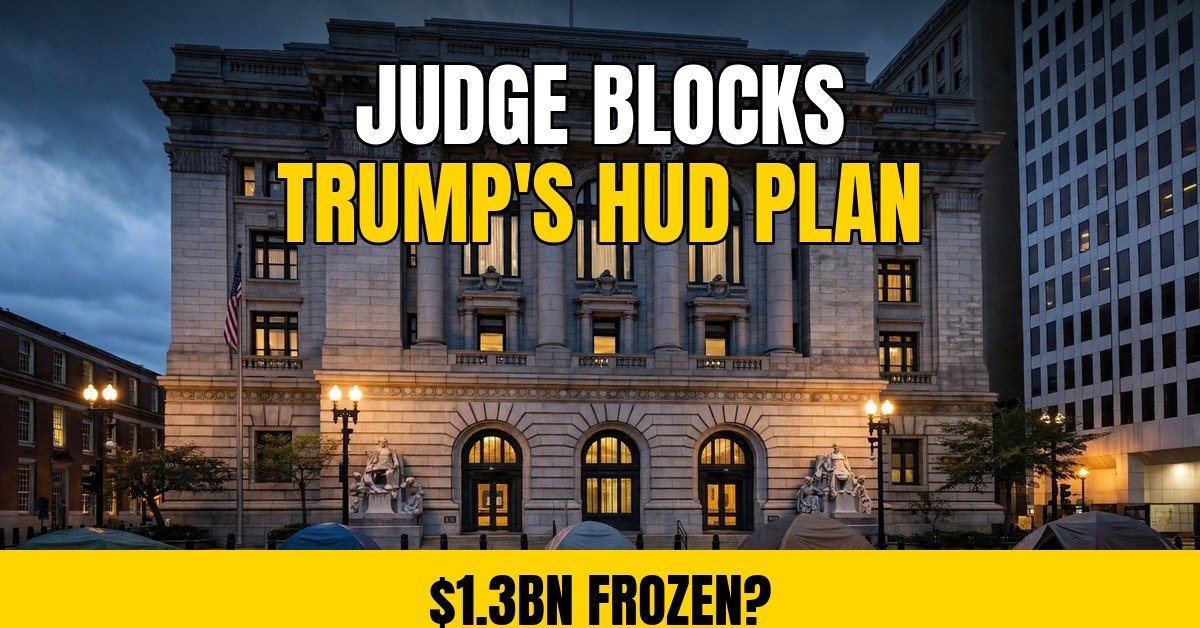
A federal judge on Friday ruled that the Trump administration unlawfully tried to overhaul a $4 billion homelessness program — and the Trump homelessness program ruling blocks the government from steering the money away from permanent housing.
The Trump homelessness program ruling by U.S. District Judge Mary McElroy in Providence, Rhode Island, is the latest setback for the U.S. Department of Housing and Urban Development’s efforts to change how grants are awarded through the Continuum of Care program.
Since 1987, that program has provided resources for states, local governments, and non-profits to deliver support services to homeless people, with a focus on veterans, families, and people with disabilities. The Trump homelessness program fight is about what that money is for — and who gets to decide.
What the Administration Tried to Change
The program traditionally has followed a housing-first model, prioritizing placing people in permanent housing without preconditions such as sobriety or employment. Grants also support services including childcare, job training, mental health counseling, and transportation.
The Trump administration has criticized that approach and has sought to redirect funding toward temporary housing and supportive services instead. The shift would have moved money away from permanent homes and into short-term shelter and services.
McElroy blocked the administration from making changes in 2025 and again earlier this year, only to have a federal appeals court lift that order. After that ruling, 22 mostly Democratic-led states, the District of Columbia, and a coalition of homelessness and housing advocacy groups renewed their challenge on different grounds.
They focused on HUD’s plan to set aside $1.3 billion of the more than $4 billion that Congress appropriated for fiscal year 2026 for transitional housing and supportive service-only grants. That set-aside was the heart of the case, and McElroy struck it down.
Why the Judge Said No
McElroy found HUD exceeded its authority under the McKinney-Vento Homeless Assistance Act by adding criteria that effectively allowed it to bypass requirements to evaluate existing projects’ performance and move people into permanent housing.
“Although Congress delegated to the secretary the power to create additional criteria for awarding funds, this residual clause cannot be read as allowing HUD to nullify the other congressionally established mandatory factors,” she wrote.
In plain terms: Congress set the rules for the program, and the administration cannot rewrite them by inventing new criteria that push money away from permanent housing. The judge’s reasoning turned on a simple point — the law says what the money is for, and HUD does not get to override that.
McElroy, a Trump appointee first nominated by Democratic President Barack Obama, ordered HUD to let applicants amend and resubmit grant applications through December 1 and award funding by December 31.
The judge also struck down other parts of HUD’s plan, including a restriction on needle exchanges and a provision letting the agency disqualify applicants that do not promote “self-sufficiency.”
Reaction to the Trump Homelessness Program Ruling
The coalition of homelessness-focused groups who pursued the case hailed the ruling in a joint statement, saying it “protects the ability of communities and service providers to compete fairly for essential funding without being penalized for providing permanent housing.”
For the groups on the ground, the ruling means the grants they applied for will be judged on the rules Congress wrote, not on the administration’s new preferences.
HUD Secretary Scott Turner said in a statement that the agency reserves the right to appeal. Turner said the ruling “disrupts $4 billion for our most vulnerable, just days before funding awards were set to be made.”
“Under President Trump, HUD is no longer in the business of throwing taxpayers’ money at a status quo that has repeatedly failed America’s most vulnerable,” Turner said.
The administration has framed the housing-first model as a failure, pointing to homelessness numbers that kept rising even as billions flowed into permanent housing programs. The advocates say the model works when it is funded properly.
What Happens Next for the Trump Homelessness Program
The Trump homelessness program case is not over. HUD has said it reserves the right to appeal, and the administration has fought this battle in court before — winning at the appeals court level earlier this year after losing twice before McElroy.
For now, though, the money must move on Congress’s terms. Applicants have until December 1 to amend and resubmit their grant applications, and HUD must award the funding by December 31.
The ruling also matters beyond this one program. It is the latest court decision limiting how far the administration can go in redirecting money Congress has already appropriated.
For the 22 states and the advocacy groups that sued over the Trump homelessness program, the win protects a model they believe in — permanent housing first, services alongside it, no preconditions before a person gets a roof. For the administration, it is another defeat in a fight it clearly intends to keep waging.
Sources and Resources
Frequently Asked Questions
What did the judge decide about the Trump homelessness program?
Judge Mary McElroy ruled the Trump administration unlawfully tried to overhaul the $4 billion Continuum of Care homelessness program and blocked HUD from setting aside $1.3 billion for transitional housing grants.
What is the Continuum of Care program?
The Continuum of Care program has provided funding since 1987 for states, local governments, and non-profits to help homeless people, focusing on veterans, families, and people with disabilities, using a housing-first model.
What is the housing-first model?
The housing-first model prioritizes placing people in permanent housing without preconditions such as sobriety or employment, alongside services like childcare, job training, mental health counseling, and transportation.
Who sued to stop the Trump homelessness program changes?
Twenty-two mostly Democratic-led states, the District of Columbia, and a coalition of homelessness and housing advocacy groups including the National Alliance to End Homelessness challenged the changes.
Will HUD appeal the ruling?
HUD Secretary Scott Turner said the agency reserves the right to appeal the Trump homelessness program ruling.
Conclusion
The Trump homelessness program revamp is blocked — again. A federal judge ruled the administration overstepped its authority by steering $4 billion in homelessness grants away from permanent housing, and she ordered the money awarded on Congress’s terms by December 31. HUD may appeal, but for now the housing-first model stands.