
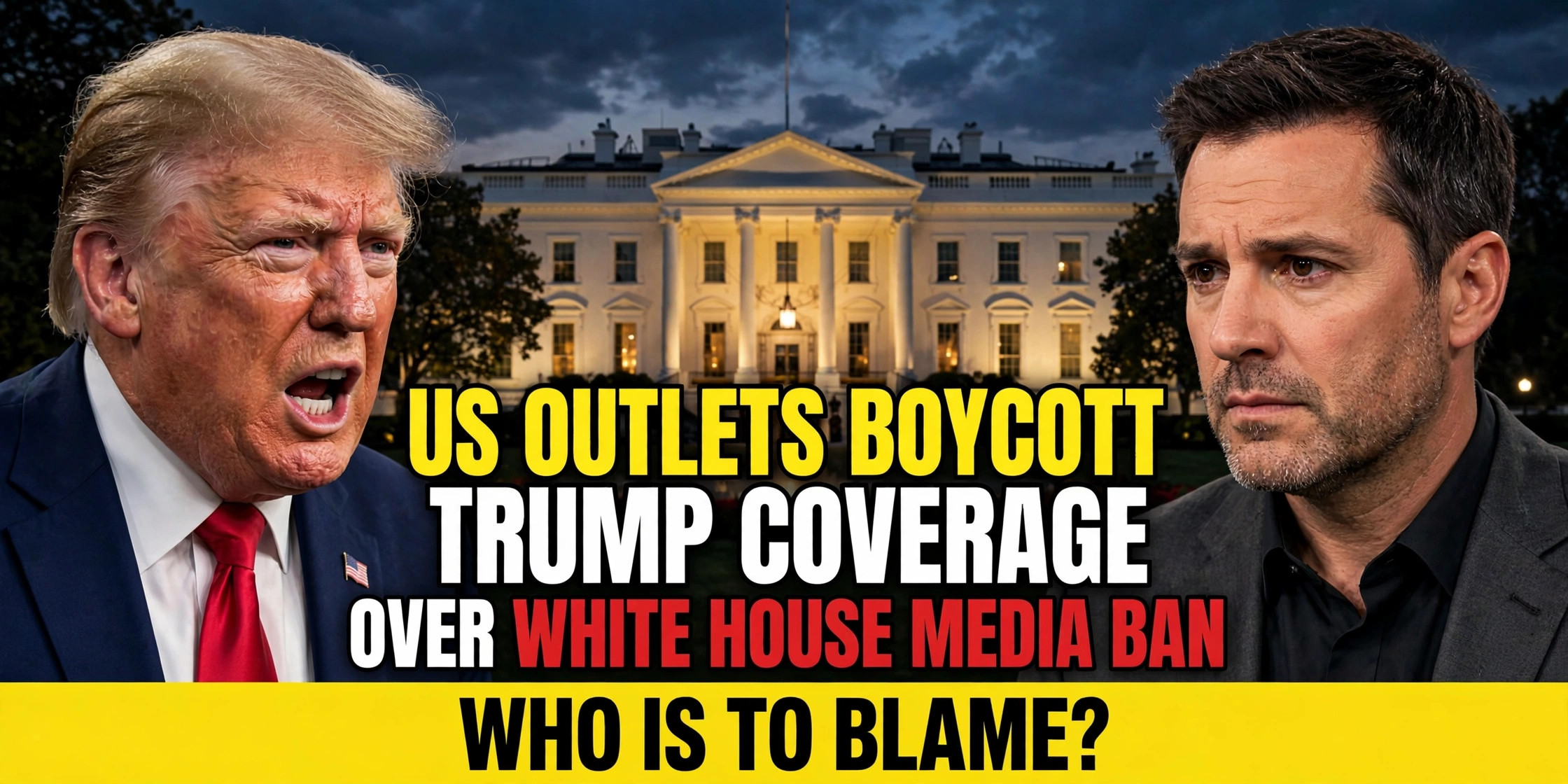
US Outlets Boycott Trump Coverage Over White House Media Ban
A severe standoff between the American press corps and the White House hit a boiling point after major U.S. television networks took the unprecedented step of suspending shared pool coverage of President Donald Trump. The unified boycott — ABC, CBS, NBC, CNN, and Fox News together — came in direct response to the administration revoking press credentials for journalists from CNN, MS NOW, and Politico.
The protest by rival broadcasters has disrupted daily presidential media coverage, leaving official events without standard pooled video or clear audio feeds. And with the conflict escalating into federal court, the dispute ranks among the most significant press freedom confrontations in modern American history.
Also read:
Trump Accelerating Global Chaos: How His Policy Reshapes World Power
1. What Sparked the Media Boycott?
The conflict began when President Trump announced an immediate ban barring reporters from CNN, MS NOW (formerly MSNBC), and Politico from White House grounds. The administration defended the revoked hard passes by accusing the three organizations of publishing “fake news” and biased reporting.
Secret Service agents turned credentialed journalists from the banned outlets away at White House security gates. Press advocacy groups fired back fast, warning that selectively barring outlets over critical coverage sets a dangerous precedent for government transparency.
In a joint statement condemning the move, the participating networks declared:
“The public has a vital interest in receiving accurate, independent information about its government. No administration should restrict a news organization because it objects to its reporting.”
2. Rival Networks United: How the Pool Suspension Works
The White House television pool is a long-standing cooperative agreement among five primary networks: ABC, CBS, CNN, Fox News, and NBC. Under it, news organizations rotate duty days to capture video, audio, and photo feeds from presidential events where space is tight — sharing the raw footage with outlets worldwide.
When the administration blocked CNN from taking its scheduled rotation, the remaining four networks refused to step in as replacements. Fox News Washington Bureau Chief Bryan Boughton, acting as pool chair, notified members that shared pool coverage of presidential events would be suspended.
Where each network stands:
- ABC News: Active pool member — suspended shared coverage in solidarity.
- CBS News: Active pool member — suspended shared coverage in solidarity.
- NBC News: Active pool member — suspended shared coverage in solidarity.
- Fox News: Active pool member — suspended shared coverage in solidarity.
- CNN: Banned by the White House — co-plaintiff in the First Amendment lawsuit.
- MS NOW & Politico: Banned by the White House — co-plaintiffs in the First Amendment lawsuit.
The decision was a rare show of unity across a fiercely competitive media world — conservative-leaning Fox News standing shoulder to shoulder with traditional broadcast rivals to defend press access standards.
3. Immediate Impact: Inaudible Speeches and Visual Blackouts
The consequences of the pool suspension hit instantly:
- Inaudible Presidential Remarks: During a White House South Lawn ribbon-cutting ceremony for a new helipad, no pool microphone sat near the podium. Local and independent camera feeds picked up audio from a distance — and Trump’s speech was drowned out by the noise of an idling Marine One helicopter.
- Photo Still Blackout: Photographers from major publications, including The New York Times, agreed to hold back pooled still photographs taken on White House grounds in a coordinated effort to support the excluded newsrooms.
- UN General Assembly Disruption: The boycott coincided with the start of high-profile diplomatic events at the United Nations General Assembly in New York — shrinking the administration’s broadcast footprint across major domestic networks.
4. First Amendment Lawsuit Filed in Federal Court
Alongside the media blackout, CNN, MS NOW, and Politico filed a joint federal lawsuit against the Trump administration in Washington, D.C., requesting an emergency temporary restraining order to immediately restore their press credentials.
The two tracks of the standoff — the five major networks (ABC, CBS, NBC, Fox News, CNN) boycotting the TV pool on one side, and the excluded outlets (CNN, MS NOW, Politico) taking their case to federal court on the other — converge on one outcome: a historic press freedom showdown.
The lawsuit argues that yanking credentials over editorial tone amounts to unconstitutional viewpoint discrimination under the First Amendment and violates due process rights. Legal scholars note that while the White House controls security access, precedent bars arbitrary credential revocations based on content.
5. The White House Standpoint and “Trump TV”
President Trump hasn’t budged, rejecting claims that the ban is an assault on press freedom. He told reporters that while he respects a free press, the administration isn’t obligated to grant daily access to outlets he considers hostile or deceptive.
To counter the blackout, the White House pushed its own direct-to-consumer digital video feed: “TRUMP TV: The Essentials Station.” The streaming network carries administration announcements, official speeches, and government-produced clips — a way to bypass traditional news outlets entirely.
But media analysts stress the obvious: direct government channels can’t replace independent press scrutiny, and they can’t match the audience reach of traditional broadcast television.
Navigating the Future of Executive Press Coverage
The standoff exposes deep structural tensions over executive accountability and access. As federal judges weigh the emergency injunction, the unified boycott shows that major broadcasters treat pooled coverage rights as non-negotiable. Whether the clash ends through judicial intervention or diplomatic compromise, it sets a powerful benchmark for how news organizations respond when government authorities challenge established press freedoms.
Frequently Asked Questions (FAQs)
What is a White House press pool and how does it work?
It’s a small, rotating group of reporters, videographers, and photographers who follow the president to space-constrained events. They share raw footage, audio, and written reports with the broader media so the public gets consistent access.
Why did Fox News join the media boycott?
As a member of the White House television pool consortium, Fox News joined despite its different political perspective — backing the principle that administrations shouldn’t selectively ban accredited outlets over their coverage.
Which news outlets were barred from the White House?
The White House banned journalists from CNN, MS NOW (formerly MSNBC), and Politico, citing objections to their coverage.
What legal arguments are the banned outlets using in court?
The outlets argue the revocations amount to viewpoint discrimination under the First Amendment — and that pulling credentials without due process violates Fifth Amendment protections around press access.
Disclaimer
This article is an independent news synthesis intended for educational, journalistic, and analytical purposes. It compiles verified public reporting, press statements, and legal filings regarding White House media coverage disputes. It does not represent an official legal opinion or government statement.
1 thought on “US Outlets Boycott Trump Coverage Over White House Media Ban”