
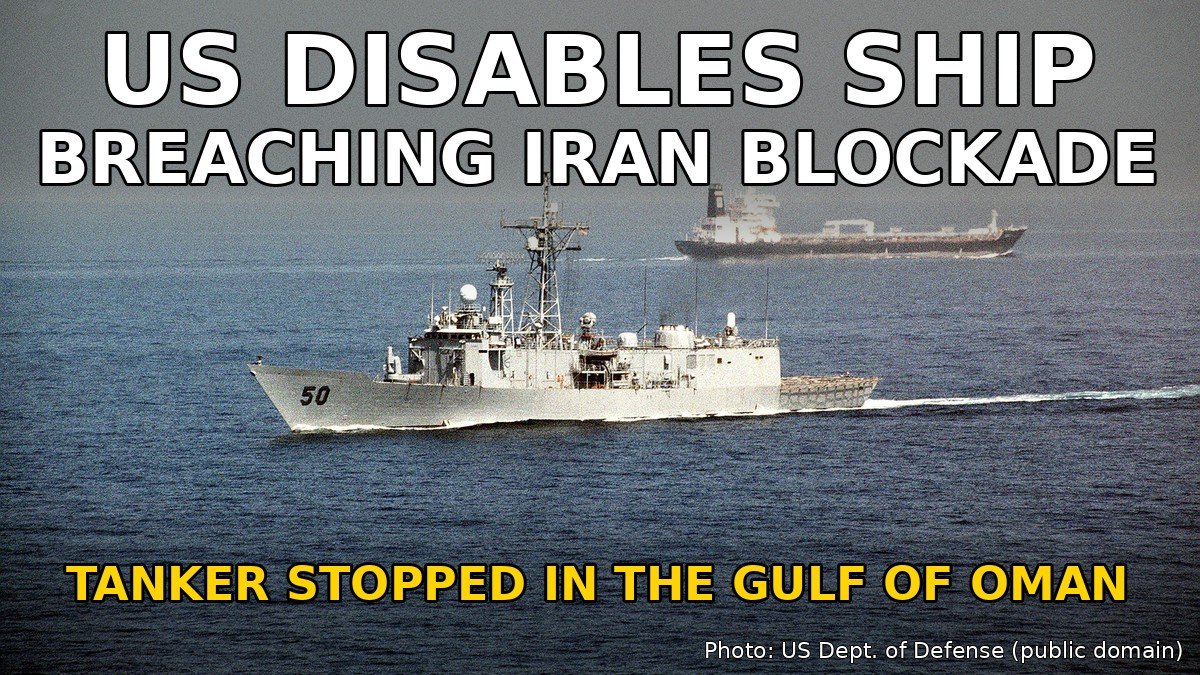
US disables ship in the Gulf of Oman after it tried to slip through the American naval blockade of Iranian ports, in a Thanksgiving Day strike that destroyed the vessel’s propulsion but left its civilian crew unharmed. It was the sixth vessel the US military has disabled since the blockade began — and the clearest sign yet that Washington intends to enforce it with force, not just warnings.
The strike happened on Thursday, November 26, Thanksgiving Day. The Palau-flagged M/V Pacific Archer had left Bandar Abbas, a major port city on Iran’s southern coast, when a US military aircraft fired precision munitions at the ship’s stern, destroying its propulsion, according to US Central Command.
A video released by the military shows a projectile hitting the back of the ship and causing an explosion. The civilian crew was unharmed in the strike, CENTCOM said.
US Disables Ship: What Happened in the Gulf of Oman
The Pacific Archer was not an Iranian warship. It was a commercial vessel, flagged in Palau, sailing out of one of Iran’s busiest ports — and that is exactly the point of the blockade. Since mid-July, the United States has maintained a naval blockade of all Iranian ports, stopping and searching commercial shipping bound to or from Iran. Vessels that comply are redirected; vessels that refuse are disabled.
The operation is run from the Gulf of Oman and the Strait of Hormuz, the narrow waterway through which a large share of the world’s seaborne oil passes. Bandar Abbas sits on the strait’s northern shore, and any ship leaving it for the open sea must pass through waters the US Navy now patrols.
CENTCOM has not said what the Pacific Archer was carrying, or who owned its cargo. What it has said is that the ship tried to evade the blockade — and that the response was deliberate: a precision strike on the stern, aimed at the propulsion system, designed to stop the ship without sinking it and without harming the people on board.
That distinction matters. Disabling a ship’s propulsion leaves it dead in the water but afloat, its crew alive. It is a show of force calibrated to send a message to the next captain thinking about running the blockade, without creating a sinking, an oil spill, or dead sailors.
Six Ships Disabled, 158 Redirected: The Blockade So Far
The Pacific Archer was the sixth vessel US forces have disabled for refusing to comply with the blockade. Another 158 commercial vessels have been redirected — stopped, inspected, and turned away or sent on their way after complying with US instructions.
Those numbers tell their own story. The blockade is not a one-off strike but a sustained campaign, now in its fifth month, and it is being enforced ship by ship. Most captains comply. A small minority test it — and so far, six have had their ships disabled for doing so.
The blockade is one of the sharpest tools in the Trump administration’s campaign against Iran. It follows months of escalation: US strikes on Iranian targets, an Iranian vow to keep the Strait of Hormuz shut, and a war that has already seen tankers attacked and shipping disrupted across the region. Earlier this month, two oil supertankers exploded in the Strait of Hormuz as Iran warned of a wider war: Two Oil Supertankers Explode in Strait of Hormuz as Iran Warns of Wider War.
The blockade also fits into a longer pattern. In November, the Trump administration moved to tighten the noose further, targeting the tankers that carry Iranian oil to market: Trump’s Iran Blockade Targets 14 Tankers.
Trump: Victory “At Hand” as US Offers Iran a Deal
President Trump spoke about the war on Thursday while celebrating Thanksgiving at Mar-a-Lago in Palm Beach, Florida, telling US service members in a phone call that victory in the Iran war would come “whenever I want it.”
“We have victory at hand. It’s going to be whenever, sort of, whatever I want it to be. To be honest, and we’re trying to be nice, we’re giving them every chance to make a deal and save a lot of lives. But I am not sure if they are going to take advantage of that,” he said.
Trump also praised US troops for their role in preventing Iran from obtaining a nuclear weapon. “Each of you is playing an essential role to protect not only our country today but future generations of Americans by ensuring that Iran will never have a nuclear weapon. They will never have a nuclear weapon. That I can tell you,” he said.
The president added that the US has launched 150 missiles to intercept threats targeting commercial shipping in the Strait of Hormuz — a figure that underlines how much of the war is now being fought over the waterway itself, rather than on land.
Pickaxe Mountain and the 150 Missiles Over Hormuz
Asked whether Moscow and Beijing are providing Iran with intelligence to help it target US military bases, Trump played down the likelihood and said China was not heavily involved. He maintained that both countries are interested in helping the US bring the war to a close.
But he also made clear that the bombing campaign could resume — and named the target. If the US were to resume strikes, Trump said, CENTCOM forces would “absolutely hit Pickaxe Mountain,” an underground complex near Iran’s Natanz enrichment facility.
The likelihood of Iran agreeing to a deal proposed by the US is low, Trump also told reporters — a frank admission that the offer he described to the troops may not be taken up.
Tehran, for its part, has vowed to keep the Strait of Hormuz shut and to confront the blockade. The Pacific Archer incident shows what that confrontation looks like in practice: a commercial ship, a precision strike on its stern, and a crew left alive to tell the story.
What Happens Next
The question now is whether the Pacific Archer becomes a pattern or a warning that works. If more captains test the blockade, the count of disabled ships will climb past six — and each new strike raises the risk of a miscalculation, a crew harmed, or a ship sunk rather than stopped. If the warning holds, the blockade tightens without another shot fired, and the pressure on Tehran grows with every tanker turned back.
Either way, the Thanksgiving Day strike has made the American position unmistakable. The blockade of Iranian ports is not a threat on paper. It is enforced at sea, by aircraft, with live munitions — and the next ship that tries to slip through it will know exactly what happened to the last one.
The story was first reported by the New York Post. Read the full source report here: US military disables tanker ship attempting to slip through Iran blockade on Thanksgiving Day.