
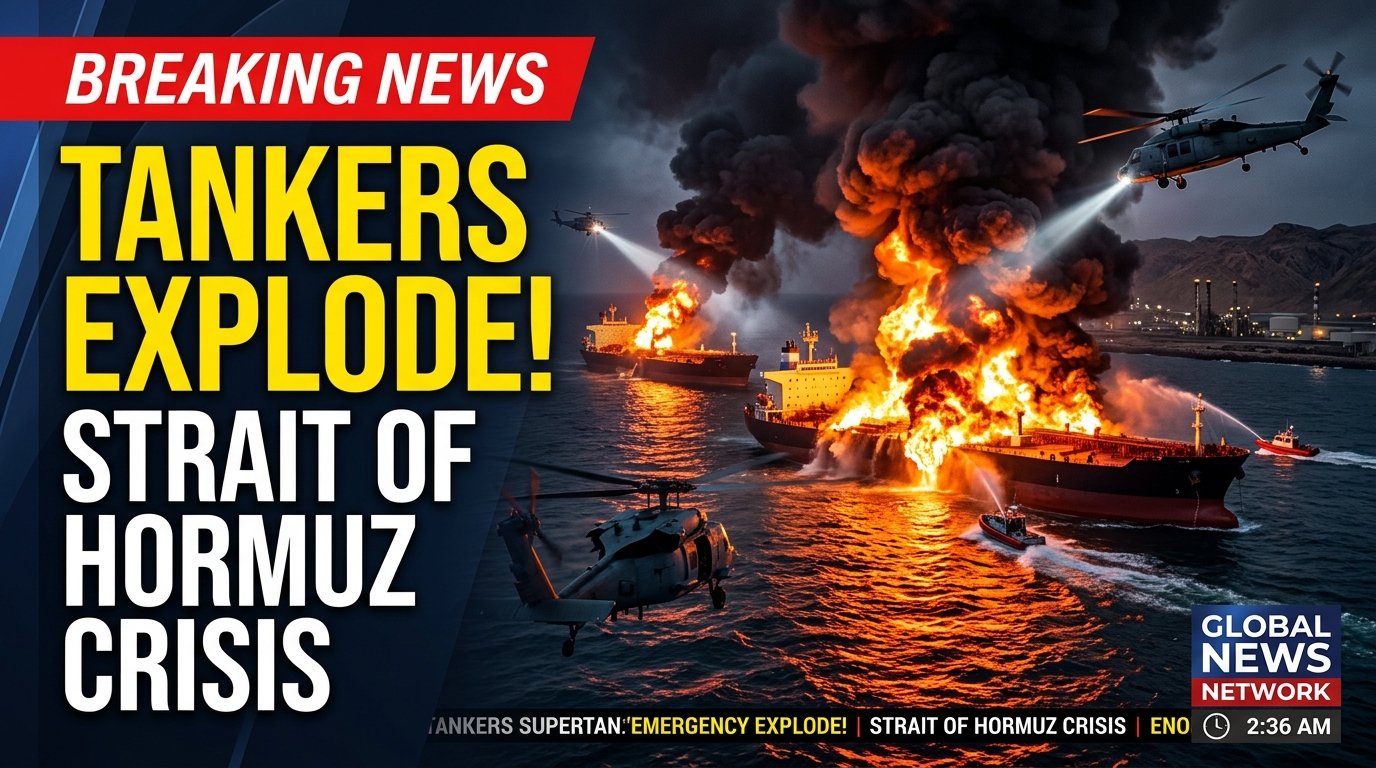
Two Oil Supertankers Explode in Strait of Hormuz as Iran Warns of Wider War
Global energy markets and maritime security forces are on high alert after two oil supertankers explode in Strait of Hormuz, igniting massive blazes aboard vessels carrying more than four million barrels of crude oil. The incident, confirmed by Iran’s Islamic Revolutionary Guard Corps (IRGC) Navy on November 12, 2026, has sharply escalated military tensions in the Persian Gulf as Tehran issues stark warnings of a wider regional conflict.
According to statements from Iranian military authorities, the explosions disabled both supertankers overnight while they were transiting the southern maritime corridor of the strategic waterway. The latest maritime strikes underscore the volatile security environment gripping the world’s most vital oil chokepoint amid ongoing friction between Washington and Tehran.
Also Read:
Russian Ambassador Dies Suddenly at 66 in Moscow
What Happened When Two Oil Supertankers Explode in Strait of Hormuz
The news that two oil supertankers explode in Strait of Hormuz unfolded rapidly following an official communique from the IRGC Navy’s public relations office. Iranian officials stated that the two massive crude carriers were struck by “violent explosions” late Wednesday night after entering what Tehran designates as an unauthorized and prohibited southern route through the strait.
Iranian military sources reported that both vessels had switched off their automatic identification and navigation systems prior to attempting the passage without coordinating with Iranian maritime traffic control centers. Carrying a combined cargo exceeding four million barrels of oil, the supertankers were immobilized and engulfed in flames following the blasts.
In a separate report issued on the same day, Iran’s regular armed forces stated that additional tankers caught fire east of the Strait of Hormuz after striking naval mines in restricted waters. While Tehran did not publicly disclose the names, flag states, or crew casualty figures of the stricken supertankers, video footage broadcast by Iranian state media showed thick plumes of black smoke rising from burning vessels on the open water.
Iran’s IRGC Issues Stark Warnings of Wider Escalation
Beyond reporting the explosions, the IRGC Navy used the incident to deliver an uncompromising warning to international shipping companies and the United States military. Tehran accused the disabled supertankers of “cooperating with the U.S. military” and attempting to bypass Iranian naval oversight under the protection of American forces.
In its statement, the IRGC declared that any commercial vessel in the Persian Gulf or the Strait of Hormuz that disables its transponders and coordinates with U.S. forces to traverse the southern corridor “will meet the same fate”. Iranian officials also rejected recent assertions from Washington that naval mines had been cleared and that the waterway had been fully secured for uncoordinated transit.
The confrontation occurs against the backdrop of deeply strained U.S.-Iran relations throughout 2026. Following military strikes in February, a temporary April ceasefire, and a stalled June memorandum of understanding, sporadic clashes and maritime interdictions have repeatedly threatened to spiral into a broader regional war.
Why the Strait of Hormuz Is Critical to the Global Economy
Whenever two oil supertankers explode in Strait of Hormuz, the reverberations extend immediately from naval command centers to global financial exchanges. Situated between Oman and Iran, the Strait of Hormuz connects the oil-rich Persian Gulf with the Gulf of Oman and the Arabian Sea. At its narrowest point, the waterway spans roughly 21 nautical miles, with designated shipping lanes only a few miles wide in each direction.
Approximately one-fifth of the world’s total petroleum liquids consumption—and a substantial share of global liquefied natural gas (LNG) exports from Qatar—passes through this narrow maritime corridor every single day. Major energy producers, including Saudi Arabia, Iraq, the United Arab Emirates, Kuwait, and Iran, rely heavily on uninterrupted transit through Hormuz to reach Asian, European, and North American markets.
Because alternative overland pipelines have limited spare capacity, any sustained disruption, mining campaign, or military blockade in the Strait of Hormuz creates an immediate supply bottleneck.
Impact on Crude Oil Prices, Shipping Insurance, and Environmental Risks
Following reports that two oil supertankers explode in Strait of Hormuz, benchmark crude oil prices rebounded sharply from recent two-month lows as energy traders priced in renewed geopolitical risk premiums. Analysts warn that continued attacks on vessels carrying millions of barrels of crude could tighten near-term physical supply, inflate global freight rates, and drive up war-risk insurance premiums for maritime operators operating in the Persian Gulf.
In addition to economic disruption, maritime experts are closely monitoring the severe environmental threat posed by two burning supertankers loaded with over four million barrels of crude oil. A large-scale structural breach or sinking in the shallow, semi-enclosed waters of the Persian Gulf could trigger one of the worst marine oil spills in decades, threatening fragile coastal ecosystems, commercial fisheries, and vital desalination plants that supply drinking water to millions of residents across Gulf states.
International Response and Maritime Security Outlook
Naval coalitions and commercial shipping associations are urgently reviewing transit protocols in the region. Maritime security advisories have urged merchant vessels to maintain heightened vigilance, keep transponders active where required by international maritime law, and exercise extreme caution near disputed maritime zones.
As diplomatic channels remain deadlocked and military rhetoric intensifies, the international community faces a precarious standoff: containing hostilities in the Strait of Hormuz before further strikes on commercial shipping ignite a wider, uncontrollable conflict across the Middle East.
Frequently Asked Questions (FAQs)
What happened when two oil supertankers exploded in the Strait of Hormuz? Two large oil supertankers carrying a combined total of more than four million barrels of crude oil were struck by massive explosions and caught fire while transiting the southern route of the Strait of Hormuz without coordinating with Iranian authorities.
Who claimed responsibility or reported the supertanker explosions? Iran’s Islamic Revolutionary Guard Corps (IRGC) Navy reported the explosions, stating that the vessels ignored repeated warnings against using an unauthorized maritime route and accused them of cooperating with the U.S. military.
How much oil were the two supertankers carrying? According to Iranian military statements, the two supertankers were carrying a combined cargo of over four million barrels of oil.
Why is the Strait of Hormuz so important for global oil supplies? Roughly 20% of the world’s daily oil consumption and significant volumes of liquefied natural gas pass through the Strait of Hormuz, making it the single most critical energy transit chokepoint in the world.
How are global oil markets reacting to the Strait of Hormuz explosions? Crude oil prices rose following the news as traders factored in heightened geopolitical risks, potential supply disruptions, and increased shipping insurance costs in the Persian Gulf.
Disclaimer
This article is for informational and news reporting purposes only and does not constitute financial, investment, or commodities trading advice. Developments in the Strait of Hormuz are ongoing, and details regarding vessel identities, causes of explosions, and official military responses remain subject to verification by international maritime authorities.