
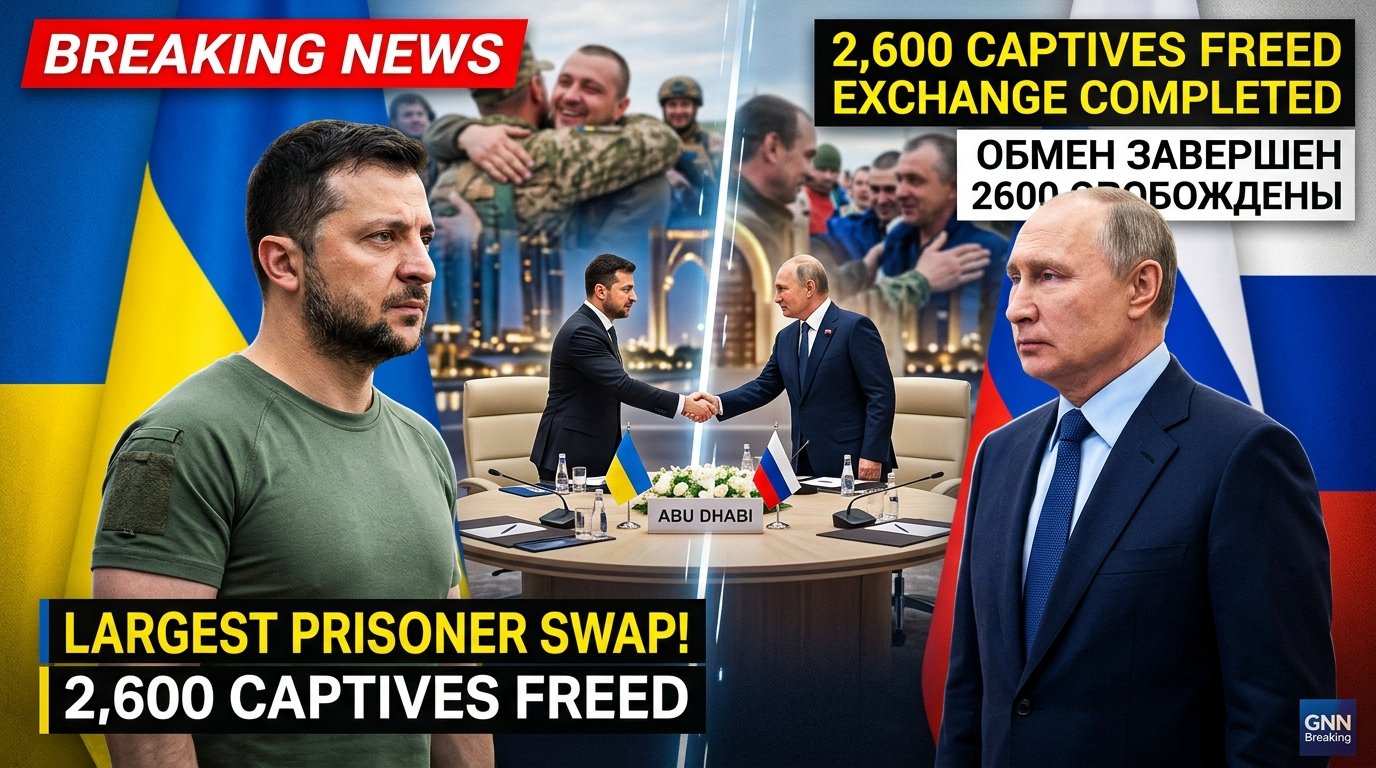
Russia and Ukraine Agree Largest Prisoner Exchange of the War
In a rare diplomatic breakthrough amid nearly five years of grinding conflict, Russia and Ukraine agree largest prisoner exchange of the war following two days of high-stakes, U.S.-mediated trilateral negotiations in Abu Dhabi. Announced in mid-November 2026, the landmark humanitarian agreement is set to bring home between 1,200 and 1,300 prisoners of war from each side—surpassing every previous swap since Russia launched its full-scale invasion in February 2022.
Ukrainian President Volodymyr Zelenskyy confirmed the scale of the agreement on Saturday, November 14, 2026, calling the swap the “main outcome” of the Abu Dhabi talks. While core disputes over territory and long-term security guarantees remain unresolved, both Moscow and Kyiv—alongside American mediators—hailed the prisoner release as a vital humanitarian step that could help rebuild basic trust between the warring nations.
Also Read:
No Migrant Caravans Headed to US, Says Mexico President Claudia Sheinbaum
How the Abu Dhabi Talks Led to the Historic Prisoner Swap
The decision in which Russia and Ukraine agree largest prisoner exchange of the war emerged from two days of direct discussions held in the United Arab Emirates on November 10 and 11, 2026. The negotiations marked the first face-to-face round of talks between Russian and Ukrainian delegations in nine months, bringing together senior officials from Kyiv, Moscow, and Washington.
The delegations at the table included:
Ukraine: Led by Rustem Umerov alongside senior parliamentary representative Davyd Arakhamiia.
Russia: Headed by Kremlin aide Vladimir Medinsky and Russian General Staff representative Alexander Zorin.
United States: Mediated by U.S. special envoy Steve Witkoff and Jared Kushner, senior adviser and son-in-law to U.S. President Donald Trump.
Following the conclusion of the second day of talks in Abu Dhabi, Jared Kushner announced that both sides had agreed in principle to execute the largest humanitarian release of prisoners to date. Immediately afterward, Kushner and Witkoff traveled to Moscow on Thursday, November 12, to brief Russian President Vladimir Putin before flying to Dublin, Ireland, to consult directly with President Zelenskyy and European partners.
Breaking Down the Scale and Timeline of the Exchange
Speaking at press briefings in Dublin and Kyiv, President Zelenskyy emphasized what the agreement means for thousands of anxious families. “After Russia, the American team also accepted that we will have an exchange of POWs. It will be the biggest, as Steven and Jared told me, the biggest exchange of war prisoners. And these guys, our soldiers will come home,” Zelenskyy stated.
By Saturday, November 14, Zelenskyy clarified that negotiators are finalizing lists involving 1,200 to 1,300 captives from each side—eclipsing the previous record swap of 1,000 soldiers per side conducted a year earlier. According to Russian General Staff deputy chief Alexander Zorin, the logistical transfer is expected to take place within two to three weeks once final verification lists are completed.
Humanitarian organizations and United Nations monitors have long underscored the urgency of prisoner releases, noting that thousands of Ukrainian service members and civilian detainees remain in Russian captivity, with widespread reports of severe mistreatment.
Broader Peace Negotiations Remain Deadlocked Over Territory
Even as Russia and Ukraine agree largest prisoner exchange of the war, officials from Washington, Kyiv, and Moscow acknowledged that a comprehensive ceasefire or peace settlement remains elusive.
Key sticking points continue to divide the two sides:
Territorial Demands: Russian forces currently occupy roughly one-fifth of Ukraine. Moscow continues to demand full control over the entire eastern Donbas region—including areas still defended by Ukrainian forces—as well as parts of southern Ukraine. President Zelenskyy flatly rejected ceding Ukrainian land, stating that Kyiv will not surrender its sovereign territory in exchange for a peace deal.
Security Guarantees and NATO: Zelenskyy revealed that U.S. envoys raised questions regarding whether Kyiv would consider territorial compromises in Donbas in exchange for security assurances or NATO membership, while European leaders insist that wider European security architecture cannot be negotiated before a formal ceasefire takes hold.
European Participation: In a notable diplomatic shift, U.S. envoy Steve Witkoff confirmed that President Putin agreed to allow European representatives to participate in the upcoming round of peace talks, a move Zelenskyy welcomed as essential for lasting regional security.
What Comes Next After the Prisoner Swap Agreement?
While a prisoner exchange alone does not halt front-line fighting or overnight drone and missile strikes, diplomats view the Abu Dhabi breakthrough as a critical confidence-building measure. Over the next two to three weeks, military and humanitarian coordinators from both countries will finalize the identities of the 2,400 to 2,600 combined prisoners slated for release.
Simultaneously, U.S., Ukrainian, Russian, and European officials are preparing for the next round of negotiations before the end of 2026, testing whether the momentum generated by the largest POW swap of the war can translate into broader de-escalation.
Frequently Asked Questions (FAQs)
How many prisoners will be released in the new Russia-Ukraine exchange? According to Ukrainian President Volodymyr Zelenskyy, Russia and Ukraine are finalizing a swap involving 1,200 to 1,300 prisoners from each side, making it the largest prisoner exchange of the war.
Where was the Russia-Ukraine prisoner swap negotiated? The agreement was reached during two days of U.S.-mediated trilateral talks held in Abu Dhabi, United Arab Emirates, on November 10–11, 2026.
When will the prisoner exchange take place? Russian military negotiator Alexander Zorin indicated that the exchange is expected to occur within two to three weeks once both sides finalize the lists of detainees.
Did Russia and Ukraine also agree to a ceasefire in Abu Dhabi? No. While both sides made progress on the prisoner swap and agreed to include European representatives in the next round of talks, major disagreements remain over occupied territory and security guarantees.
Who mediated the talks between Russia and Ukraine? The negotiations were hosted by the United Arab Emirates and mediated by U.S. special envoy Steve Witkoff and Jared Kushner.
Disclaimer
This article is for informational and news reporting purposes only. Exact prisoner counts, transfer schedules, and diplomatic developments remain subject to official confirmation and execution by Ukrainian, Russian, and mediating authorities.