
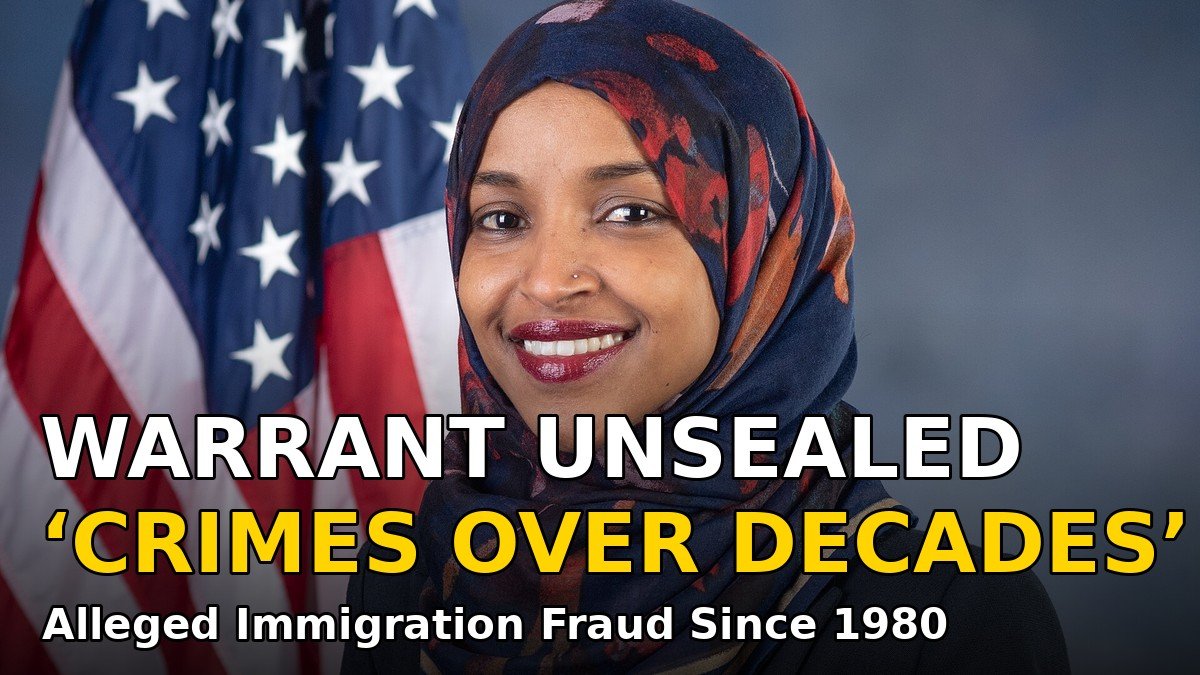
The Ilhan Omar search warrant unsealed on Monday has pulled back the curtain — if only slightly — on a federal investigation into the Minnesota congresswoman, with prosecutors writing that they believe she committed crimes “over decades” in a case centred on alleged immigration fraud.
A federal judge ordered the release of the heavily redacted warrant records after more than a dozen news organisations sued for their disclosure, as the New York Post reported. The documents include an abbreviated inventory of what agents took from Omar’s Washington home during the October 12 raid, but they name no potential charges. The most revealing passages are the ones that survived the redactions: filings that describe the scope of the probe in sweeping terms, stretching from 1980 to the present day.
What the Ilhan Omar Search Warrant Reveals
“The United States believes ILHAN has committed [redacted] crimes over decades — beginning long before she was ever in Congress,” one filing stated, adding that the case had nothing to do with ILHAN’s professional life. In another filing, prosecutors wrote that they were “in the throes of a preindictment investigation.”
That framing matters. It suggests the government is not looking at anything Omar did as a lawmaker, but at her history before she entered politics — specifically, at how she and her family came to the United States after fleeing war-torn Somalia in the 1990s.
DC US District Chief Judge James Boasberg ordered some of the filings unsealed but agreed with prosecutors at a hearing last Tuesday that the “vast majority” of entries in the case should stay sealed — including the 67-page affidavit that supported the search warrant in the first place. The affidavit is the document that would lay out, in detail, what the government believes happened. For now, it remains under wraps.
What Agents Seized in the October Raid
The warrant authorised agents to seize “papers, records, photographs, documents and any other physical objects,” along with “thumb drives, external hard drives, computers” and all “cellular phones registered or used” by Omar.
Omar has previously said that federal agents searched her Washington home in October and “took 17 items” from her home, including several mobile phones and notebooks. Homeland Security Investigations agents also seized her passport and computers. She has since filed a petition asking for the 17 items to be returned.
A federal judge agreed to seal the search warrant in early October, citing “reasonable grounds to believe the disclosure will result in flight from prosecution, destruction of or tampering with evidence, intimidation of potential witnesses, and serious jeopardy to the investigation.”
On Friday, federal prosecutors filed a notice on the docket confirming they had complied with a judge’s order to submit the search warrant records with redactions for sensitive investigative information. The unsealed records were then made public on a court website.
The Questions at the Heart of the Case
Prosecutors in DC US Attorney Jeanine Pirro’s office and the Minnesota US Attorney’s office have been building a case against Omar related to possible immigration fraud committed by her or family members, according to people familiar with the probe.
One line of inquiry has focused on whether Omar allegedly misrepresented her birth date as falling on October 4, 1982, rather than a year earlier, on government papers, in order to become a citizen when her father naturalised in 2000. The distinction matters because of how citizenship is passed on: a child under 18 can derive citizenship automatically when a parent naturalises. If Omar was actually 18 at the time, rather than 17, the government could argue her citizenship was obtained improperly.
Sources have also said the federal investigators re-opened files on her second marriage to Ahmed Nur Said Elmi, a British national who is suspected of being her brother. The two were legally married from 2009 to 2017, though she filed joint tax returns with her first husband, Ahmed Hirsi, at least twice during that period. A filing released on Monday referred to her by an alternative surname — “Congresswoman Ilhan Nur Said Elmi, a/k/a Ilhan Abdullahi Omar” — nearly identical to her second husband’s.
Asked in an interview on MS NOW on October 21 whether she married her brother, Omar answered: “Not to my knowledge.”
Elmi is a self-described gay man studying “queer violence in Kenya” and other issues as a PhD researcher at the University of Bristol.
What Trump Administration Officials Have Said
Senior figures in the Trump administration have spoken publicly about the investigation in unusually blunt terms — something Judge Boasberg noted in Tuesday’s hearing, indicating that the administration’s own leaks about the probe have given it less of a leg to stand on in court when requesting that the potential charges being considered remain sealed.
Vice President JD Vance told podcaster Benny Johnson in a March interview: “We actually think that Ilhan Omar definitely committed immigration fraud against the United States of America.”
Homeland Security Secretary Markwayne Mullin told the same host in September: “We know that she married her brother to try to bring him to the United States. We know he lives now in London.” He added: “There may be more to this, the whole family migration and possibly some illegal activity for them to come to the United States to begin with.”
No charges have been filed against Omar, and the unsealed records do not accuse her of a specific offence. The allegations described in the filings remain unproven, and the central evidence — the 67-page affidavit — is still sealed.
What Happens Next
It is unclear whether other dockets related to the Omar search warrant will remain sealed. Lawyers for Judicial Watch, one of the groups that sued for the release of the warrant, have filed another motion to unseal information on a separate docket as well.
Omar’s attorneys did not respond to a request for comment.
For now, the unsealing answers one question and raises several more. The public now knows the government believes the alleged conduct spans decades — but not what charges, if any, it intends to bring, or when. Until the affidavit is released or an indictment is filed, the case against one of Congress’s most prominent members remains largely behind closed doors.