
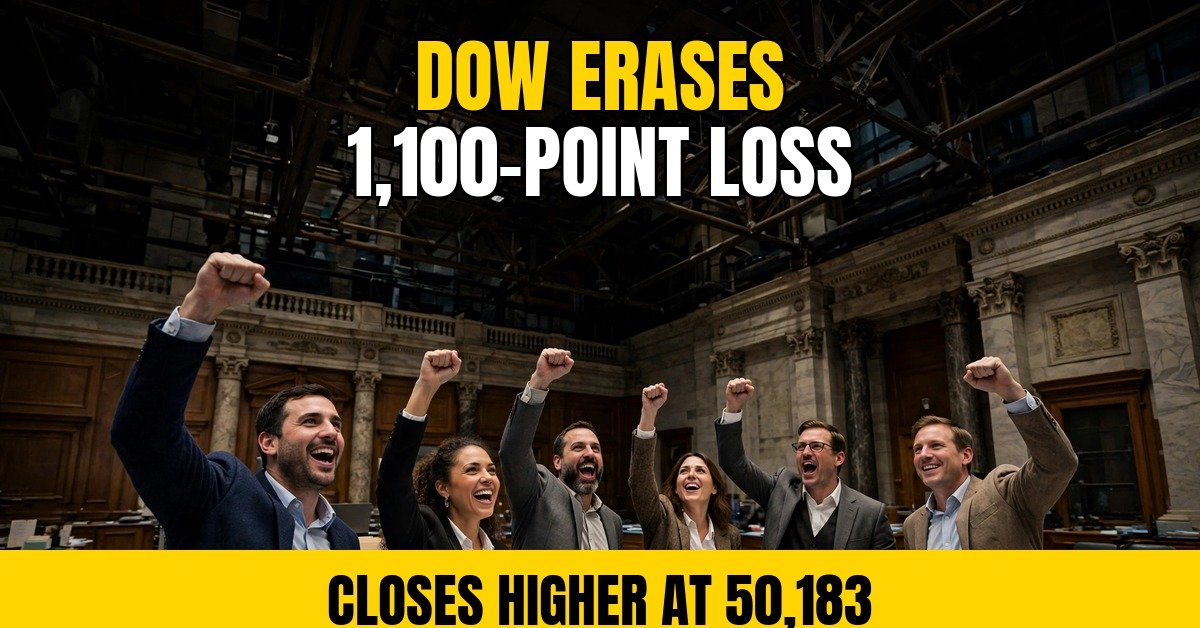
The Dow erases 1,100-point loss on Wednesday and closes higher, capping one of the wildest trading days of the year on the eve of Thanksgiving. The Dow Jones Industrial Average finished up 164.25 points, or 0.33%, at 50,182.95, after falling more than 1,100 points in the first hour of trading. From its low to the close, the Dow erases 1,100-point loss and then some, climbing more than 1,250 points.
The morning looked like a rout. By about 9:45 a.m. ET, the Dow had lost roughly 1,105 points, or 2.2%, to an intraday low of 48,913.74. The S&P 500 was down 3.2% and the Nasdaq Composite was down 4.6%. Then buyers stepped in, and the market spent the rest of the day clawing back the losses, one sector at a time.
It was the second straight session the Dow closed above 50,000, and the only one of the three major indexes to finish higher. The S&P 500 fell 0.25% to 7,182.78, and the Nasdaq fell 0.62% to 23,585.80. The Russell 2000, which tracks smaller companies, rose 0.71% to 2,704.06.
What set off the morning selloff
Three things hit the market at once. Hotter-than-expected inflation data, in the form of the personal consumption expenditures price index, told investors that prices were still rising faster than hoped. New tariff proposals from the Trump administration added to the worry. And a renewed selloff in artificial intelligence stocks, led by chip giant Nvidia, turned a bad morning into a rout.
Nvidia fell more than 9% in early trading, and the chip sector headed for a seven-month low. Nearly all sectors fell at the open, and the selling spread from technology into the rest of the market. The VIX, Wall Street’s fear gauge, jumped 7.32% to 28.29. Gold rose 0.50% to $3,609.20 an ounce, and oil climbed 2.47% to $84.08 a barrel.
The Dow erases 1,100-point loss only after the panic faded and buyers started to separate the market into two stories: the AI trade, which was falling, and everything else, which was starting to look cheap.
The turnaround: buyers rotate out of tech
The turn started around midday. Selling in technology stocks eased, and money rotated into the old-economy stocks that fill the Dow: industrials, banks, energy and healthcare. Of the 11 key S&P 500 sectors, eight closed higher. The technology sector still led the decliners, but it pared a 5.5% intraday loss to close down just 0.8%.
The breadth of the market told the story. On the New York Stock Exchange, advancing stocks outnumbered decliners 1,941 to 762. On the Nasdaq, advancers beat decliners 2,944 to 2,015. And 371 stocks inside the S&P 500 gained ground, according to Dow Jones Market Data. The rally was broad, not narrow, and it was built on stocks outside the AI trade.
Nvidia still finished lower, and the chip sector stayed weak. But the damage was contained. The Nasdaq, which had been down 4.6% at its worst, finished down just 0.62%. That is still a loss, but it is a very different day from the one the market feared at 9:45 in the morning.
The Dow erases 1,100-point loss because its mix helped it. The Dow holds 30 big industrial and financial companies, not the AI names that drove the selloff. When investors rotated out of technology and into value stocks, the Dow was the index that caught the money.
What the numbers say as the Dow erases 1,100-point loss
Erasing a 1,100-point loss in a single session is a strong signal that investors are still willing to buy American blue chips, especially outside technology. A 2.2% intraday drop that ends in a gain does not happen in a market where everyone wants out. It happens when buyers see a price they like and step in.
The session also showed how much of the market’s mood now rides on two things: inflation and AI. The hot PCE reading rattled bonds and stocks alike, because it pushed back the case for lower interest rates. The AI selloff did the rest, as investors asked again whether chip stocks had run too far, too fast.
But the breadth numbers cut against the gloom. Eight of 11 sectors higher, nearly two thousand advancers on the NYSE, and 371 of 500 S&P stocks up — those are not the numbers of a market in freefall. They are the numbers of a market rotating, not collapsing.
The Dow erases 1,100-point loss and still leaves the S&P 500 and the Nasdaq in the red, which is a reminder that the rotation has winners and losers. The winners on Wednesday were the old-economy stocks. The losers were the AI names that had carried the market for two years.
A holiday pause, and what comes next
United States stock markets are closed on Thursday for Thanksgiving, and trading ends early at 1 p.m. ET on Friday. The break gives investors a day to digest a session that swung more than 1,250 points from low to close.
The questions that drove the selloff have not gone away. Inflation is still running hot, the tariff proposals still need to work through a hearing in January, and the AI trade still has to prove that chip spending will pay off. The market will test those questions again on Friday, and again next week.
For now, the Dow’s comeback is the story. An index that fell 1,100 points before most people had finished their coffee ended the day in the green, above 50,000, with buyers in control by the close. It was a Thanksgiving Eve rebound in the truest sense: a bad morning, a long climb back, and a finish that nobody expected at the open.
Sources and Resources
Frequently Asked Questions
How much did the Dow fall before it recovered?
The Dow erases 1,100-point loss after falling about 1,105 points, or 2.2%, to an intraday low of 48,913.74 by about 9:45 a.m. ET on Wednesday, November 25. It then climbed more than 1,250 points from that low to close at 50,182.95.
Where did the Dow close on November 25?
The Dow erases 1,100-point loss and closes at 50,182.95, up 164.25 points or 0.33%. It was the second straight session the index closed above 50,000.
Did the S&P 500 and Nasdaq recover too?
Partly. The S&P 500 fell 0.25% to 7,182.78 and the Nasdaq Composite fell 0.62% to 23,585.80. The Nasdaq had been down as much as 4.6% during the session, so it pared most of its loss but still finished lower.
What caused the morning selloff?
Three things hit at once: hotter-than-expected PCE inflation data, new tariff proposals from the Trump administration, and a renewed selloff in AI stocks led by Nvidia, which fell more than 9% and dragged the chip sector toward a seven-month low.
Are US markets open on Thanksgiving?
No. United States stock markets are closed on Thursday, November 26, for Thanksgiving, and trading ends early at 1 p.m. ET on Friday, November 27.
Conclusion
The Dow erases 1,100-point loss to close up 164 points at 50,182.95, turning a brutal morning into a Thanksgiving Eve comeback. Hot inflation data, new tariffs and an AI selloff knocked the index down 2.2% in the first hour, but buyers rotated into old-economy stocks and eight of 11 sectors finished higher. The S&P 500 and Nasdaq still closed lower, so the rotation had losers too — but the Dow’s finish above 50,000 showed that buyers are still willing to step in when prices fall.