
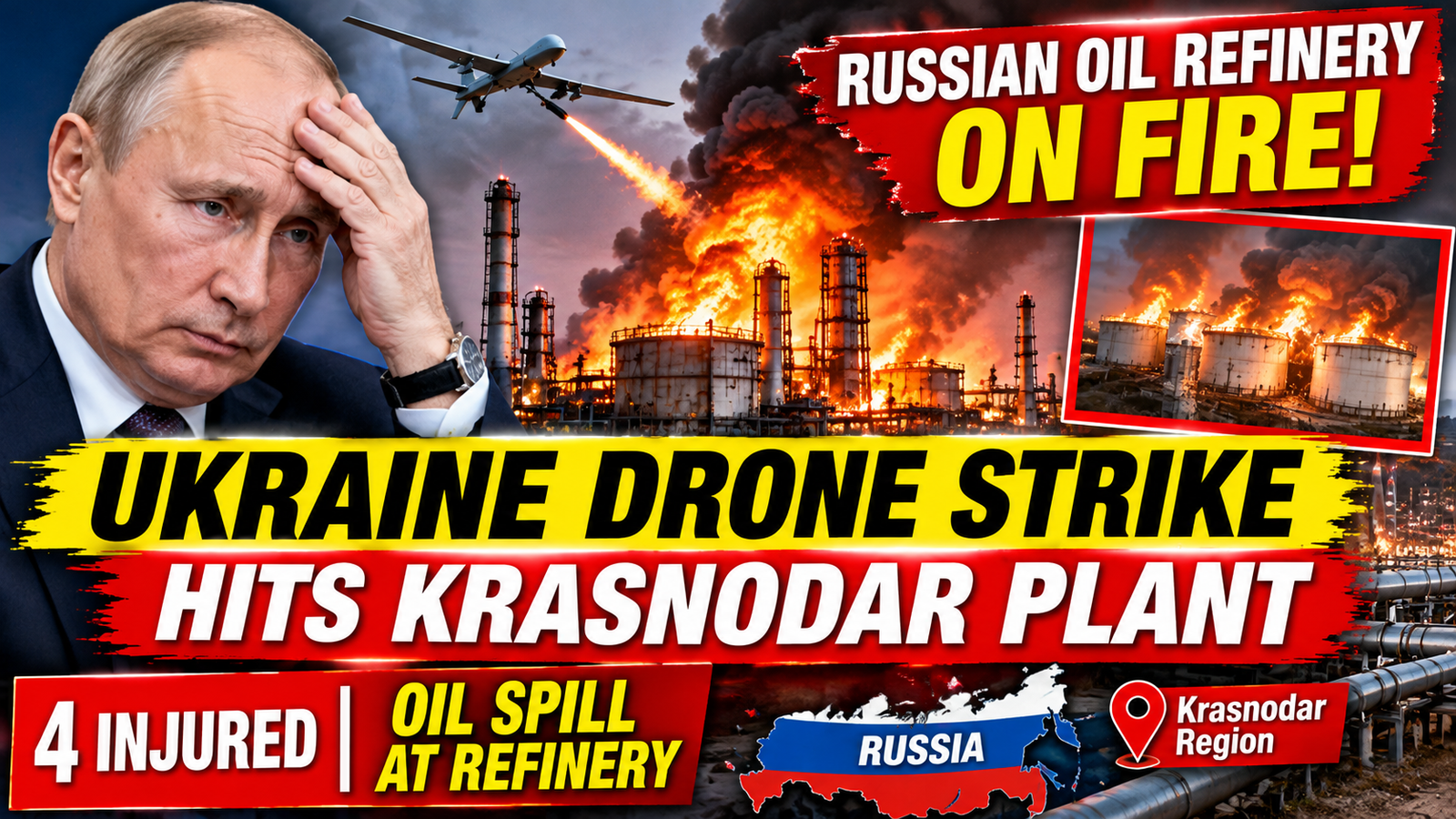
Russian Oil Refinery in Krasnodar Region on Fire After Drone Attack
Emergency crews in southwestern Russia battled heavy flames and a petroleum spill this week after a major Russian oil refinery in Krasnodar region on fire after drone attack sustained severe structural damage. The overnight strike hit the Slavyansk-Eco oil refinery in Slavyansk-on-Kuban, igniting storage tanks and puncturing key transport pipelines at a facility that was already undergoing repairs from earlier strikes.
The latest incident underscores the sustained campaign targeting Russia’s southern energy infrastructure, which supplies refined fuel to both domestic markets and military logistics networks near the Black Sea.
Also Read:
Two Italians Killed in Iranian Drone Attack in Kuwait, Italy Confirms
Details of the Slavyansk-Eco Refinery Strike
Long-range Ukrainian drones targeted the Slavyansk-Eco plant overnight on November 26, 2026, striking primary production infrastructure, the facility’s tank farm, and connected pipelines. According to a corporate statement released by Slavyansk-Eco, the impact triggered “serious fires” across damaged sectors of the complex.
Company officials confirmed extensive physical destruction across the plant’s storage and transfer systems:
Destroyed Tanks: Storage tanks holding heavy petroleum products were completely destroyed in the blaze.
Punctured Pipelines: Crude oil storage tanks and connected transfer pipelines were punctured during the strike.
Oil Spill: The ruptured containment units caused an active petroleum spill at the site, though operators have not yet disclosed the exact volume of the leak.
Ukraine’s Defense Intelligence (DIU) claimed responsibility for the operation, noting that the strike hit key facilities while the refinery was still attempting to recover from previous drone attacks.
Casualties and Surrounding Residential Damage
While the Slavyansk-Eco refinery had already suspended active refining operations to carry out restoration work following an earlier September strike, maintenance personnel and local residents were caught in the overnight barrage.
Krasnodar regional operational headquarters reported that four people were injured during the drone attack on Slavyansk-on-Kuban, with two victims requiring hospitalization. Beyond the industrial perimeter, shockwaves and falling debris damaged surrounding civilian neighborhoods:
The facades of four residential apartment buildings in Slavyansk-on-Kuban sustained structural damage and shattered windows.
Three private homes in the nearby village of Starovelichkovskaya, located in the Kalininsky District, were also damaged.
Strategic Importance of the Slavyansk-Eco Facility
Located in Krasnodar Krai near the Sea of Azov and Black Sea export corridors, the Slavyansk-Eco refinery is a vital component of southern Russia’s downstream energy network. The plant boasts an annual processing capacity of approximately 5.2 million metric tons of crude oil, representing roughly 9% of the total refining capacity in Russia’s Southern Federal District.
Under normal operating conditions, the facility produces a wide range of critical fuels, including:
Automotive gasoline and diesel fuel
Naphtha and kerosene fractions
Vacuum gas oil and heavy fuel oil
Crucially, the refinery serves as a primary fuel supplier for Russian forces and civilian infrastructure in Russian-occupied Crimea. Because of its role in sustaining Moscow’s military supply chain and generating export revenue, the European Union formally imposed sanctions on Slavyansk-Eco on November 16, 2026—just ten days before the latest drone strike. Financial filings from the second quarter of 2026 showed the company generated 153 billion rubles (roughly $1.9 billion) in revenue and 2.37 billion rubles ($29 million) in net profit prior to its autumn shutdown.
A Pattern of Repeated Strikes on Krasnodar Energy Hubs
The fire at Slavyansk-Eco is part of a broader, intensifying wave of aerial strikes targeting oil refineries and terminals across the Krasnodar region throughout 2026. The Slavyansk facility itself was previously hit in June and September 2026, forcing management to halt production for extensive safety and structural repairs.
Other major refining complexes in Krasnodar Krai have faced similar disruption:
Afipsky Oil Refinery: Struck multiple times during the year—including major incidents in June, August, and November 2026—causing recurring fires and localized infrastructure damage.
Tuapse Oil Refinery and Terminal: Targeted in multi-wave drone attacks earlier in 2026, which halted Black Sea export operations and triggered severe environmental contamination.
By striking facilities mid-repair, Ukrainian forces aim to prevent Russian operators from bringing offline refining capacity back into service, creating compounding bottlenecks in regional fuel distribution.
Impact on Russian Fuel Logistics and Markets
Energy market analysts note that while isolated fires at storage tank farms typically cause short-term logistical headaches, repeated strikes along the southern Black Sea refining corridor place sustained pressure on regional clean-product availability and freight schedules. With Slavyansk-Eco’s restoration timeline now pushed back indefinitely due to destroyed heavy fuel tanks and punctured pipelines, Russian energy planners must reroute diesel and gasoline supplies from inland refineries to cover southern and Crimean demand.
Frequently Asked Questions (FAQs)
Which Russian oil refinery caught fire in the Krasnodar region?
The Slavyansk-Eco oil refinery, located in Slavyansk-on-Kuban in southwestern Russia’s Krasnodar Krai, caught fire following an overnight drone strike.
What damage was caused by the drone attack on the Slavyansk-Eco refinery?
According to Slavyansk-Eco, the strike triggered major fires, completely destroyed storage tanks holding heavy petroleum products, punctured oil tanks and connected pipelines, and caused an oil spill at the facility.
Were any people injured in the Krasnodar drone attack?
Yes. Krasnodar regional authorities confirmed that four people were injured during the attack on Slavyansk-on-Kuban, two of whom required hospitalization. Nearby apartment buildings and private homes also sustained window and facade damage.
Was the refinery operating at full capacity when it was hit?
No. The Slavyansk-Eco refinery had already suspended production for repair work following a previous drone strike in September 2026. The latest attack damaged ongoing restoration efforts.
Why is the Slavyansk-Eco refinery strategically important?
With a capacity of 5.2 million metric tons per year, it accounts for roughly 9% of the refining capacity in Russia’s Southern Federal District and supplies gasoline, diesel, and fuel oil to both Russian forces and Russian-occupied Crimea.
Disclaimer: This news report is compiled from official company disclosures, regional emergency statements, and verified international media reporting for informational purposes only. Conflict-related infrastructure assessments and casualty figures remain subject to ongoing updates.