
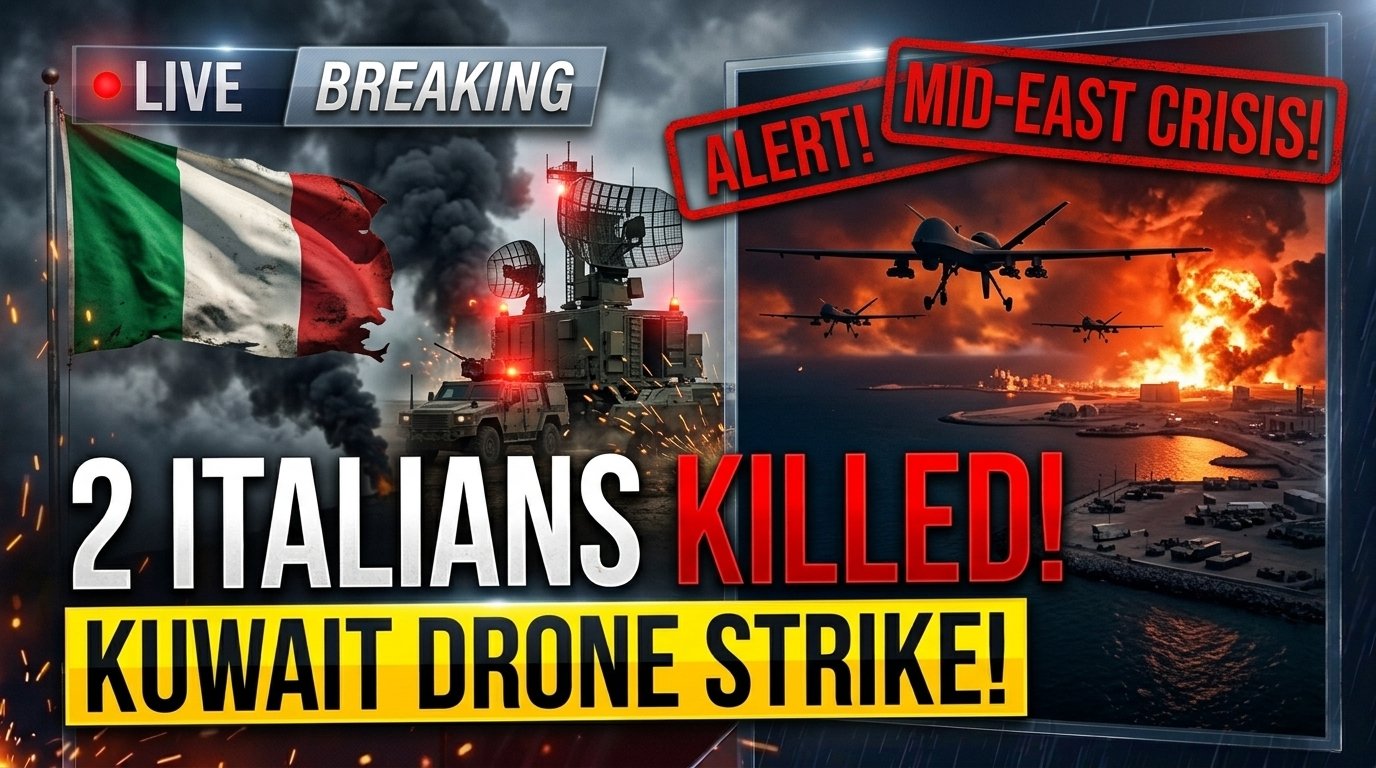
Two Italians Killed in Iranian Drone Attack in Kuwait, Italy Says
Rome and Kuwait City are reeling after Italian officials confirmed that two Italians killed in Iranian drone attack in Kuwait were civilian technicians working on air defense equipment. The incident occurred on Thursday, November 26, 2026, when Kuwaiti air defenses intercepted a wave of incoming unmanned aerial vehicles, sending lethal shrapnel raining down onto a vital facility.
The deaths mark a sharp escalation in the broader regional crisis rippling across the Persian Gulf, drawing immediate condemnation from European and Gulf leaders while prompting sharp denials from Tehran.
Also Read:
Passenger Tries to Open Plane Door Mid-Flight, American Airlines Flight Diverted to Phoenix
What Happened During the Kuwait Drone Strike
According to Kuwait’s Ministry of Defense, the country’s armed forces detected multiple drones breaching Kuwaiti airspace early Thursday morning in what authorities explicitly identified as an Iranian attack targeting a “vital facility”. Kuwaiti air defense units engaged and intercepted the incoming drones before they could achieve direct hits on their intended targets.
However, debris and falling shrapnel from the intercepted drones struck four workers on the ground, causing significant material damage. Initially, Kuwaiti defense officials reported four injuries: two Italian nationals, one Kuwaiti citizen, and one Pakistani national. Hours later, both Kuwaiti authorities and Italian officials confirmed that the two Italian workers had succumbed to their severe injuries.
Who Were the Victims?
Italy’s Foreign Ministry and Prime Minister Giorgia Meloni’s office confirmed the fatalities, identifying the victims as specialized technicians employed by Rheinmetall Italia, a subsidiary of the prominent German defense contractor Rheinmetall.
According to statements from the Italian Foreign Ministry, the two men were stationed in Kuwait on a technical mission to maintain “detection antennas” for an air defense radar system operated by the Kuwaiti Armed Forces. European defense contractors routinely deploy technical personnel across Gulf Cooperation Council (GCC) nations to service, calibrate, and upgrade military hardware sold under bilateral defense agreements.
Prime Minister Giorgia Meloni issued a formal statement expressing the government’s grief: “On behalf of myself and the Government, I express my deepest sorrow and extend my heartfelt condolences to the victims’ families”. Italian Foreign Minister Antonio Tajani also confirmed the deaths, noting that diplomatic staff in Kuwait City were actively assisting the victims’ families and coordinating the repatriation of their remains.
Tehran Denies Involvement Amid Regional Tensions
Despite clear attribution from both Kuwait and Italy, the Iranian government swiftly rejected responsibility for the strike. Iran’s embassy in Rome released a statement asserting that it “categorically” rejected allegations that Iranian forces launched the drone attack against a military installation in Kuwait. Furthermore, state-aligned Iranian media outlets circulated unsubstantiated claims suggesting the incident could be a false-flag operation orchestrated by external actors.
Western and Gulf intelligence officials, however, dismissed Tehran’s denials, pointing to the trajectory and technical profile of the unmanned aerial vehicles intercepted by Kuwaiti radar. The attack took place amid heightened military friction across the Strait of Hormuz and the Persian Gulf. Earlier in November 2026, Iranian officials had publicly threatened retaliatory strikes against U.S. and allied military installations in Kuwait following American military action on Iran’s Qeshm Island and an ongoing U.S. naval blockade targeting Iranian crude oil exports.
International Condemnation and Diplomatic Fallout
News that two Italians were killed in the Iranian drone attack in Kuwait triggered immediate diplomatic backlash across Europe and the Middle East:
European Union: European Commission President Ursula von der Leyen called for tougher international measures against Tehran, stating, “We must step up pressure on Iran to put an end to these unacceptable attacks against its neighbours and our partners in the Gulf”.
Saudi Arabia: Saudi Arabia’s Foreign Ministry strongly condemned the assault on Kuwaiti territory, warning that Iranian aggression undermines international diplomatic efforts aimed at restoring regional stability.
Israel: Israeli Foreign Minister Gideon Sa’ar extended condolences to Rome and asserted that Tehran’s “unchecked aggression” across the Middle East must be brought to an end.
For Italy, the loss of civilian defense technicians abroad puts renewed scrutiny on the safety of European contractors operating in Gulf states hosting Western military assets. Defense analysts note that while modern air defense networks successfully intercept the vast majority of one-way attack drones, falling debris remains a persistent, deadly hazard to personnel working near protected sites.
Broader Implications for Gulf Security
The incident underscores the vulnerability of energy infrastructure and defense installations across the Persian Gulf as regional hostilities spill over borders. On the same day as the Kuwait strike, regional authorities reported separate maritime and energy security incidents, including a vessel struck off the coast of the United Arab Emirates and a drone attack targeting a Saudi Aramco refinery in Jazan.
As Kuwaiti investigators examine the recovered drone wreckage alongside international partners, European capitals face mounting pressure to bolster force protection protocols for overseas technicians and reconsider diplomatic deterrence strategies against Tehran.
Frequently Asked Questions (FAQs)
How were the two Italians killed in Kuwait?
The two Italian workers were killed by falling shrapnel after Kuwaiti air defense forces intercepted incoming Iranian drones targeting a vital facility in Kuwait.
Who did the two Italian victims work for?
According to Italian officials and news agencies, the two victims were civilian technicians working for Rheinmetall Italia, a subsidiary of the German defense group Rheinmetall. They were maintaining air defense detection antennas for Kuwait’s armed forces.
Was anyone else injured in the drone attack in Kuwait?
Yes. Kuwait’s Ministry of Defense confirmed that four people in total were struck by falling debris: the two Italian nationals who died of their injuries, one Kuwaiti national, and one Pakistani national.
How did Iran respond to the accusations?
Iran’s embassy in Rome categorically denied responsibility for the drone attack in Kuwait, while Iranian media suggested without evidence that the strike could be a false-flag incident.
How have Italy and the European Union reacted?
Italian Prime Minister Giorgia Meloni and Foreign Minister Antonio Tajani offered condolences to the victims’ families, while European Commission President Ursula von der Leyen called for increased international pressure on Iran to halt attacks against Gulf states.
Disclaimer: This news article is compiled from official statements by the governments of Italy and Kuwait, as well as verified international wire reports, for informational purposes only. Geopolitical and military developments in the Persian Gulf remain fluid and subject to ongoing official investigations.