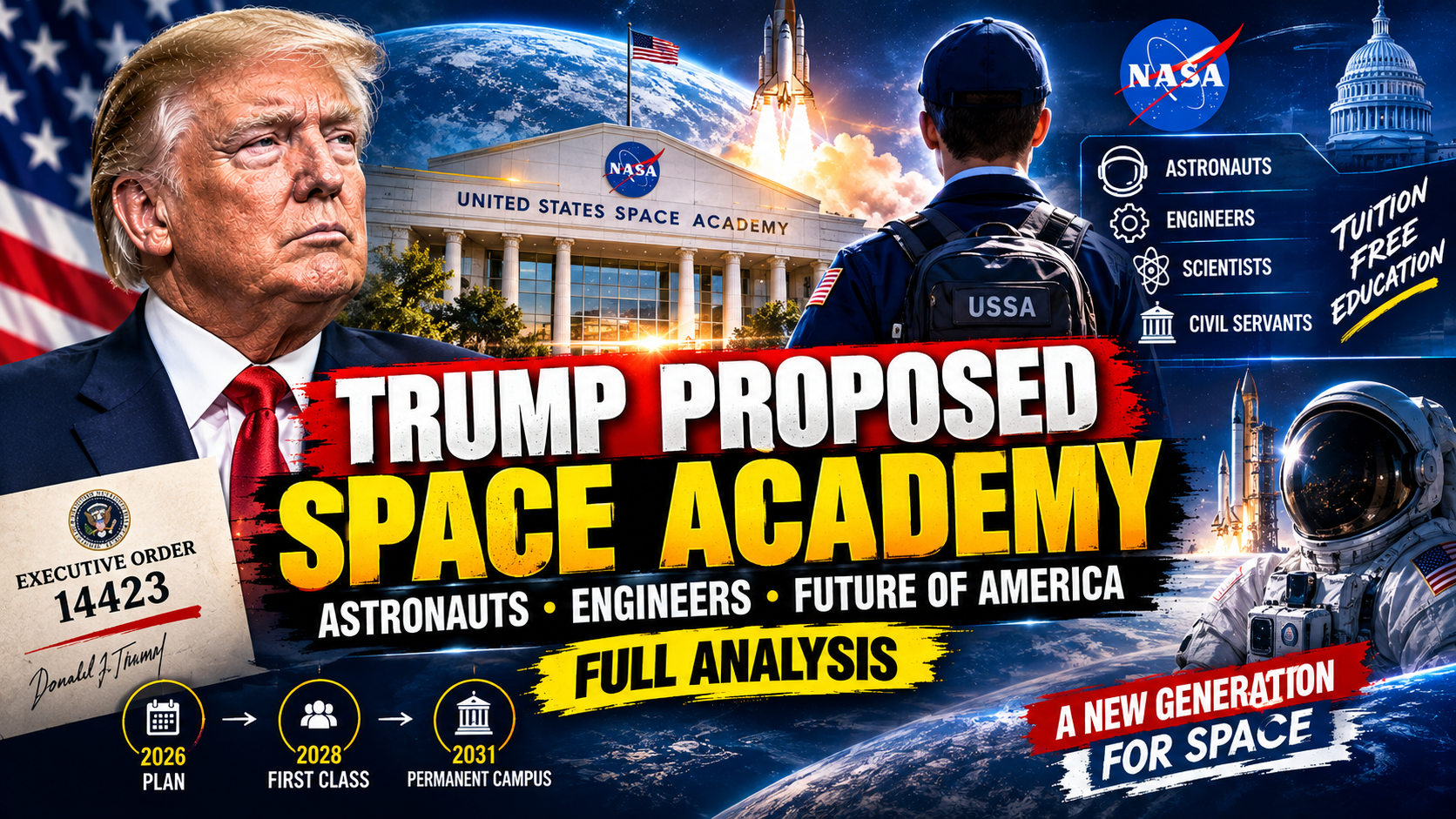
Trump Proposed Space Academy Astronauts Engineers Framework: Full Analysis
The Trump proposed Space Academy astronauts engineers framework represents an unprecedented effort to build a tuition-free, civilian-led federal institution dedicated to cultivating America’s future aerospace workforce. Enacted via Executive Order 14423, the directive establishes a Presidential Commission chaired by National Aeronautics and Space Administration (NASA) Administrator Jared Isaacman. The commission is tasked with presenting a comprehensive roadmap for the United States Space Academy (USSA).
Designed to offer a four-year higher education program akin to existing federal service academies, the USSA aims to bridge a critical workforce gap in science, technology, engineering, and mathematics (STEM) fields vital to national space superiority. By providing a non-military, service-obligated pathway for top-tier talent, the academy seeks to prepare graduates for positions across civil government agencies, commercial space ventures, and defense entities.
Also Read:
U.S. Bond Market Scott Bessent Crisis: Why Treasury Buybacks Are Failing
1. Executive Order 14423 and the 120-Day Mandate
Signed during a ceremony honoring the Artemis II crew, Executive Order 14423 creates the Presidential Commission on the United States Space Academy. The order grants the commission 120 days—setting a deadline of late December—to deliver actionable recommendations covering six institutional pillars:
Governance Structure: Evaluating administrative frameworks, including housing the institution directly under NASA oversight.
Curriculum Design: Developing specialized tracks in orbital mechanics, propulsion engineering, autonomous systems, life support sciences, and space law.
Candidate Eligibility & Selection: Establishing merit-based admission criteria that balance national geographic representation with academic excellence.
Service Obligations: Designing post-graduation commitments in civil service, national security, or key commercial aerospace defense sectors.
Site Selection Process: Managing state-level competitive bids for campus infrastructure and supporting aerospace ecosystems.
Interagency Coordination: Aligning curricula and research efforts with the U.S. Space Force, Department of Defense, and federal research laboratories.
2. Institutional Architecture: Civilian Service vs. Military Model
A defining characteristic of the USSA proposal is its civilian-led identity. Unlike the U.S. Military Academy (West Point), Naval Academy (Annapolis), or Air Force Academy (USAFA), the Space Academy will operate primarily as a NASA-administered federal institution rather than a uniformed armed services branch.
                     [ Presidential Executive Order 14423 ]
                                       |
                                       v
             [ NASA Administrator / Presidential Commission ]
                                       |
         +-----------------------------+-----------------------------+
         |                                                           |
         v                                                           v
[ Curriculum & Track Systems ]                          [ Post-Graduation Service Tracks ]
* Aerospace & Propulsion Engineering                     * NASA & Federal Civil Service
* Orbital Mechanics & Astrophysics                      * U.S. Space Force / Defense Contracting
* Spacecraft Operations & Life Support                   * Commercial Space Operations
         |                                                           |
         +-----------------------------+-----------------------------+
                                       |
                                       v
                [ 4-Year Tuition-Free Undergraduate Program ]
                (In Exchange for mandatory Post-Graduation Public Service)
While graduates of military academies receive commissions into the Armed Forces, USSA graduates will fulfill their service obligations through direct civil service roles at NASA, civil federal appointments, or specialized positions within the national security space architecture. This approach offers an alternative pathway for high-achieving students who wish to serve national aerospace interests without committing to military active duty.
3. Comparative Framework: Federal Academies vs. Civilian Universities
The proposed academy seeks to combine the tuition-free, service-oriented structure of federal service academies with the specialized technical focus of elite engineering universities.
| Feature / Dimension | U.S. Space Academy (USSA Proposed) | U.S. Air Force Academy (USAFA) | Civilian Engineering Universities |
| Primary Governance | Civilian (NASA / Federal Executive) | Military (Department of the Air Force) | Independent / State University Boards |
| Tuition & Costs | Fully Funded / Tuition-Free | Fully Funded / Tuition-Free | Standard Tuition & Student Debt |
| Post-Grad Service | Mandatory Civil Service or Military Obligation | Mandatory Active Duty Military Commissioning | None (Market-Based Employment) |
| Primary Focus | Astronautics, Commercial & Civil Space Engineering | Air & Space Force Officer Development | Broad Academic & Industrial Disciplines |
| Target Initial Class | ~300 Undergraduates (Expanding Post-2028) | ~1,000 Cadets Per Year | Varies by University Size |
4. Implementation Timeline and State Campus Competition
To accelerate operational deployment, NASA issued a Request for Information (RFI) encouraging state governments to submit location proposals. States must demonstrate robust local infrastructure, site readiness, proximity to existing spaceflight facilities, and strong academic-industry partnerships.
  August 28, 2026          October 26, 2026          December 26, 2026           Fall 2028                2031
+-------------------+    +-------------------+    +-------------------+    +-------------------+    +-------------------+
|  EO 14423 Signed  | -> | State RFI Bids    | -> | Commission Report | -> | Inaugural Class   | -> | Permanent Campus  |
|  by President     |    | Submissions Due   |    | Delivered to White|    | Enrolls (300      |    | Fully Operational |
|  Trump            |    |                   |    | House             |    | Students)         |    |                   |
+-------------------+    +-------------------+    +-------------------+    +-------------------+    +-------------------+
The ambitious execution timeline calls for:
State Bid Deadline: October 26, 2026, for governor-designated proposals.
Final Recommendation: December 2026 submission of the Presidential Commission report.
Groundbreaking Target: Site development commencing no later than 2027.
Temporary Campus Launch: Matriculation of an inaugural class of 300 students in 2028.
Permanent Operations: Completion of the permanent academic and research campus by 2031.
5. Legislative Authorization and Policy Challenges
While Executive Order 14423 initiates planning, establishing a permanent federal academy requires congressional authorization and dedicated appropriations. Historical analysis from the Congressional Research Service (CRS) highlights that creating the U.S. Air Force Academy in 1954 required seven years of legislative deliberation and an initial appropriation equivalent to nearly $1.87 billion in 2026 dollars.
Policy analysts and lawmakers are evaluating key legislative hurdles:
Budgetary Requirements: Securing sustained multi-year funding in an environment of fiscal scrutiny.
Workforce ROI: Determining whether building a physical academy yields higher returns on investment compared to expanding NASA fellowship programs and government ROTC-style scholarships at existing universities.
Academic Freedom & Accreditation: Structuring curriculum governance to meet higher education accreditation standards while fulfilling federal workforce mandates.
If authorized by Congress, the United States Space Academy could represent a significant institutional shift in federal higher education, creating a direct pipeline for domestic talent entering the commercial and civil space industry.
Frequently Asked Questions (FAQs)
What is the primary purpose of the proposed U.S. Space Academy?
The proposed academy is designed to provide a tuition-free, four-year undergraduate education to train future astronauts, engineers, scientists, and civil servants needed to support U.S. civil, commercial, and defense space operations.
Is the U.S. Space Academy a military institution?
No. While it shares structural similarities with federal service academies, the proposed USSA is a civilian-led institution managed under NASA, offering non-military service pathways alongside potential defense tracks.
When will the Space Academy open for students?
Under NASA’s current timeline, the academy aims to host its first class of 300 students at a temporary location in 2028, with a permanent campus becoming fully operational by 2031.
Who is leading the planning commission for the academy?
The Presidential Commission on the United States Space Academy is chaired by NASA Administrator Jared Isaacman following Executive Order 14423.
Disclaimer
This article is an analytical synthesis based on public executive orders, NASA releases, and Congressional Research Service reports. It is published strictly for educational, informational, and news reporting purposes.