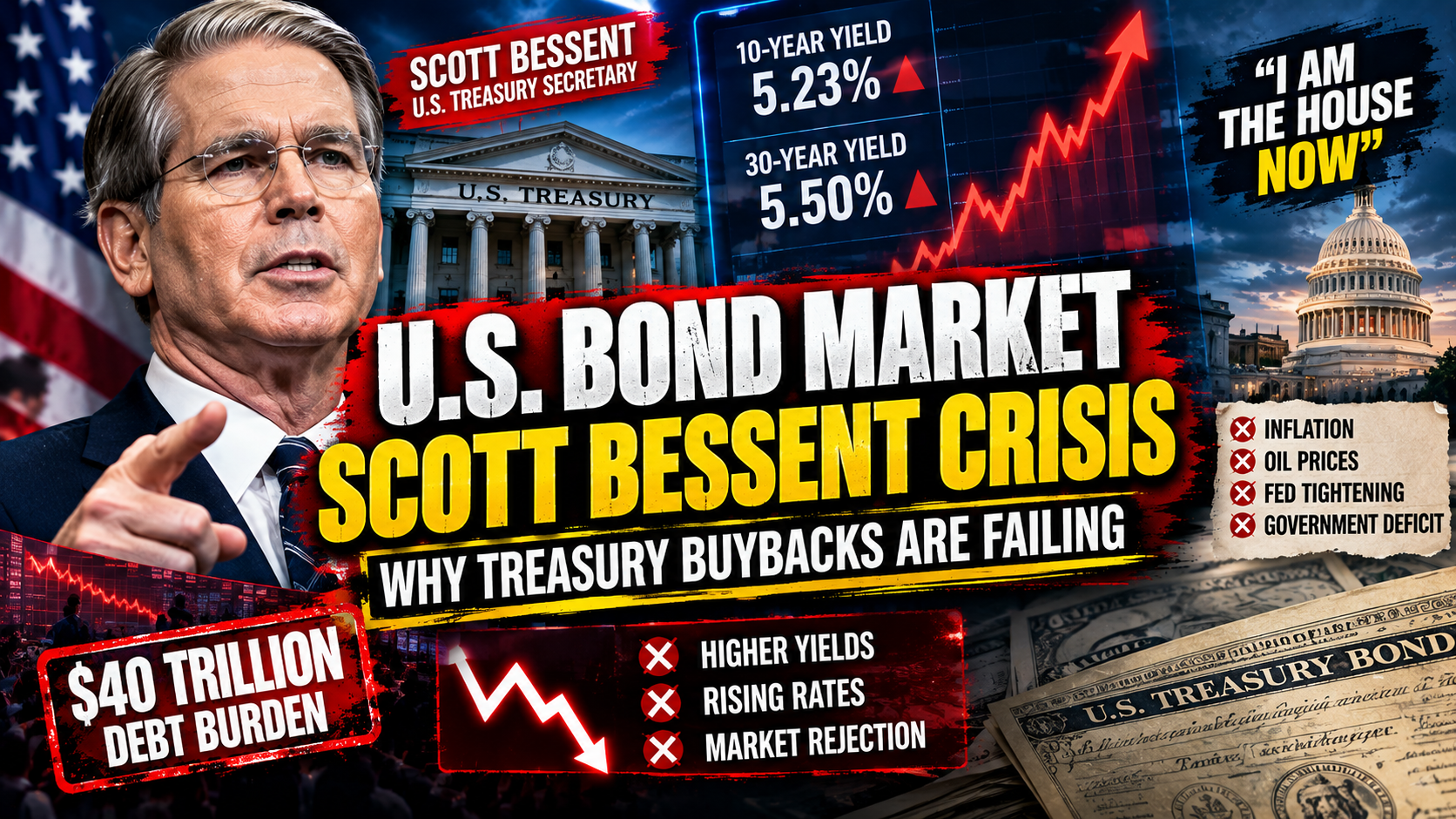
U.S. Bond Market Scott Bessent Crisis: Why Treasury Buybacks Are Failing
The U.S. bond market Scott Bessent intervention strategy is facing a severe reality check as global investors reject the Treasury Department’s attempts to artificially depress sovereign borrowing costs. Despite bold rhetoric from Treasury Secretary Scott Bessent—who declared to congressional lawmakers that he holds “asymmetric information” and boasts that “I am the house now”—the $40 trillion U.S. sovereign debt market continues to sell off sharply.
Yields on 10-year Treasury notes have breached 5.23%, reaching their highest levels since 2007, while 30-year Treasury yields have surged past 5.50%, touching 22-year highs. The relentless rise in borrowing costs demonstrates that institutional bondholders, foreign central banks, and hedge funds are prioritizing macroeconomic fundamentals—such as surging oil prices, stubborn inflation, and massive federal deficits—over Treasury market management tricks.
Also Read:
Trump Quiet China Wins Outshine Xi’s Empty State Visit
1. The “I Am the House” Strategy vs. Market Reality
When Treasury Secretary Scott Bessent announced a series of expanded debt buyback operations, the objective was clear: use federal cash to purchase long-dated government bonds from the open market, reduce available supply, and drive down benchmark yields. In August and September, the Treasury upsized its buyback targets from $2 billion to $6 billion per tranche, while simultaneously engaging in euro-yen currency swaps to deter Japanese institutions from dumping U.S. debt.
However, the fixed-income market reacted in the exact opposite direction. Instead of triggering a rally in bond prices, the Treasury’s interventions were met with heavy selling pressure.
“Governments defending prices against fundamentals always lose. The only variable is how much they spend before conceding,” noted macro strategists reviewing the Treasury’s buyback execution.
During recent operations, the Treasury fell far short of its $6 billion target, acquiring only $4.08 billion in bonds because primary dealers were unwilling to sell at the Treasury’s offered price levels. The failed execution highlighted a fundamental truth: a $6 billion buyback is a drop in the ocean against a $40 trillion market experiencing structural supply-demand imbalances.
2. Structural Dynamics of the Sovereign Debt Sell-Off
                      [ Macroeconomic Inflation Pressures ]
                      (Persisting Oil & Geopolitical Shocks)
                                         |
                                         v
                      [ Explosive Federal Debt Issuance ]
                      ($40 Trillion Gross Debt Burden)
                                         |
                                         v
            +--------------------------------------------------+
            |                                                  |
            v                                                  v
[ Treasury Buyback Intervention ]            [ Investor Flight / Auction Tails ]
  (Target: $6B Long-Term Debt)                  (7-Year & 30-Year Yields Surge)
            |                                                  |
            +------------------------+-------------------------+
                                     |
                                     v
                  [ Failed Stabilization / Spreading Volatility ]
                  * 10-Year Yield > 5.20%
                  * 30-Year Yield > 5.50%
                  * Mortgage Rates Surging to 7.0%+
The underlying mechanics driving higher bond yields stem from a mismatch between government issuance and market demand:
Auction Tail Risks: Recent Treasury auctions for 5-year and 7-year notes showed weak demand. The bid-to-cover ratio dropped to 2.42, signaling that investors require higher yields to absorb new federal debt.
Short-Term Rollover Bottlenecks: Earlier this year, the Treasury opted to issue short-term Treasury bills rather than locking in 10-year and 30-year fixed rates, betting that interest rates would fall. As short-term debt matures, the government must refinance hundreds of billions of dollars at elevated interest rates, compounding total debt service costs.
Global Rate Contagion: Surging U.S. yields have spilled over into global debt markets. Japanese 10-year government bond yields surged to 3.08% (highest since 1996), German 10-year Bunds rose to 3.61%, and UK Gilts jumped to 5.38%.
3. Macroeconomic Headwinds: Oil, Inflation, and the Fed
Secretary Bessent’s efforts are being undermined by persistent macroeconomic forces that the Treasury cannot control.
| Economic Factor | Current Indicator / Trend | Direct Impact on U.S. Bond Market |
| Energy Prices | Brent Crude exceeding $106–$108/barrel | Fuels headline inflation expectations, forcing bond yields higher. |
| Federal Deficit | Annual borrowing running near historic highs | Saturates primary markets with an excess supply of new Treasuries. |
| Monetary Policy | Fed futures pricing 70% chance of rate hikes | Limits Federal Reserve ability to purchase debt or ease conditions. |
| 30-Year Mortgages | Fixed mortgage rates hovering near 7.0% | Increases domestic borrowing costs and cools housing market activity. |
With inflation metrics re-accelerating toward 3.4%–4.2% over the summer, the Federal Reserve faces growing pressure to maintain restrictive policy or resume benchmark interest rate increases. Consequently, fixed-income investors are demanding a higher “term premium”—additional yield compensation for holding long-term U.S. debt in an inflationary environment.
4. Why Unconventional Interventions Are Backfiring
In financial markets, perception matters as much as capital deployment. When a sovereign Treasury department engages in unconventional market interventions—such as rapid debt repurchases combined with foreign currency swaps—institutional investors interpret the moves not as strength, but as early signs of fiscal distress.
Unlike the Federal Reserve, which can expand its balance sheet via monetary creation (Quantitative Easing), the U.S. Treasury must finance its buyback operations by issuing additional short-term debt. Swapping long-term debt for short-term debt does not reduce the net debt burden; it simply shifts interest rate risk onto the government’s balance sheet.
As total national debt crosses $40 trillion, net interest payments on federal obligations have surpassed annual national defense spending. Without fiscal consolidation or a clear reduction in inflation, market participants view small-scale bond buybacks as an inadequate response to systemic fiscal expansion.
5. Outlook: What It Takes to Restore Bond Market Stability
The ongoing friction between the U.S. Treasury and global bond traders underscores a fundamental economic principle: public confidence in sovereign debt depends on structural fiscal discipline, not public relations messaging.
To stabilize 10-year and 30-year Treasury yields, market strategists emphasize that Washington must address the underlying causes of the sell-off:
Energy Price Stabilization: Easing geopolitical tensions in key oil-producing regions to lower inflation expectations.
Credible Deficit Trajectories: Demonstrating clear structural pathways toward reducing net borrowing requirements.
Monetary Policy Alignment: Allowing market-driven price discovery without attempting to artificially cap yields through undersized buyback programs.
Until the federal government aligns fiscal policy with broader macroeconomic realities, the bond market is likely to continue testing higher yield thresholds.
Frequently Asked Questions (FAQs)
Why are U.S. Treasury yields rising despite government buyback efforts?
Treasury yields are rising because broad market forces—including elevated oil prices, persistent inflation concerns, and massive federal deficits—far outweigh the financial impact of the Treasury Department’s buyback program.
What is the purpose of a Treasury debt buyback operation?
A debt buyback occurs when the government purchases its own previously issued long-term bonds from investors to boost market liquidity and lower borrowing costs. However, if selling pressure is too strong, yields continue to rise.
How do rising Treasury yields affect ordinary consumers?
Rising 10-year Treasury yields directly push up consumer borrowing costs across the economy, leading to higher rates for 30-year mortgages, auto loans, credit cards, and business financing.
What does “I am the house now” refer to in Scott Bessent’s statement?
The phrase was used by Treasury Secretary Scott Bessent during congressional testimony to assert that the U.S. Treasury possesses superior market power and information over bond traders. However, fixed-income markets responded with further selling pressure.
Disclaimer
This article is an independent financial analysis compiled from official Treasury statements, market reporting, and open-source economic data. It is intended strictly for educational, analytical, and informational purposes and does not constitute financial or investment advice.