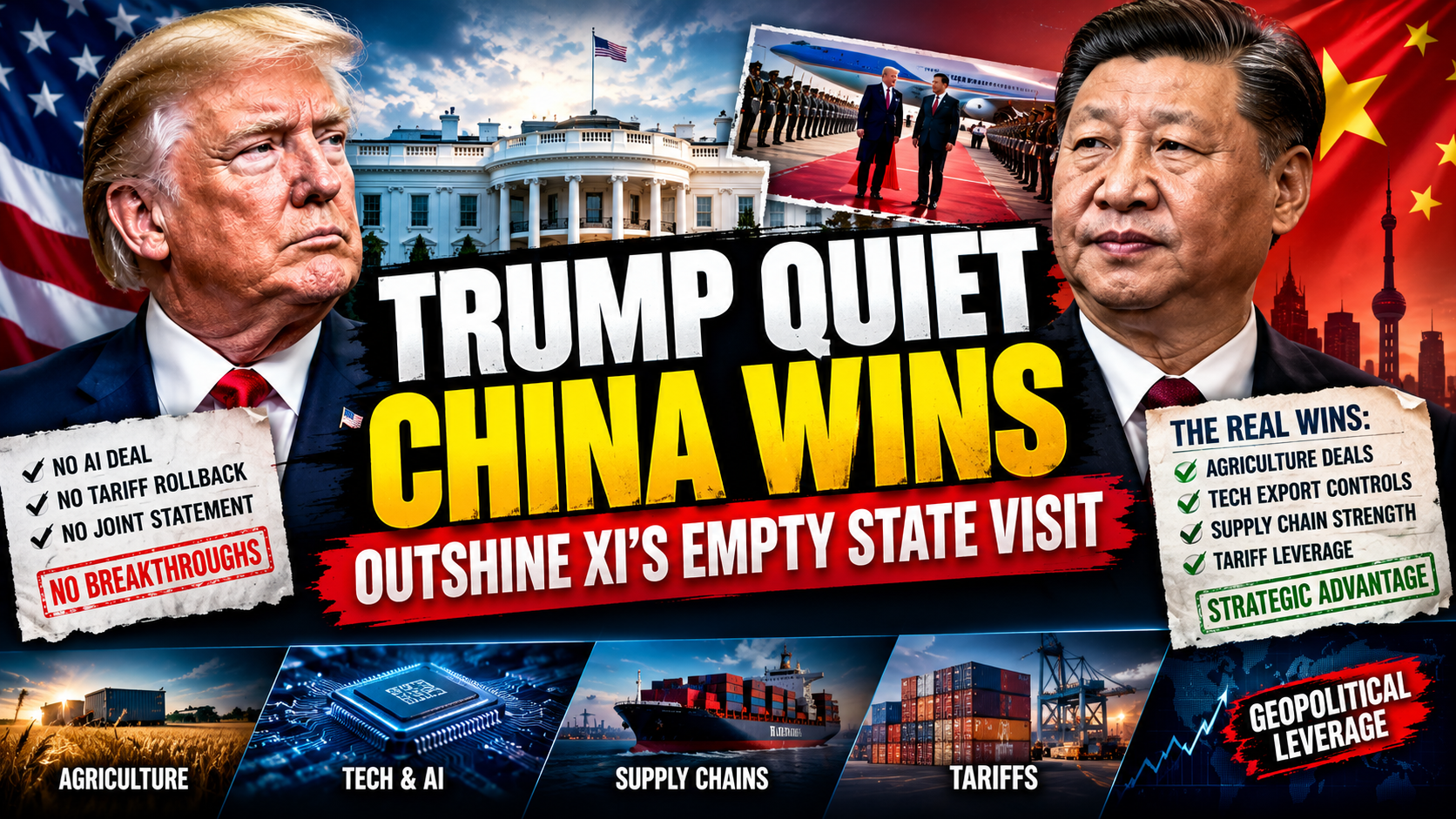
Trump Quiet China Wins Outshine Xi’s Empty State Visit
While international media fixated on the lavish red-carpet ceremonies in Washington, Trump quiet China wins behind closed doors represent the true shifting baseline of Sino-American competition. Chinese President Xi Jinping’s three-day state visit ended with impressive ceremonial pageantry—military flyovers, state dinners with Silicon Valley elites, and symbolic tours of the National Archives. Yet, beneath the diplomatic theater lay a summit conspicuously devoid of major joint communiqués, AI arms control treaties, or tariff rollbacks.
For foreign policy analysts and economic strategists, the lack of headlines out of the Washington summit is not a failure of American diplomacy; it is a feature of a calibrated, long-term leverage strategy. While Beijing sought public stability and photo opportunities to project domestic strength, Washington secured tangible structural gains through quiet, working-level mechanisms that protect core U.S. economic and security interests.
Also Read:
Clubs Seek Legal Advice Over Man City Charges Compensation After Landmark Verdict
1. The Pageantry Fallacy: Xi’s State Visit and the Limits of Symbolic Diplomacy
The September state visit was designed to deliver maximum visual impact. President Xi’s first visit to the U.S. capital in over a decade featured full military honors at Joint Base Andrews, an exclusive tea at the White House, and a black-tie state dinner attended by America’s top technology CEOs.
However, when measured by concrete policy deliverables, the summit delivered remarkably little to Beijing:
No AI Restrictions: Despite public pressure for a bilateral framework on artificial intelligence, Washington refused to sign binding pauses on advanced model development or military AI deployment, preserving the U.S. innovation lead.
No Tariff Concessions: The broad tariff structure on Chinese industrial exports remained fully intact, with Washington granting only short-term operational extensions rather than permanent rollbacks.
No Reversal on Taiwan: U.S. policy regarding defensive assistance and regional security postures in the Indo-Pacific remained firm, despite Beijing’s diplomatic lobbying.
Critics who labeled the summit “light on substance” missed the broader strategic picture. By maintaining ceremonial warmth while refusing structural concessions, Washington prevented Beijing from using the summit to unwind existing economic pressures.
2. Mapping the Strategic Divide: Optics vs. Policy Wins
The divergence between the public spectacle of the state visit and the underlying mechanics of U.S. leverage highlights two distinct diplomatic approaches.
                    [ 2026 U.S.-China Strategic Dynamics ]
                                      |
         +----------------------------+----------------------------+
         |                                                         |
         v                                                         v
[ Symbolic Public Optics ]                             [ Quiet Structural Wins ]
* Red carpet & military flyovers                       * Agricultural purchase floors enforced
* Tech CEO state dinner                                * Advanced chip export controls locked
* National Archives document tour                      * Supply chain reshoring incentives
         |                                                         |
         +----------------------------+----------------------------+
                                      |
                                      v
                [ Outcome: Washington Retains Strategic Leverage ]
3. Dissecting the Quiet Wins: Supply Chains, Energy, and Trade Mechanisms
While the cameras captured toasts in the White House Grand Foyer, institutional working groups quietly consolidated critical advantages for the U.S. economy. These incremental policy victories reflect a shift away from high-risk, single-event summitry toward sustained operational pressure.
| Strategic Domain | State Visit Optics (Public) | Quiet U.S. Strategic Win (Behind Scenes) |
| Agricultural Trade | Friendly toasts regarding American farm exports. | Firm enforcement of binding purchase floors for Midwest grain and soy exports. |
| Technology & AI | General discussion on “Super Intelligence” controls. | Zero restrictions placed on U.S. AI development; export controls on advanced chips preserved. |
| Critical Minerals | Joint statements on global market stability. | Quiet expansion of bilateral frameworks securing non-Chinese rare-earth supply chains. |
| Industrial Tariffs | Polite disagreement over trade imbalances. | Baseline tariffs preserved as perpetual leverage for future working-group negotiations. |
Agricultural Purchasing Safeguards
During private bilateral sessions, U.S. trade representatives secured commitments maintaining expanded market access and purchase volumes for American agricultural producers. Rather than trading these gains for grand diplomatic gestures, the administration anchored them into existing bilateral mechanisms, guaranteeing stable revenue streams for American farming communities.
Uncompromising Tech Defense
In the lead-up to the summit, Beijing hoped to leverage discussions on AI safety to slow down American semiconductor export restrictions. Washington held its position, keeping advanced hardware controls separate from high-level diplomatic talks and ensuring U.S. technology firms maintain their competitive edge.
4. Why Incremental Realism Beats Ceremonial Breakthroughs
In modern geopolitical rivalries, public summits rarely resolve deep structural conflicts. Great power competition between the United States and China is defined by economic endurance, technological dominance, and supply chain resilience—domains where quiet, methodical enforcement yields far greater dividends than signed pieces of paper.
By allowing President Xi to enjoy the prestige of a grand state visit, Washington satisfied Beijing’s desire for international stature and domestic stability. In exchange, the U.S. preserved its entire arsenal of economic tariffs, technological restrictions, and regional security alliances.
As President Xi’s aircraft departed Andrews Air Force Base, the fundamental balance of power remained unchanged. The administration proved that effective statecraft does not require trading away structural advantages for a ceremonial press release—confirming that quiet operational wins are infinitely more valuable than an empty state visit.
Frequently Asked Questions (FAQs)
What were the main outcomes of President Xi’s 2026 state visit to Washington?
The state visit focused primarily on personal diplomacy, symbolic events, and managing bilateral communications. While both leaders held extensive bilateral meetings, no major formal treaties or policy breakthroughs on AI or tariffs were announced.
Why are analysts describing Trump’s policy wins as “quiet wins”?
Unlike high-profile summit agreements, these wins consist of incremental, working-level policy victories—such as enforcing farm purchase floors, maintaining semiconductor export controls, and preserving tariff leverage—without making major strategic concessions to Beijing.
Did the United States agree to pause AI development during the summit?
No. Despite discussions regarding AI safety and “Super Intelligence,” the U.S. did not sign any agreements restricting American AI innovation or model development.
How did the summit impact existing U.S. tariffs on China?
Baseline U.S. tariffs on Chinese goods remained fully intact following the summit, preserving them as a key economic leverage tool for ongoing trade negotiations.
Disclaimer
This article is an analytical commentary and news synthesis based on official diplomatic briefings, public economic data, and open-source intelligence reporting. It is published strictly for educational, informational, and analytical purposes.