White-Collar Job Market Stabilization & Tech Hiring Shifts: Navigating the 2026 Economy
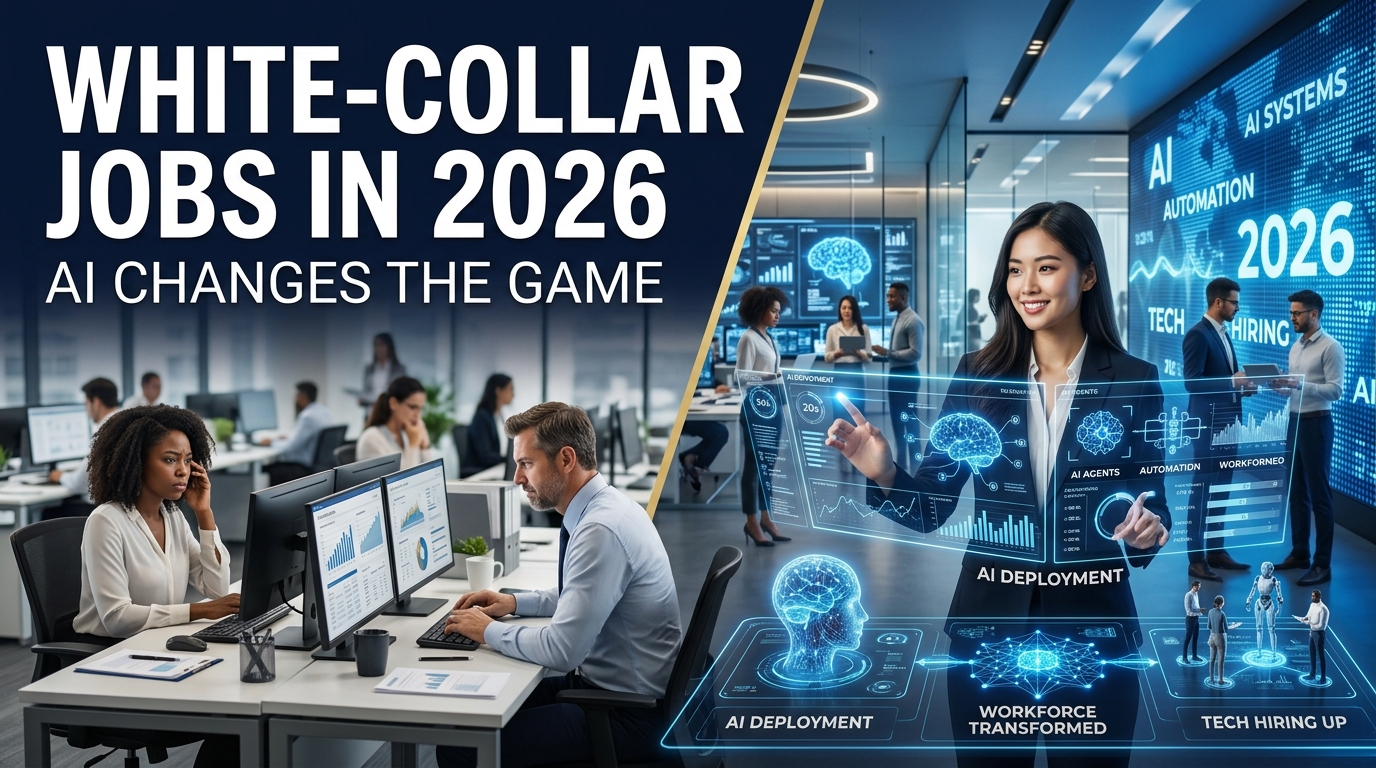
The landscape of corporate employment is undergoing its most radical transformation in decades. As we navigate through 2026, the white-collar job market is shifting away from the post-pandemic growth-at-all-costs model toward strict margin preservation, efficiency, and technological integration. While the headlines often point to widespread anxiety and corporate belt-tightening, a deeper look reveals a complex story of stabilization, structural evolution, and a heavy pivot toward AI-adjacent roles.
Also read:
U.S. Bond Yields and Stock Market Fluctuations: Impact & Analysis
This article explores the driving forces behind white-collar job market stabilization, structural shifts in tech hiring, and actionable insights for professionals looking to future-proof their careers.
1. The Anatomy of the White-Collar Slowdown
For years following the pandemic, corporate hiring surged across nearly all sectors. However, the subsequent normalization of economic growth brought a sharp correction. Data from labor economists indicates that new white-collar job postings have experienced a sustained contraction relative to historical peaks, heavily impacting segments like software development, business analysis, and market research.
Unlike blue-collar sectors—which have seen steady wage adjustments—white-collar salary growth for early-career professionals has largely plateaued. Companies are no longer aggressively expanding headcount for the sake of scale. Instead, organizations are prioritizing leaner, flatter teams that leverage modern software and automation tools to maintain high productivity with fewer resources.
2. Tech Sector Realignment and the Rise of AI Agents
The technology sector remains the epicenter of these workforce shifts. Following massive adjustments and targeted layoffs across major tech firms, hiring managers have rewritten the playbook. The emphasis has shifted from generalist engineering to specialized, high-impact capabilities.
The Agentic AI Era
A primary catalyst for this shift is the commercialization of generative and agentic AI—systems capable of executing complex multi-step workflows with limited human oversight.
Task Automation: Routine coding, preliminary data synthesis, and administrative workflows are increasingly handled by automated agents.
The Senior Premium: While entry-level technical postings have contracted, demand and compensation for senior-level professionals who possess deep strategic judgment and architectural oversight have grown significantly.
Reorganizing Work: Rather than simply cutting headcount to save money, companies are fundamentally redesigning workflows around human-AI collaboration.
3. Stabilization vs. Stagnation: Finding the Silver Lining
Despite fears of a continuous corporate downturn, economists point toward signs of structural stabilization. The “wild west” era of speculative hiring has given way to a disciplined market where efficiency rules.
Interestingly, data tracking advertised salaries in highly AI-exposed occupations shows that premium compensation is holding firm—and often pulling ahead—for those who master AI-adjacent skills. The market is not necessarily dying; it is polarizing. Professionals who bridge the gap between technical execution and high-level human judgment (such as cross-functional leadership, negotiation, and complex problem-solving) are finding ample opportunity, while those tethered strictly to repetitive, automatable tasks face compressed prospects.
Frequently Asked Questions (FAQs)
What is causing the current white-collar job market stabilization?
The stabilization is driven by a corporate shift toward margin preservation, higher interest rate environments, and the rapid adoption of AI and automation tools that allow companies to do more with fewer employees.
Are tech jobs completely disappearing?
No. While entry-level and routine coding roles have faced steep corrections, tech hiring has shifted toward specialized roles involving AI implementation, cloud infrastructure, systems architecture, and senior engineering leadership.
How is AI impacting entry-level white-collar workers?
Entry-level knowledge workers face heightened competition because many foundational tasks—such as initial drafts, basic data analysis, and entry-level programming—are prime candidates for generative AI assistance.
What skills are most resilient against automation?
Skills rooted in human judgment, complex emotional intelligence, cross-functional leadership, ethical accountability, and strategic negotiation remain difficult for AI to replicate and are heavily rewarded by modern employers.
Conclusion
The stabilization of the white-collar and tech job markets should not be viewed as a permanent economic contraction, but rather as a painful yet necessary maturation phase. As corporations integrate advanced automation and AI agents into their daily operations, human workers must evolve alongside them. By focusing on continuous upskilling, embracing technology as an augmentative tool rather than a threat, and cultivating high-level strategic capabilities, professionals can successfully navigate this new era of employment.