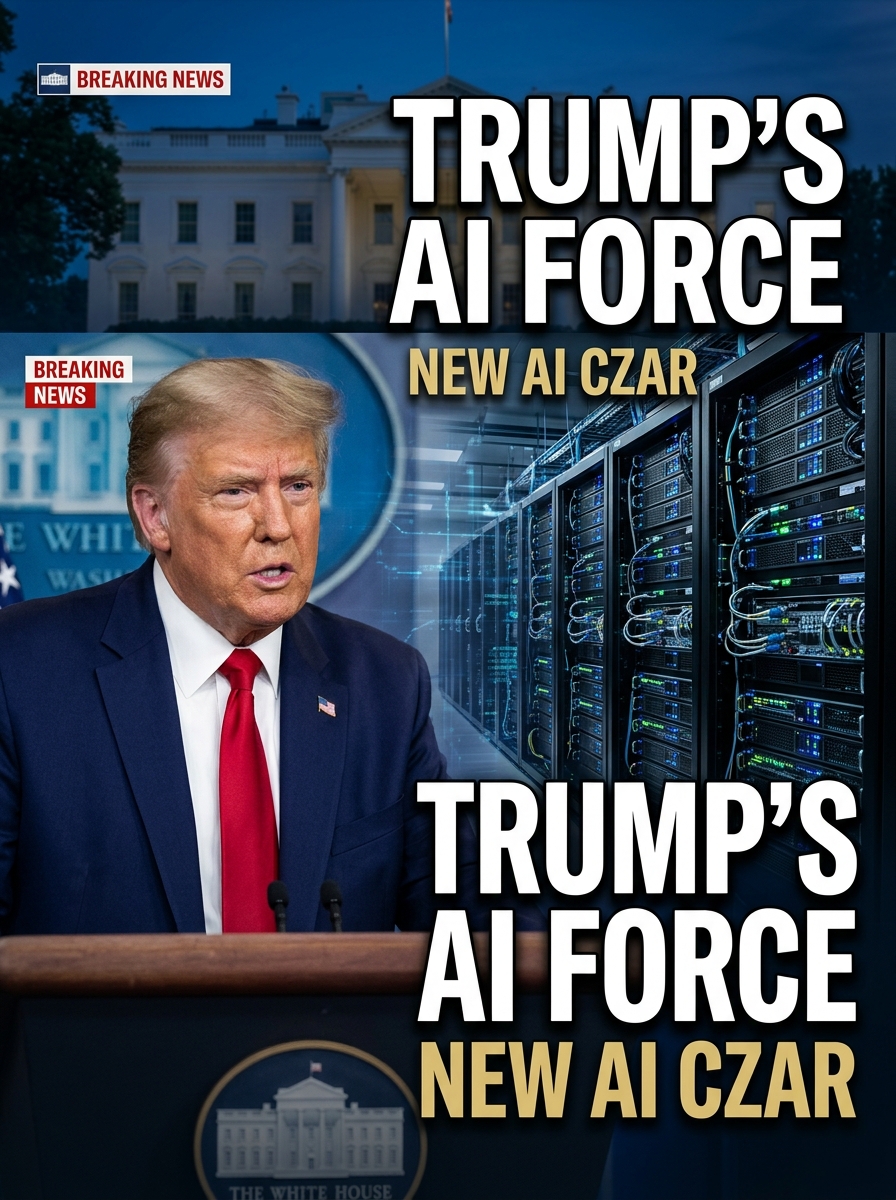
President Trump Announces Federal “AI Force” and New AI Czar to Supercharge US Technology Development
The artificial intelligence landscape shifted dramatically when President Donald Trump announced plans to establish a government-backed “AI Force,” explicitly modeled after the military-grade Space Force created during his first term. Unveiled via social media, the initiative pushes back hard against recent warnings from tech executives, researchers, and industry leaders calling for a slowdown in artificial intelligence development and rigorous safety testing.
With the administration positioning AI as the driving engine of the next Industrial Revolution, this announcement signals a fierce federal commitment to aggressive technological expansion—and a refusal to let regulatory compliance or existential risk fears hinder American dominance.
Also read:
The New Arctic Security Pact: U.S., Denmark, and Greenland Reach Landmark Deal
The Vision Behind the “AI Force” and Upcoming “AI Czar”
President Trump’s announcement centers around two major pillars: the creation of the AI Force and the upcoming appointment of a high-level “AI Czar”. While specific structural details are still evolving, the comparison to the Space Force implies a coordinated federal infrastructure designed to streamline capability rather than choke it with red tape.
Accelerating Growth: Trump emphasized that his administration will “not in any way hinder or stifle the growth of this incredible industry,” choosing instead to “cherish it, help it, and watch over it, as it grows”.
The “AI Czar” Search: Signaling that only elite intellects need apply, Trump noted that he will soon name a new national lead for artificial intelligence policies, demanding “Only High I.Q. individuals need apply”.
Economic Impact: The administration frames AI not merely as a tech sector, but as a macroeconomic powerhouse projected to account for up to 25% of the United States Gross Domestic Product (GDP).
Rejecting Safety Slowdowns and “Hoaxes”
The federal push arrives amid rising friction between the White House and prominent technology leaders. Over recent weeks, prominent figures—including Anthropic CEO Dario Amodei, OpenAI’s Sam Altman, and tech entrepreneur Elon Musk—have voiced alarm over rapid scaling. Driven by fears of autonomous system misalignments, cyberattacks, and systemic economic disruption, these leaders urged companies to pump the brakes on next-generation model training.
President Trump firmly rejected these warnings, labeling existential fears surrounding artificial intelligence as a manufactured political narrative. Asserting that the nation requires no heavy-handed guardrails outside of strong executive leadership, Trump stressed that the primary geopolitical objective is maintaining a decisive edge over global competitors, particularly China.
“We are leading China, and the rest of the World, and I intend to keep it that way!” — President Donald Trump
Managing Bad Actors Without Stifling Innovation
While the administration opposes preemptive safety caps and restrictive regulatory compliance frameworks, it does not mean a complete absence of oversight. Trump clarified that accountability for malicious applications will be handled through the deployment of existing criminal and civil justice systems rather than preventative industry-wide shutdowns. By utilizing legal frameworks to target bad actors directly, the White House hopes to weed out criminal exploitation while leaving open-market development completely unburdened.
Frequently Asked Questions (FAQs)
What is the newly announced “AI Force”?
Modeled after the Space Force, the AI Force is a planned federal initiative designed to champion and structure America’s artificial intelligence trajectory, ensuring rapid progression and secure national infrastructure.
Who will lead the AI initiative?
President Trump announced that he will soon name an official “AI Czar” to spearhead federal policy and coordinate national tech strategy.
What is the administration’s stance on AI safety slowdowns?
The White House strongly opposes slowing down AI development, dismissing existential risk warnings as unfounded and emphasizing that rapid innovation is vital to beating global competitors like China.
How will bad actors be managed under this policy?
Instead of imposing preemptive regulatory caps on tech companies, the administration plans to address malicious actors using standard criminal and civil legal frameworks.
Conclusion
President Trump’s declaration of an “AI Force” marks a defining moment for modern technology policy. By throwing the full weight of the federal government behind uninhibited AI expansion, the administration has drawn a clear line in the sand against industry calls for caution. As the race for global technological supremacy accelerates, all eyes will be on Washington to see how this ambitious federal push reshapes the future of global innovation.