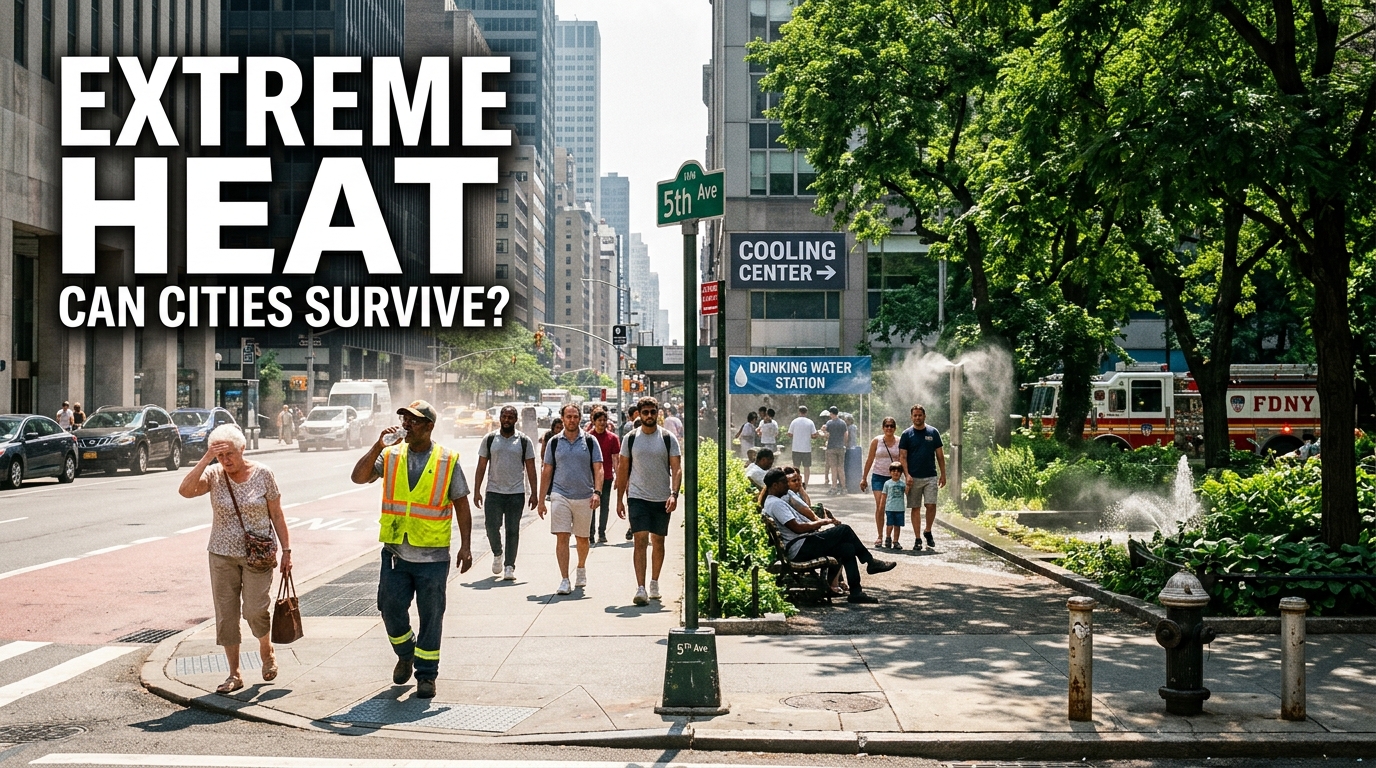
Extreme Heat Resilience and Urban Microclimate Planning
Introduction: The Escalating Urban Thermal Crisis
As global climatic shifts accelerate, extreme heatwaves have emerged as one of the most lethal and persistent threats to modern urban populations. High-density metropolitan centers are uniquely vulnerable due to the Urban Heat Island (UHI) effect, a phenomenon driven by the proliferation of dark, heat-absorbing built surfaces such as asphalt roads, concrete towers, and minimal vegetation cover (Sen & Khazanovich, 2021). Without aggressive microclimate intervention, cities face escalating public health emergencies, infrastructure strain, and soaring energy costs (EPA, 2026).
To combat this existential hazard, municipal governments are pivoting from reactive emergency measures to systemic urban redesign. Modern resilience frameworks require an integrated triad of interventions: immediate thermal relief infrastructure, high-albedo reflective materials, and robust emergency response protocols designed to protect vulnerable demographic groups.
Also read:
Tokenized Treasuries & Real-Time Assets: Institutional Blockchain Guide
Immediate Cooling Infrastructure: Blue-Green Networks
Deploying immediate cooling infrastructure is vital to lowering ambient temperatures at the pedestrian level. Municipalities are increasingly investing in blue-green infrastructure (BGI), which combines vegetation, soil, and water systems to harness natural evaporative cooling mechanisms (Data-Smart City Solutions, 2024).
Urban Forestry and Tree Canopies: Strategic planting of native, drought-tolerant shade trees directly deflects shortwave solar radiation and reduces localized temperatures by $2^\circ\text{F} – 9^\circ\text{F}$ via evapotranspiration (Data-Smart City Solutions, 2024).
Active Water Features and Misting Stations: Public plazas equipped with interactive fountains, smart water spray parks, and solar-powered misting stations provide immediate thermal relief, dropping local ambient temperatures instantly.
Green Roofs and Vertical Facades: Retrofitting commercial and residential rooftops with extensive vegetation buffers interior spaces from extreme solar loads, reducing building cooling energy expenses by 10% to 15% (Data-Smart City Solutions, 2024).
Key Insight: When urban planning prioritizes multi-layered green infrastructure in historically under-resourced neighborhoods, it simultaneously mitigates extreme heat inequities and strengthens community-level climate justice (Climate Resilience Project, 2026).
Reflective Pavements and Albedo Modification: Promises and Trade-offs
Pavements cover nearly one-third of total surface area in typical metropolitan regions. Traditional asphalt absorbs up to 95% of incoming solar radiation, storing thermal energy and re-emitting it long after sunset. To counteract this, cities are piloting advanced solar-reflective coatings and high-albedo cool pavements (Sen & Khazanovich, 2021).
Cool pavement technologies—ranging from light-colored cementitious overlays to specialized resin-based sealants—can reduce pavement surface temperatures by $10^\circ\text{F}$ to $20^\circ\text{F}$ (Data-Smart City Solutions, 2024). However, urban microclimate research highlights critical engineering trade-offs. While high-albedo surfaces successfully lower pavement temperature, studies utilizing mobile biometeorological observation platforms (such as MaRTy) indicate that reflected shortwave radiation can increase mean radiant temperatures for pedestrians during peak midday hours if not balanced with adequate shade trees (Middel et al., 2020).
Consequently, progressive city planners are adopting optimal spatial distribution models—applying reflective surfaces strategically to upstream neighborhood corridors and pairing them with dense urban canopies to maximize cooling efficiency without increasing human thermal discomfort.
Emergency Response Frameworks and Institutional Coordination
While long-term infrastructure changes alter the built environment, acute heatwave anomalies demand immediate, coordinated emergency protocols. Leading municipalities have established dedicated Chief Heat Officer (CHO) roles to unify cross-departmental operations spanning public health, emergency management, transportation, and parks (Data-Smart City Solutions, 2024).
Core Components of Modern Heat Emergency Frameworks:
Data-Driven Heat Mapping and Early Warning Systems: Utilizing high-resolution spatial sensors to identify hyper-local urban heat hotspots and trigger automated public health alerts prior to heatwave onset.
Accessible Cooling Centers and Transit Interventions: Transforming public libraries, community centers, and municipal buildings into climate-resilient cooling hubs equipped with backup power, hydration stations, and medical support.
Community Wellness Check Networks: Mobilizing local volunteers and emergency personnel to conduct direct welfare checks on elderly, isolated, and unhoused residents who face the highest risk of heat stroke and mortality.
Frequently Asked Questions (FAQs)
1. What is the Urban Heat Island (UHI) effect, and why is it dangerous?
The UHI effect occurs when cities replace natural land cover with dense concentrations of concrete, asphalt, and buildings that absorb and retain solar heat. This elevates daytime and nighttime temperatures, exacerbating heat-related illnesses, increasing cardiovascular strain, and driving up electricity demand.
2. How effective are cool pavements in lowering city temperatures?
Cool pavements utilizing high-albedo coatings can reduce surface temperatures by $10^\circ\text{F} – 20^\circ\text{F}$. However, planners must balance albedo modifications with shade structures to prevent reflected shortwave radiation from increasing pedestrian thermal discomfort during midday hours.
3. What role does a Chief Heat Officer (CHO) play in municipal government?
A CHO coordinates cross-functional strategies across emergency management, public health, and urban planning to execute both immediate heatwave responses and long-term climate adaptation initiatives.
Conclusion
Navigating the escalating threat of extreme thermal anomalies requires a decisive shift in municipal policy. By integrating immediate cooling infrastructure, scientifically optimized reflective pavements, and proactive emergency response frameworks, modern cities can transform from vulnerable heat traps into resilient, livable urban ecosystems.
References
Climate Resilience Project. (2026). Urban cooling strategies and community resilience frameworks. https://climateresilienceproject.org/strategies/urban-cooling/
Data-Smart City Solutions. (2024). Addressing extreme heat in your cities: What works and where to begin. Harvard Kennedy School. https://datasmart.hks.harvard.edu/addressing-extreme-heat-your-cities
Sen, S., & Khazanovich, L. (2021). Limited application of reflective surfaces can mitigate urban heat pollution. Nature Communications, 12, Article 3542. https://doi.org/10.1038/s41467-021-23634-7 (Cited by: 67)
US EPA. (2026). Reduce heat islands: Using green infrastructure and cool pavements. United States Environmental Protection Agency. https://www.epa.gov/green-infrastructure/reduce-heat-islands