
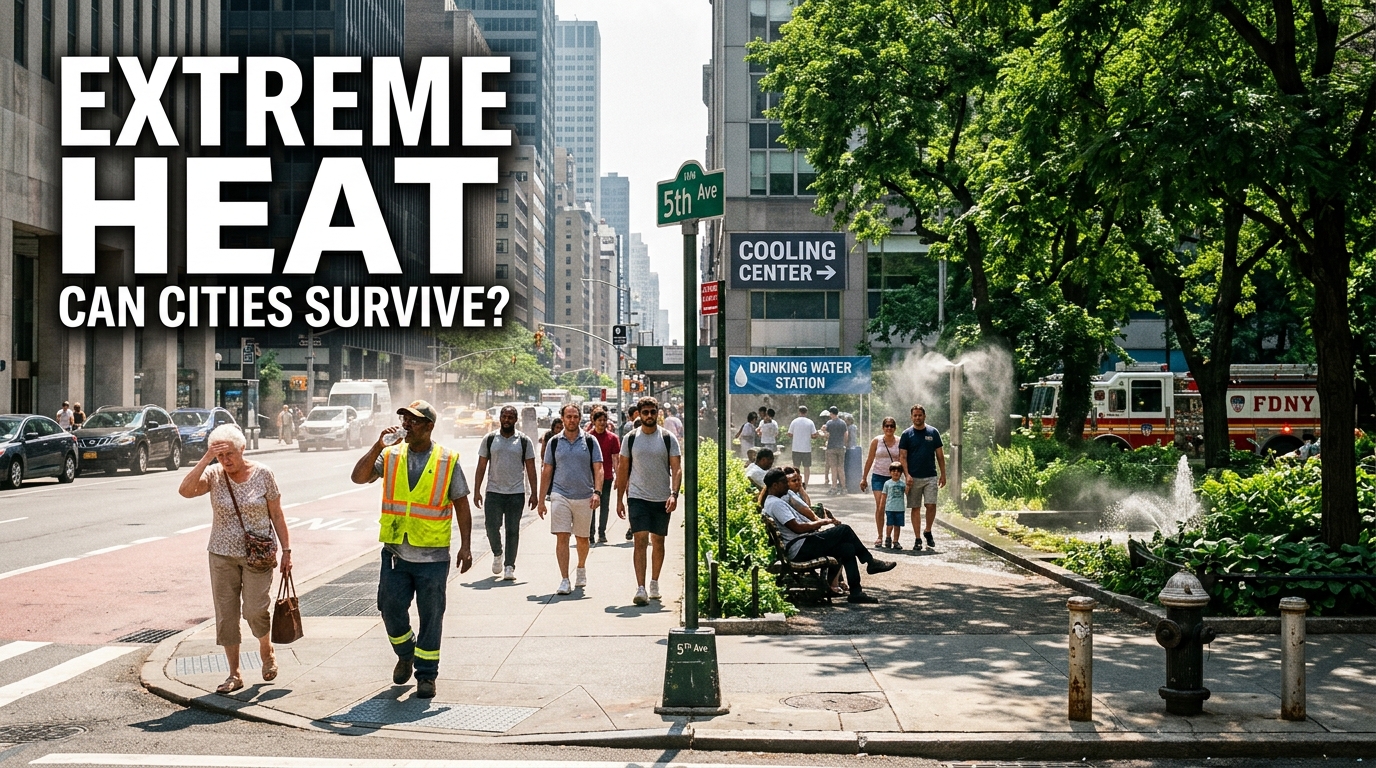
Extreme Heat Resilience and Urban Microclimate Planning
Introduction: The Escalating Urban Thermal Crisis
Extreme heatwaves have become one of the deadliest, most persistent threats facing modern urban populations. Dense cities are uniquely exposed thanks to the Urban Heat Island (UHI) effect — dark, heat-absorbing surfaces like asphalt roads and concrete towers, with barely any vegetation to break it up (Sen & Khazanovich, 2021). Do nothing serious about microclimate, and cities are looking at public health emergencies, buckling infrastructure, and energy bills that keep climbing (EPA, 2026).
The response is shifting. Municipal governments are moving past reactive emergency measures and toward systemic redesign. The modern resilience playbook rests on three things: thermal relief infrastructure that works now, high-albedo reflective materials, and emergency response protocols built to protect the most vulnerable people.
Also read:
Tokenized Treasuries & Real-Time Assets: Institutional Blockchain Guide
Immediate Cooling Infrastructure: Blue-Green Networks
Cooling the pedestrian level — that’s where immediate infrastructure matters. More and more municipalities are betting on blue-green infrastructure (BGI): vegetation, soil, and water systems combined to squeeze every drop out of natural evaporative cooling (Data-Smart City Solutions, 2024).
- Urban Forestry and Tree Canopies: Planting native, drought-tolerant shade trees in the right places deflects shortwave solar radiation directly. Through evapotranspiration, good canopy cover can cut localized temperatures by 2°F – 9°F (Data-Smart City Solutions, 2024).
- Active Water Features and Misting Stations: Public plazas with interactive fountains, smart spray parks, and solar-powered misting stations deliver thermal relief on demand — dropping local ambient temperatures fast.
- Green Roofs and Vertical Facades: Vegetation layered onto commercial and residential rooftops shields interior spaces from extreme solar loads. The payoff: building cooling energy costs fall by 10% to 15% (Data-Smart City Solutions, 2024).
Key Insight: When planners put multi-layered green infrastructure into historically under-resourced neighborhoods first, they fight extreme heat inequities and community climate injustice in the same stroke (Climate Resilience Project, 2026).
Reflective Pavements and Albedo Modification: Promises and Trade-offs
Pavements cover nearly a third of a typical metro region’s surface. Traditional asphalt absorbs up to 95% of incoming solar radiation — soaking up heat all day and radiating it back long after sunset. Cities are now piloting solar-reflective coatings and high-albedo cool pavements to fight back (Sen & Khazanovich, 2021).
The tech works, with a catch. Light-colored cementitious overlays and resin-based sealants can drop pavement surface temperatures by 10°F to 20°F (Data-Smart City Solutions, 2024). But microclimate research flags a real trade-off: high-albedo surfaces bounce shortwave radiation back up, and mobile biometeorological platforms (like MaRTy) show that can raise mean radiant temperatures for pedestrians at peak midday — unless shade trees are part of the picture (Middel et al., 2020).
So planners are getting surgical. Reflective surfaces go on upstream neighborhood corridors, paired with dense urban canopies — maximum cooling efficiency, without making pedestrians more uncomfortable.
Emergency Response Frameworks and Institutional Coordination
Infrastructure is the long game. But when a heatwave anomaly hits, cities need coordinated emergency protocols right now. Leading municipalities have created dedicated Chief Heat Officer (CHO) roles to weld public health, emergency management, transportation, and parks into one operation (Data-Smart City Solutions, 2024).
Core Components of Modern Heat Emergency Frameworks:
- Data-Driven Heat Mapping and Early Warning Systems: High-resolution spatial sensors pinpoint hyper-local heat hotspots and trigger automated public health alerts before the heatwave even arrives.
- Accessible Cooling Centers and Transit Interventions: Libraries, community centers, and municipal buildings get converted into climate-resilient cooling hubs — backup power, hydration stations, medical support on site.
- Community Wellness Check Networks: Local volunteers and emergency personnel run direct welfare checks on elderly, isolated, and unhoused residents — the people at highest risk of heat stroke and death.
Frequently Asked Questions (FAQs)
1. What is the Urban Heat Island (UHI) effect, and why is it dangerous?
Cities swap natural land cover for dense concrete, asphalt, and buildings that absorb and hold solar heat. That pushes daytime and nighttime temperatures up — more heat-related illness, more cardiovascular strain, and a surge in electricity demand. That’s the UHI effect, and it’s dangerous precisely because it never lets the city cool down.
2. How effective are cool pavements in lowering city temperatures?
Pretty effective at the surface level: high-albedo coatings can cut pavement temperatures by 10°F – 20°F. The catch is reflected radiation — planners have to pair cool pavements with shade so pedestrians don’t feel worse during midday heat.
3. What role does a Chief Heat Officer (CHO) play in municipal government?
The CHO is the coordinator. They pull emergency management, public health, and urban planning into one strategy — executing immediate heatwave responses while also driving long-term climate adaptation. One office, both time horizons.
Conclusion
Surviving the escalating heat threat means changing how cities are run. Immediate cooling infrastructure, scientifically placed reflective pavements, and proactive emergency frameworks — together, they can turn cities from vulnerable heat traps into places people can actually live through a heatwave.
References
- Climate Resilience Project. (2026). Urban cooling strategies and community resilience frameworks. https://climateresilienceproject.org/strategies/urban-cooling/
- Data-Smart City Solutions. (2024). Addressing extreme heat in your cities: What works and where to begin. Harvard Kennedy School. https://datasmart.hks.harvard.edu/addressing-extreme-heat-your-cities
- Sen, S., & Khazanovich, L. (2021). Limited application of reflective surfaces can mitigate urban heat pollution. Nature Communications, 12, Article 3542. https://doi.org/10.1038/s41467-021-23634-7 (Cited by: 67)
- US EPA. (2026). Reduce heat islands: Using green infrastructure and cool pavements. United States Environmental Protection Agency. https://www.epa.gov/green-infrastructure/reduce-heat-islands
1 thought on “Extreme Heat Resilience and Urban Microclimate Planning: Cooling Cities for the Future”