
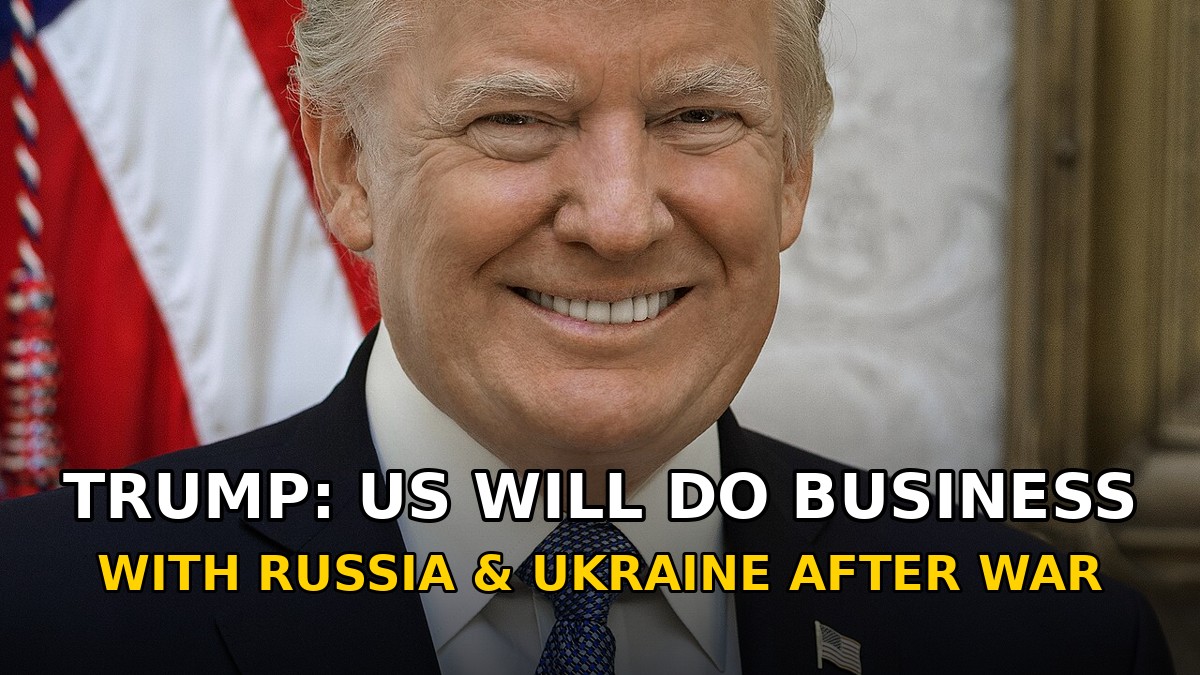
Trump Ukraine Russia business after war: Donald Trump says the United States will be ready to do business with both Russia and Ukraine once their war ends — a remark that lands just days before a ceasefire his wife says is due to begin, and ten days before Americans vote in the midterm elections.
Speaking to reporters in Palm Beach, Florida, after casting his vote alongside First Lady Melania Trump, the president framed a peace deal not just as an end to fighting, but as a return to normal commerce.
“We’d like to get back to life where Russia and Ukraine make a deal, and then we’d be able to do business with both. We’ll do business with Ukraine and with Russia after this war ends, I would think,” Trump said.
It was a short answer, but it carried a large implication. Trade and investment with Russia have been heavily restricted under years of Western sanctions imposed since Moscow’s full-scale invasion of Ukraine.
Any move back toward doing business with Moscow would mark a sharp break with that sanctions regime — and Trump offered no timetable, conditions or details for how it would happen.
Summary: Trump Ukraine Russia business after war
Contents:
- Summary: Trump Ukraine Russia business after war
- What Trump actually promised — and what he didn’t
- Melania Trump and the October 27 ceasefire claim
- Why the timing matters
- What to watch next
- Trump Ukraine Russia business after war in context
- Trump Ukraine Russia business after war: questions answered
In short, Trump Ukraine Russia business after war is presented in this report as conditional: Trump said the United States would do business with Ukraine and with Russia after this war ends, after a deal, and he offered no timetable, conditions or details.
The report’s central point on Trump Ukraine Russia business after war is that the promise concerns a post-war order, not a resumption of business with Russia now, while the war continues. It also notes Melania Trump’s claim of a ceasefire starting on October 27, the November 3 midterm elections, and three things to watch: whether any ceasefire holds, whether details of any agreements are published, and what “doing business” would mean in practice.
What Trump actually promised — and what he didn’t
Trump’s comment was conditional, and that condition matters. He did not say the United States would resume business with Russia now, while the war continues. He said it would happen after the war ends, after a deal.
That is the core of Trump Ukraine Russia business after war as described here: it would happen after the war ends, after a deal.
That distinction is the whole story. Washington already does extensive business with Ukraine, including military and economic support, and has kept channels open with Kyiv throughout the war.
Russia is the other side of the equation for Trump Ukraine Russia business after war: sanctions, export controls and the political cost of dealing with Moscow have kept American companies largely out.
By putting both countries in the same sentence, Trump was signalling what a post-war order could look like from his perspective — one in which the United States is a commercial partner to both former combatants, rather than a country still policing the peace through sanctions alone. In other words, Trump Ukraine Russia business after war is framed here as a commercial partnership after a deal.
Whether that vision for Trump Ukraine Russia business after war is realistic is another question. A peace deal would still have to settle territory, security guarantees, sanctions relief and reconstruction, none of which Trump addressed in these remarks.
Melania Trump and the October 27 ceasefire claim
The First Lady used the same appearance to talk up diplomatic efforts behind the scenes, pointing to support from the Vatican and a ceasefire she said is about to begin. That claim is separate from Trump Ukraine Russia business after war, which concerns what would happen after a deal.
“It is great to have Pope’s support and they (Russia and Ukraine) are starting ceasefire on the October 27th and I hope everything goes as it’s planned. We have talked with both (President Putin and President Zelenskyy); we signed agreements,” Melania Trump said.
Her claim deserves careful handling. A local ceasefire in the Russian-held town of Oleshky has separately been reported as starting around this period, and the White House has credited the First Lady with a back-channel role.
But a local or limited ceasefire is not the same as a full, nationwide end to the war, and readers should not take the October 27 date as a confirmed, comprehensive peace.
Trump himself praised her role in glowing terms. “I think she’s doing better than the professionals right now,” he said.
That line will draw attention — and criticism. Supporters will read it as a president crediting unconventional diplomacy.
Critics will ask why, if agreements have been signed, the details have not been made public, and what exactly has been agreed with Presidents Vladimir Putin and Volodymyr Zelenskyy.
Why the timing matters
The remarks came as Trump voted in Palm Beach, with the November 3 midterm elections just days away. The timing also frames Trump Ukraine Russia business after war as a campaign-period message.
The midterms will decide control of the House and a third of the Senate, and the president has spent the closing stretch of the campaign tying foreign policy to his domestic message.
That context helps explain the second half of his appearance, in which he turned sharply to domestic politics and attacked Democrats, accusing them of widespread corruption.
“Democrats are very corrupt. To me, corruption is one of the biggest things. If you look at Minnesota, if you look at Los Angeles, if you look at New York, the corruption is rampant and to me, corruption is a very big factor,” Trump said.
He also repeated claims about voting irregularities, saying: “They found a lot of discrepancies — bad ones, big ones. In Los Angeles, as you know, they have 20,000 votes, and it could be as high as a million votes… The U.S. Attorney found, potentially, hundreds of thousands of illicit votes.”
Those are Trump’s claims, and they should be reported as such. No evidence was presented during the appearance to support the figures he cited.
Election officials have previously disputed similar broad claims about large-scale illicit voting.
What to watch next
Three things will tell us whether Trump Ukraine Russia business after war was campaign rhetoric or the start of a real shift:
First, whether any ceasefire actually holds from October 27, and whether it extends beyond a local area to a broader halt in fighting.
Second, whether the White House publishes any detail of the agreements Melania Trump referred to.
And third, whether Trump or his administration spells out what “doing business” would mean in practice — sanctions relief, energy deals, reconstruction contracts, or something else entirely.
Until then, the headline is what Trump said, not what has been agreed: after the war, in his view, America will do business with both sides. The war itself, for now, is not over.
That is where Trump Ukraine Russia business after war stands for now: a promise tied to a deal, not an agreement already in force.
Trump Ukraine Russia business after war in context
Put together, the report tells a clear story. Trump Ukraine Russia business after war is not described as a deal already signed, or as trade resuming today. It is described as what Trump said would follow a deal, once the war ends.
That conditional wording runs through the whole report on Trump Ukraine Russia business after war. The promise is tied to a deal, and to the war ending. It is not tied to a date, a timetable, or a set of conditions, because Trump offered none of those in the remarks reported here.
The starting point is the vote in Palm Beach, Florida. Trump spoke after casting his vote alongside First Lady Melania Trump. He framed a peace deal not just as an end to fighting, but as a return to normal commerce, and he put both Russia and Ukraine in the same sentence.
His own words, quoted earlier in this report, are the anchor for the whole discussion. He said he would like to get back to life where Russia and Ukraine make a deal, and then the United States would be able to do business with both. He added that the United States would do business with Ukraine and with Russia after this war ends, as he put it.
That is why the sanctions background matters for Trump Ukraine Russia business after war. Trade and investment with Russia have been heavily restricted under years of Western sanctions imposed since Moscow’s full-scale invasion of Ukraine. Any move back toward doing business with Moscow would therefore mark a sharp break with that sanctions regime.
The contrast with Ukraine is also part of the picture. Washington already does extensive business with Ukraine, including military and economic support, and has kept channels open with Kyiv throughout the war. For Russia, sanctions, export controls and the political cost of dealing with Moscow have kept American companies largely out.
A peace deal, if one were reached, would still have to settle major questions. The report lists territory, security guarantees, sanctions relief and reconstruction among them. None of those questions was addressed in the remarks reported here, and that gap is why Trump Ukraine Russia business after war remains, for now, a statement of intent rather than a plan.
Melania Trump’s remarks form a second thread in the report. She pointed to support from the Vatican and a ceasefire she said is about to begin, and she said Russia and Ukraine are starting a ceasefire on October 27. She also said she had talked with Presidents Putin and Zelenskyy, and that agreements had been signed.
Readers are asked to handle that claim with care. A local ceasefire in the Russian-held town of Oleshky has separately been reported as starting around this period, and the White House has credited the First Lady with a back-channel role. But a local or limited ceasefire is not the same as a full, nationwide end to the war.
Trump’s praise for his wife is also recorded in the report. He said he thought she was doing better than the professionals right now. Supporters, the report notes, will read that as credit for unconventional diplomacy, while critics will ask why, if agreements have been signed, their details have not been made public.
The timing thread for Trump Ukraine Russia business after war is the November 3 midterm elections. Trump voted in Palm Beach with those elections just days away, and the midterms will decide control of the House and a third of the Senate. The president has spent the closing stretch of the campaign tying foreign policy to his domestic message.
That domestic turn is also part of the report, and it is reported as Trump’s claims. He attacked Democrats, accusing them of widespread corruption, and he pointed to Minnesota, Los Angeles and New York. He also repeated claims about voting irregularities, including figures for Los Angeles and a claim about illicit votes found by the U.S. Attorney.
No evidence was presented during the appearance to support the figures he cited, and election officials have previously disputed similar broad claims about large-scale illicit voting. That context matters, because it separates what Trump claimed from what has been established.
Finally, the report sets out three things to watch for Trump Ukraine Russia business after war. First, whether any ceasefire actually holds from October 27, and whether it extends beyond a local area to a broader halt in fighting.
Second, whether the White House publishes any detail of the agreements Melania Trump referred to. Third, whether Trump or his administration spells out what “doing business” would mean in practice, whether that means sanctions relief, energy deals, reconstruction contracts, or something else entirely.
Until then, the headline remains what Trump said, not what has been agreed. After the war, in his view, America will do business with both sides. The war itself, for now, is not over, and Trump Ukraine Russia business after war remains a promise tied to a deal.
Trump Ukraine Russia business after war: questions answered
What did Trump say about Trump Ukraine Russia business after war?
Trump said the United States would do business with Ukraine and with Russia after this war ends. In his words, reported above: “We’d like to get back to life where Russia and Ukraine make a deal, and then we’d be able to do business with both. We’ll do business with Ukraine and with Russia after this war ends, I would think.”
Speaking in Palm Beach after casting his vote alongside First Lady Melania Trump, he framed a peace deal not just as an end to fighting, but as a return to normal commerce.
Does Trump Ukraine Russia business after war mean business with Russia now?
No, on the account given in this report. Trump’s comment was conditional, and that condition matters. He did not say the United States would resume business with Russia now, while the war continues. He said it would happen after the war ends, after a deal.
Washington already does extensive business with Ukraine, including military and economic support, and has kept channels open with Kyiv throughout the war. For Russia, sanctions, export controls and the political cost of dealing with Moscow have kept American companies largely out, and Trump offered no timetable, conditions or details.
What did Melania Trump claim, and how should it be read?
Melania Trump pointed to support from the Vatican and a ceasefire she said is about to begin, saying that Russia and Ukraine are starting a ceasefire on October 27, that she hopes everything goes as planned, and that she had talked with Presidents Putin and Zelenskyy and signed agreements.
Her claim deserves careful handling, as set out above: a local ceasefire in the Russian-held town of Oleshky has separately been reported as starting around this period, and the White House has credited the First Lady with a back-channel role. But a local or limited ceasefire is not the same as a full, nationwide end to the war, and readers should not take the October 27 date as a confirmed, comprehensive peace.
Why does the timing matter for Trump Ukraine Russia business after war?
The remarks came as Trump voted in Palm Beach, with the November 3 midterm elections just days away. The midterms will decide control of the House and a third of the Senate, and the president has spent the closing stretch of the campaign tying foreign policy to his domestic message.
That context helps explain the second half of his appearance, in which he turned sharply to domestic politics and attacked Democrats, accusing them of widespread corruption, and repeated claims about voting irregularities. Those are Trump’s claims, and they should be reported as such: no evidence was presented during the appearance to support the figures he cited, and election officials have previously disputed similar broad claims about large-scale illicit voting.
What should readers watch next for Trump Ukraine Russia business after war?
Three things, as set out above, will tell us whether this was campaign rhetoric or the start of a real shift. First, whether any ceasefire actually holds from October 27, and whether it extends beyond a local area to a broader halt in fighting.
Second, whether the White House publishes any detail of the agreements Melania Trump referred to. And third, whether Trump or his administration spells out what “doing business” would mean in practice — sanctions relief, energy deals, reconstruction contracts, or something else entirely.
Until then, the headline is what Trump said, not what has been agreed: after the war, in his view, America will do business with both sides, and the war itself, for now, is not over.