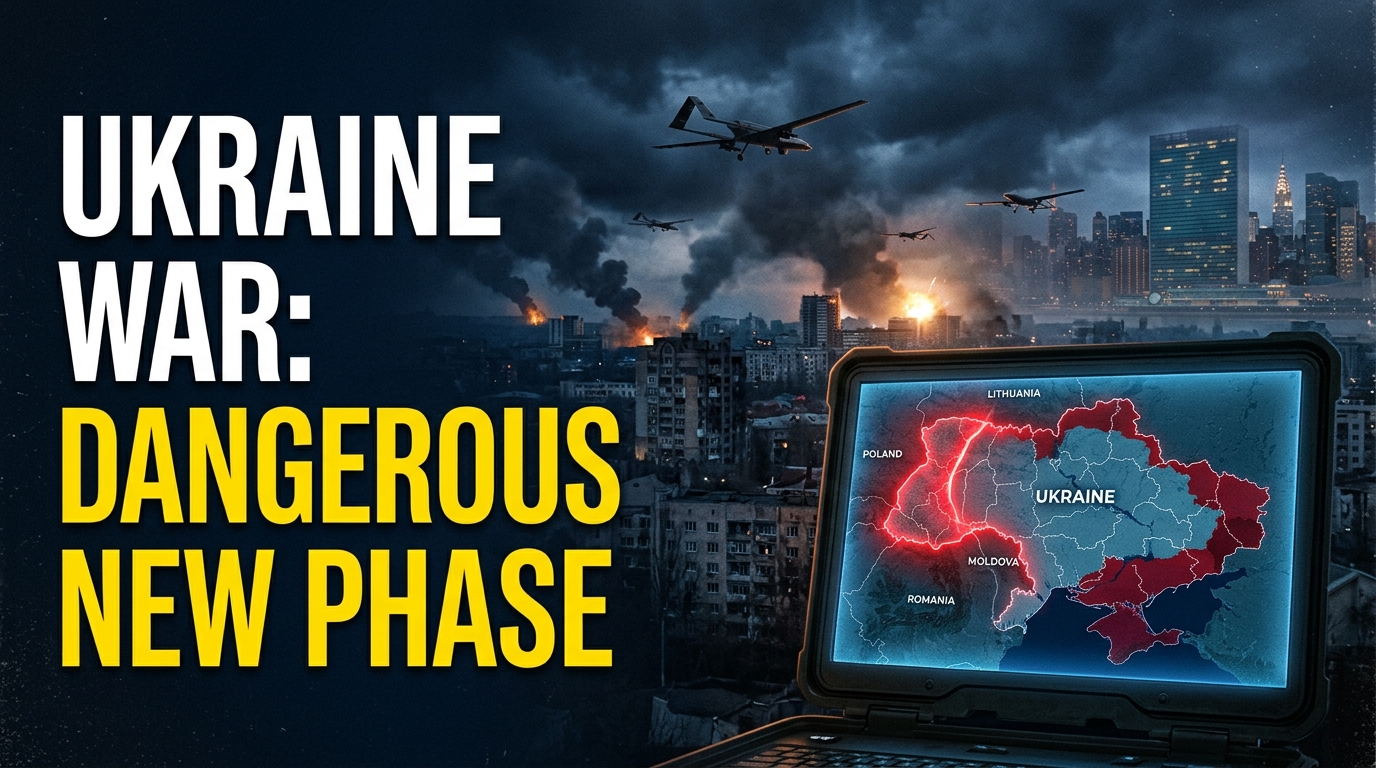
Ukraine War Dangerous New Phase: Global Warnings at the 2026 UN General Assembly
The international community is on high alert as the Ukraine war dangerous new phase dominates discussions at the United Nations General Assembly in September 2026. The ongoing conflict has taken center stage in New York, casting a long, somber shadow over the diplomatic proceedings. The atmosphere is undeniably tense, marked by stark, urgent warnings from high-ranking UN officials who emphasize that the crisis is rapidly evolving. This alarming assessment comes in the wake of intensifying cross-border attacks, mounting civilian casualties, and growing, tangible fears of regional spillover that threaten to pull neighboring nations into the fray.
Also read:
Ed Sheeran Gillette Stadium Cancelled: Weather & Tour Drama
Escalating Violence and Rising Casualties
Navigating this Ukraine war dangerous new phase requires understanding the sheer scale of the recent violence. The human cost of the war has reached staggering new heights. The UN Under-Secretary-General for Political and Peacebuilding Affairs, Rosemary DiCarlo, delivered a sobering report to the Security Council, highlighting a grim statistic: in the first eight months of 2026 alone, more civilians were killed or injured in Ukraine than during the entirety of 2025. This represents a deeply troubling trend of escalating violence that shows no signs of abating. Since February 2022, the confirmed civilian toll stands at over 17,000 killed and over 53,000 injured—a number that UN monitors readily admit is likely a significant undercount.
The conflict is no longer confined to the traditional front lines in the east and south of the country. The recent wave of attacks has seen highly advanced, long-range drones striking critical targets deep within both Ukraine and the Russian Federation, bringing the harsh reality of the war to areas previously considered relatively safe from daily bombardment. Civilian casualties resulting from Ukrainian attacks inside Russia have also seen an increase, complicating the diplomatic narrative. The sheer scale, reach, and frequency of these drone strikes are unprecedented in this conflict, prompting DiCarlo to explicitly state to the assembly that these attacks “are unacceptable and must stop immediately.”
The Threat of Regional Spillover
Perhaps the most alarming development discussed at the UNGA—and a defining characteristic of the Ukraine war dangerous new phase—is the sharply increasing risk of the war spilling over into neighboring sovereign countries. Cross-border drone incursions have become worryingly frequent, triggering air defense sirens in nations entirely outside the conflict zone. There have been multiple documented incidents involving drones breaching or approaching the airspace and border regions of Moldova, Poland, Lithuania, and Romania. These incidents underscore the extreme fragility of the current geopolitical situation and the very real potential for the conflict to broaden into a wider regional crisis that could invoke mutual defense treaties.
Furthermore, military activity in and around nuclear facilities in both Ukraine and Russia remains a source of grave, existential concern for the UN Security Council. The potential for a catastrophic nuclear incident—whether due to a tactical miscalculation, a failure of command and control, or an errant strike hitting a reactor cooling system—hangs heavily over the entire European continent.
A Looming Winter Humanitarian Crisis
As winter rapidly approaches, the situation for millions of Ukrainians looks increasingly desperate. The continuous, methodical attacks on Ukraine’s energy infrastructure have severely degraded the country’s capacity to provide baseline power, heat, and clean water to its citizens. The UN has starkly warned that the cumulative impact of these infrastructure strikes could “plunge millions of people into darkness and cold in the coming months.” This looming humanitarian disaster adds another layer of profound urgency to the international calls for an immediate cessation of hostilities.
The intentional targeting of civilian energy infrastructure, especially with the harsh Eastern European winter approaching, is viewed by many in the international community as a deliberate attempt to weaponize the cold and inflict mass suffering on non-combatants. Human rights organizations at the assembly have echoed these concerns, calling for immediate protective measures for civilian utilities.
Diplomatic Impasse and Conflicting Demands
Despite the urgent, impassioned calls for peace from UN leadership and a vast majority of member states, a viable diplomatic breakthrough remains entirely elusive. The core positions of the warring parties, as articulated from the podium at the UNGA, remain sharply polarized and seemingly irreconcilable at this juncture.
The Russian Federation, represented by Foreign Minister Sergey Lavrov, indicated a theoretical willingness to negotiate a “lasting and just peace” but firmly stipulated that there would be absolutely no pause in their ongoing military operations during any prospective talks. Russia continues to cite the protection of Russian speakers in the Donbas and broader NATO security concerns as its primary justifications for the continuation of its military actions.
Ukraine, conversely, demands an immediate, unconditional end to the conflict and a complete, verifiable withdrawal of all Russian military forces from its internationally recognized territory. Ukrainian Foreign Minister Andrii Sybiha passionately emphasized that Ukraine is ready to stop the war immediately but highlighted the dire global consequences of the ongoing conflict, stating unequivocally that it is “everyone’s war” due to its far-reaching economic and security repercussions. The Ukrainian delegation utilized their time to underscore the war’s severe impact beyond its borders, noting that the international community must apply vastly greater economic and diplomatic pressure on Moscow to force a full and unconditional ceasefire.
In a show of solidarity, fifty-one UN member states issued a joint statement ahead of the Security Council meeting, formally demanding that Russia agree to an immediate, full, and unconditional ceasefire and engage in meaningful, mediated negotiations. However, as has been the case since 2022, translating these unified diplomatic calls into tangible, verifiable action on the ground has proven exceedingly difficult.
The Broader Global Impact
The 2026 UN General Assembly serves as a stark, unavoidable reminder that the war in Ukraine is not merely a localized territorial dispute, but a profound global crisis. The war has massively disrupted global food supply chains, destabilized energy markets, exacerbated inflation in developing nations, and severely strained international relations across multiple continents. The gathering in New York, attended by numerous world leaders, reflects the deep, sometimes bitter divisions within the international community regarding how best to manage and resolve the conflict.
The discussions at the UNGA highlight the desperate need for a fundamentally new diplomatic paradigm to end the war. As the conflict officially enters this dangerous period, the stakes for global stability have never been higher. The continued, tragic loss of life, the systematic devastation of vital civilian infrastructure, and the growing risk of a wider regional conflict demand immediate, unified, and forceful action from the global community before the crisis spirals entirely out of control.
FAQs
Q: Why are officials calling this the Ukraine war dangerous new phase?
A: UN officials, including Under-Secretary-General Rosemary DiCarlo, are using this terminology due to the dramatic spike in civilian casualties in 2026, the unprecedented scale and reach of drone attacks deep into both Ukraine and Russia, escalating cross-border incidents threatening NATO and neighboring countries, and the systematic targeting of energy grids ahead of winter.
Q: Are neighboring countries actively affected by the conflict?
A: Yes. The UN has reported a troubling increase in cross-border drone incursions that are affecting or actively approaching the sovereign airspace of neighboring states, specifically including Moldova, Poland, Lithuania, and Romania, raising serious regional security alarms.
Q: What is the most immediate humanitarian concern for Ukraine right now?
A: The primary concern is the severe, methodical damage inflicted upon Ukraine’s energy infrastructure by ongoing strikes. The UN warns this deliberate destruction could leave millions of civilians completely without heat, electricity, and running water during the freezing winter months.
Q: What are Ukraine’s primary demands at the 2026 UNGA?
A: Ukraine is demanding a full, immediate, and unconditional ceasefire, a significant increase in international sanctions and pressure on Russia, and the complete withdrawal of Russian military forces from all occupied Ukrainian territories.
Q: Is the United Nations united in its response to the crisis?
A: While there is widespread, majority condemnation of the invasion and nearly universal calls for peace, the international body remains functionally divided on enforcement and strategy. However, a coalition of 51 member states successfully issued a unified joint statement demanding an immediate ceasefire.
Official United Nations Sources:
UN Meetings Coverage and Press Releases:
“Ukraine War Entering ‘Dangerous New Phase’ as Attacks Intensify, Risk of Regional Spillover Grows, Political Affairs Chief Warns Security Council”
UN Department of Political and Peacebuilding Affairs (DPPA):
“USG DiCarlo’s remarks to the Security Council on Ukraine [as delivered]” (Full transcript of Rosemary DiCarlo’s September 23, 2026 speech)
UN OCHA ReliefWeb:
“USG DiCarlo’s remarks to the Security Council on Ukraine”
Trusted News Reports:
Censor.net (Ukraine News):
“Risk of war spreading beyond Ukraine is growing – UN Under-Secretary-General”
https://censor.net/en/news/4024936/un-warns-of-growing-risk-of-war-spreading-beyond-ukraine
Xinhua (English News):
“UN official calls for efforts toward immediate ceasefire in Ukraine”
https://english.news.cn/20260924/01ecc012a5a14d9a8b3d8dae071afc1a/c.html
Conclusion
The 2026 UN General Assembly has shone a harsh, unforgiving light on the escalating severity of the conflict in Eastern Europe. Acknowledging the Ukraine war dangerous new phase is a sobering but necessary assessment of a reality characterized by soaring civilian casualties, the ruthless destruction of critical infrastructure, and the ever-growing threat of the war spilling over its current borders into neighboring nations. As the bitter winter approaches, the humanitarian crisis threatens to reach unprecedented levels of civilian suffering. The starkly contrasting, deeply entrenched positions of Russia and Ukraine, despite widespread international demands for an immediate ceasefire, underscore the immense, complex challenges facing any potential diplomatic resolution. The international community faces an urgent, historic imperative to forge a path toward meaningful de-escalation and a lasting, just peace before the regional and global consequences become irrevocably catastrophic.