
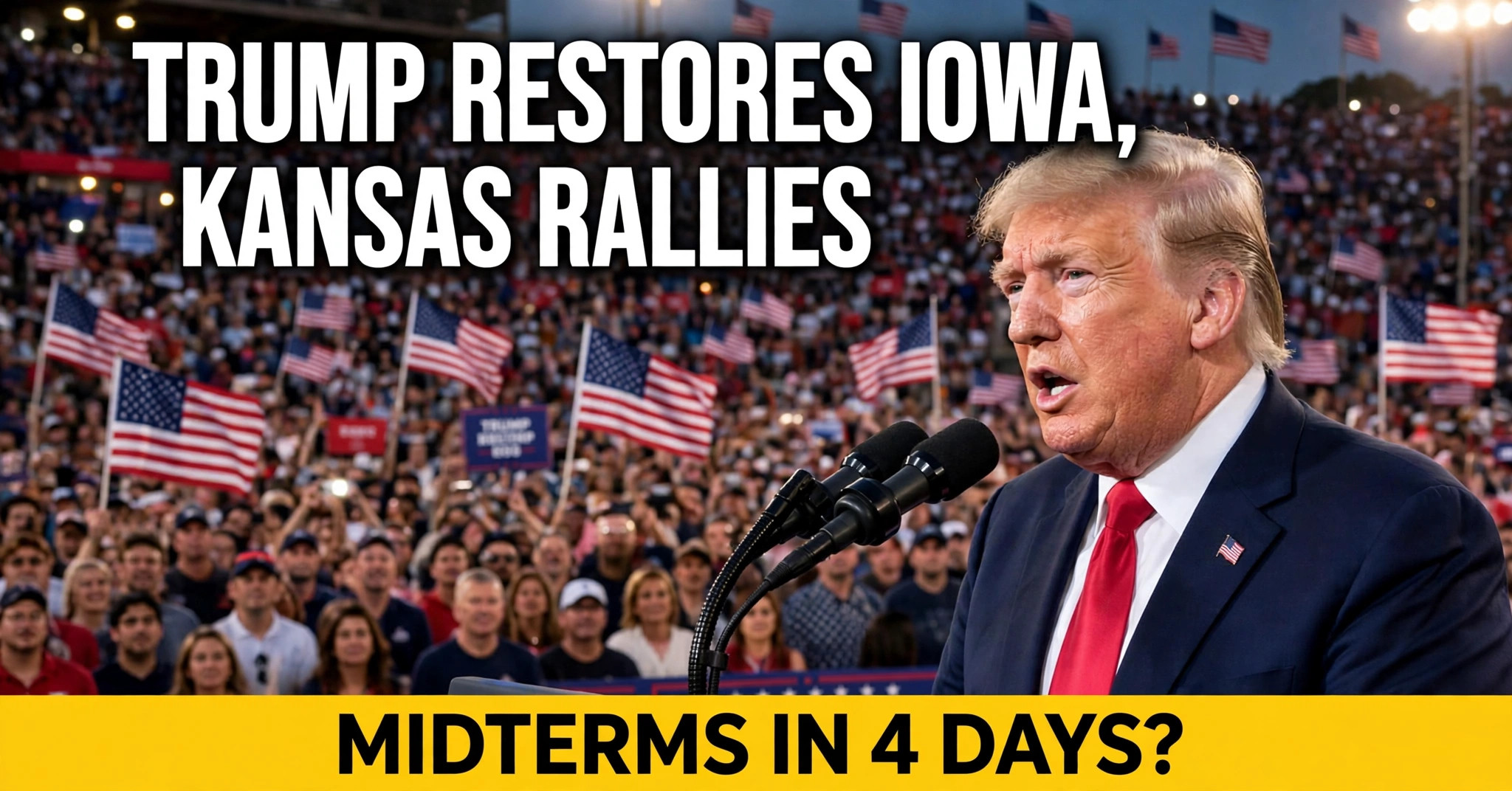
President Donald Trump has put his weekend campaign rallies in Iowa and Kansas back on the schedule, reversing a decision to scrap the in-person events just a day earlier. The Trump Iowa Kansas rallies will now both take place on Sunday, only two days before voters head to the polls for the midterm elections on Tuesday, 3 November.
The about-turn caps a chaotic 48 hours for the White House’s closing campaign push. On Thursday, 29 October, Trump’s team announced that the president would no longer travel to Salina, Kansas, on Saturday or Dubuque, Iowa, on Sunday, replacing the arena-style gatherings with a series of virtual “tele-rallies” instead. The cancellation drew sharp coverage across cable news and political media, and by Friday the president had fumed at the reporting before ordering the events put back on the calendar, according to CNN.
Under the revised plan, both of the Trump Iowa Kansas rallies will be held on Sunday, giving the president a double-header in the Midwest on the final weekend of the campaign. The rallies are expected to draw thousands of supporters in two states where Republicans are fighting to hold or flip key seats.
Why the Trump Iowa Kansas Rallies Were Cancelled
The original decision to cancel caught even some Republican operatives off guard. Trump had been scheduled to appear in Salina, a city of around 46,000 people in central Kansas, on Saturday afternoon, followed by an evening rally in Dubuque, the Mississippi River city in eastern Iowa, on Sunday.
White House officials initially framed the switch to tele-rallies as a strategic choice, arguing that virtual events would let the president reach voters in more states in the campaign’s final days. Critics, though, read it differently. With early voting already shattering records — more than 46 million ballots had been cast by Friday — some commentators suggested the campaign was scaling back because crowds had thinned or because internal polling looked shaky.
That coverage appears to have stung. CNN reported that Trump “fumed at coverage of rally cancellations before ordering the events back on,” a detail that fits a long pattern: the president has always treated rally crowd size and energy as a personal barometer of political strength, and he has rarely tolerated the suggestion that his drawing power is fading.
What the Reversal Tells Us About the Final Weekend
Restoring the Trump Iowa Kansas rallies signals that the White House wants maximum visibility in the campaign’s closing stretch. Iowa and Kansas may not be the most competitive states on the map — Trump carried both comfortably in 2024 — but the rallies serve a dual purpose. They energise the base in reliably Republican territory, and the television coverage beams the president’s closing message into neighbouring battlegrounds.
Dubuque sits in Iowa’s 1st congressional district, where Republicans are defending a seat Democrats have targeted. Eastern Iowa has swung hard to the right over the past decade, but Democrats believe a combination of high turnout and ticket-splitting could put the seat in play. A presidential visit two days before Election Day is the clearest sign the GOP is taking no chances.
Kansas tells a similar story. Salina lies in the state’s 1st district, a Republican stronghold, but the rally’s real audience extends beyond the arena. Kansas will decide a competitive governor’s race and several House contests, and a Trump appearance in the state dominates local news coverage for days.
The Tele-Rally Experiment
The brief flirtation with tele-rallies was itself revealing. The format — essentially a large conference call where the president speaks and supporters listen in — was used occasionally during the 2020 campaign when the pandemic limited travel. Campaign aides argued this week that tele-rallies are efficient, letting Trump address voters in a dozen states without leaving Washington.
But the format has obvious drawbacks. It generates no pictures of packed arenas, no local news coverage of Air Force One on the tarmac, and none of the electric atmosphere that has defined Trump’s political brand since 2015. For a president who has always governed as much through spectacle as through policy, the trade-off was never likely to last.
By restoring the Trump Iowa Kansas rallies, the White House has effectively conceded that in the final weekend, there is no substitute for the real thing. The images from Salina and Dubuque — flags, hats, chanting crowds — will lead Sunday evening news bulletins and set the tone for Monday’s final push.
How the Midterms Are Shaping Up
The rally drama is unfolding against a remarkable early-voting surge. More than 46 million Americans had already cast ballots by 30 October, surpassing the entire early-vote total from the 2022 midterms. Texas alone has seen over 6.3 million early votes, up 50 per cent on the same point in 2022, while Florida and North Carolina are also running well ahead of past cycles.
High early turnout cuts both ways. Republicans point to the numbers as evidence of enthusiasm among their own voters, while Democrats note that their supporters have historically dominated early and mail voting. With Election Day on Tuesday, both parties are now in a frantic race to bank every last vote.
Trump’s closing schedule reflects the stakes. In addition to the restored Trump Iowa Kansas rallies, the president rallied supporters in Florida on Friday, and former President Bill Clinton was campaigning for Democrats on the same day — a reminder that both parties are deploying their biggest names for the finale.
What Happens Next
All eyes will now be on Sunday’s double-header. The Salina rally is expected in the afternoon, with Dubuque to follow in the evening, though exact timings had not been confirmed at the time of writing. Both events are likely to feature the president’s standard closing arguments: the economy, immigration, and what he calls the need to finish the job his administration started.
Whether the restored Trump Iowa Kansas rallies move any votes is an open question. Political scientists have long debated how much rallies actually persuade undecided voters, as opposed to simply energising people who were already going to vote. But in a midterm election where control of Congress may hinge on a handful of districts, even a small turnout boost in the right places could matter enormously.
What is certain is that the episode has given both sides fresh material for the final 72 hours. Democrats will say the cancellation showed a campaign in disarray; Republicans will say the restoration shows a president who listens and fights. Voters in Iowa, Kansas, and beyond will deliver their verdict on Tuesday.
Sources and Resources
The row’s source link for this story is the Reuters report, which was unavailable at the time of writing due to a bot protection block: Reuters: Trump restores weekend campaign rallies in Iowa, Kansas. This article is based on the same story as reported by other leading outlets, including AP News, The New York Times, CNN, and CTV News.
Frequently Asked Questions
Why did Trump cancel the Iowa and Kansas rallies in the first place?
On Thursday, 29 October, Trump’s team announced the in-person rallies in Salina, Kansas, and Dubuque, Iowa, were off, replacing them with virtual tele-rallies. Aides framed it as a strategic choice to reach more states, but the move drew sceptical media coverage.
When will the restored Trump Iowa Kansas rallies take place?
Both rallies are now scheduled for Sunday, 1 November — two days before the midterm elections on Tuesday, 3 November. Salina was originally set for Saturday and Dubuque for Sunday; the new plan puts both events on Sunday.
Where exactly are the rallies being held?
The Kansas rally is in Salina, a city in the central part of the state, and the Iowa rally is in Dubuque, on the Mississippi River in eastern Iowa. Both are in congressional districts Republicans are keen to hold.
What is a tele-rally?
A tele-rally is essentially a large-scale conference call where the president speaks to supporters who dial in or stream the audio. The format was used during the 2020 campaign when pandemic restrictions limited travel, but it generates none of the imagery or local coverage of an in-person arena rally.
Do campaign rallies actually change election results?
Political scientists debate this. Rallies are excellent at energising existing supporters and dominating local news coverage, which can boost turnout. There is less evidence they persuade undecided voters. In close races, though, even a small turnout lift in the right district can prove decisive.
Conclusion
The restoration of the Trump Iowa Kansas rallies closes a strange chapter in the 2026 campaign’s final week — a cancellation that lasted barely 24 hours before the president reversed it. Whether the episode reveals a campaign second-guessing itself or simply a president who changed his mind after seeing the coverage, the practical result is the same: Trump will be in front of live crowds in Salina and Dubuque on Sunday, making his closing case in person.
With more than 46 million votes already banked and Election Day just days away, both parties are throwing everything at the finale. Sunday’s double-header will be Trump’s loudest statement yet that he intends to finish the campaign the way he started his political career — on stage, in front of thousands, with the cameras rolling.
Related: Trump Pulls Out of Kansas and Iowa Rallies Days Before Midterms