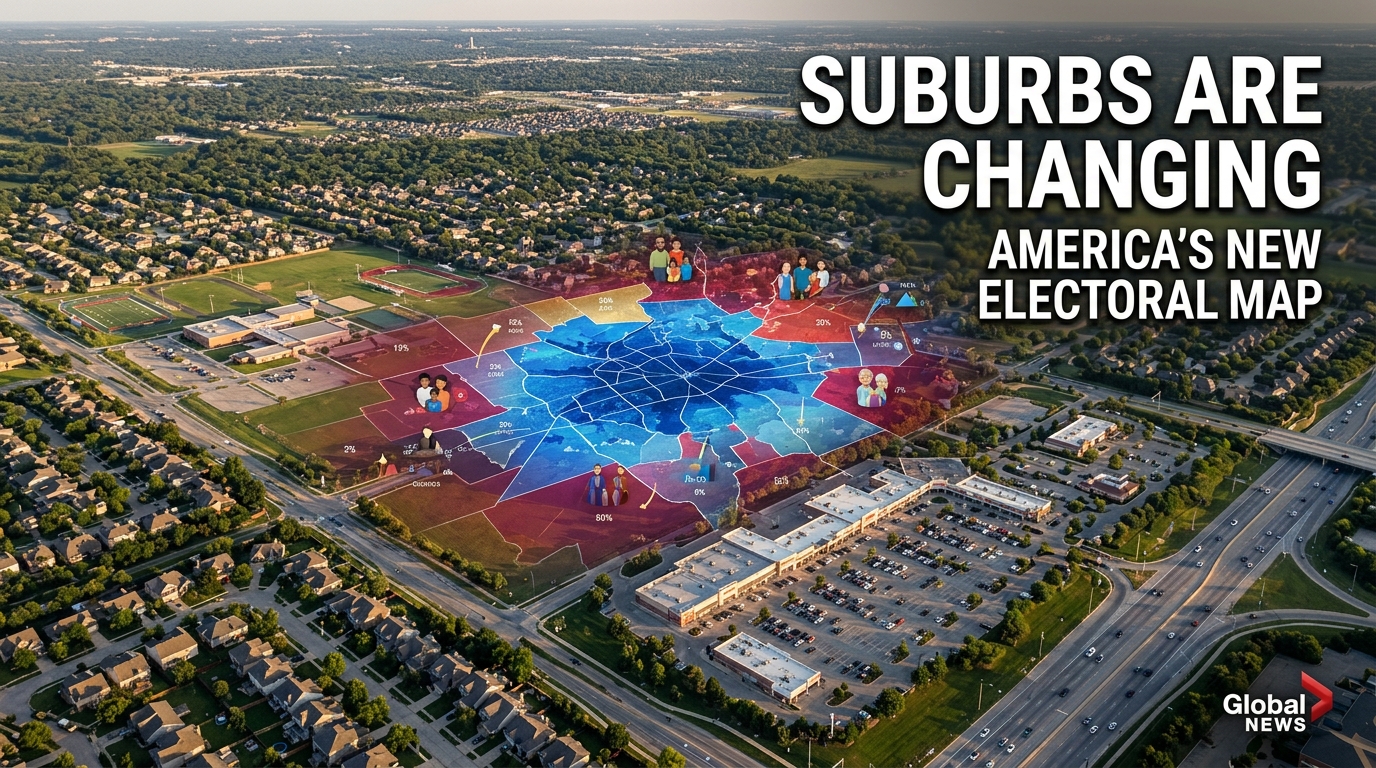
The Great Suburban Realignment: How Shifting Demographics Are Redrawing American Electoral Maps
For decades, political science textbooks taught a reliable, straightforward rule of thumb: urban cores leaned heavily Democratic, rural expanses belonged reliably to the Republicans, and the sprawling ring of suburbs in between acted as the ultimate swing battleground. These suburbs—frequently stereotyped as homogeneous bastions of middle-class families concerned with property taxes and local school boards—decided elections.
Also read:
Election Officials Prepare for Midterm Chaos Amid Mounting Pressures
However, the modern American electorate has undergone a profound evolution. Driven by rapid diversification, rising educational attainment, and shifting lifestyle patterns, suburbia is no longer a monolith. The intersection of changing voter demographics and evolving suburban voting patterns has completely altered the layout of modern campaigns. Understanding these shifts requires looking closely at how the modern metropolitan fringe operates.
The Changing Face of Suburbia: Diversity Beyond the “Soccer Mom”
For years, campaign strategists focused almost exclusively on the archetype of the white suburban parent. While this demographic remains politically influential, it tells only a fraction of the story. Modern suburbs have become the primary landing ground for millions of Americans of color.
Between successive census cycles, millions of Black, Hispanic, and Asian-American families moved directly from major metropolitan cores into first- and second-tier suburbs (Rastogi & Jones-Correa, 2023). This dispersion means that the majority of people of color in the United States now live in suburban communities rather than dense urban centers (Rastogi & Jones-Correa, 2023).
This multi-ethnic evolution has rewritten local political dynamics. Diverse suburban precincts exhibit distinct voting habits compared to their predominantly white counterparts. For instance, data analyzing multi-cycle voting behavior reveals that while heavily white outer-ring suburbs and exurbs lean conservative, inner-ring and multi-ethnic suburbs display complex voting patterns influenced heavily by education levels, economic security, and community engagement (Rastogi & Jones-Correa, 2023).
The Education Polarization Factor
Beyond race and ethnicity, educational attainment has emerged as one of the most powerful predictors of suburban political behavior. Over the past few election cycles, college-educated suburban voters—particularly college-educated white women—have shifted significantly away from the Republican Party.
This trend is especially visible in “middle suburbs” and urban-adjacent communities. Voters with university degrees have increasingly prioritized social issues, institutional norms, and environmental policies, making them a lucrative target for progressive and moderate Democratic platforms. Conversely, non-college-educated suburban and exurban voters have trended in the opposite direction, aligning more closely with populist and conservative platforms. This internal educational divide has created a distinct geographical sorting within the suburbs themselves, splitting communities street by street.
Turnout Versus Persuasion in the New Suburbia
As national political parties adapt to these realities, campaign strategies have pivoted. In high-stakes midterm and presidential cycles, the battle for suburbia is less about convincing a hardened partisan to change their mind and more about mobilizing low-propensity or “irregular” voters.
Data from recent election cycles shows that fluctuations in suburban turnout often dictate statewide outcomes. When diverse, working-class suburban communities turn out at high rates, the electoral landscape tilts. When these groups stay home or experience voter fatigue, margins narrow dramatically. Consequently, grassroots organizations spend significant resources year-round building trust within these evolving communities, linking local pocketbook issues directly to broader electoral choices.
Frequently Asked Questions (FAQs)
Why are suburbs considered the most important battleground in modern elections?
Suburbs contain a massive share of the national voting-age population and house diverse demographic groups. Because they feature a mix of political viewpoints, slight shifts in suburban turnout or preferences can swing entire states.
How has racial diversity impacted suburban voting trends?
As suburbs have diversified—with growing Black, Hispanic, and Asian populations—they have lost their old reputation as exclusively white, conservative enclaves. Different ethnic groups bring varied priorities, leading to nuanced, multi-coalitional voting patterns rather than a single uniform block.
What role does education play in suburban voting behavior?
Educational attainment is one of the sharpest dividers in modern politics. College-educated suburbanites have trended increasingly toward the Democratic Party, while non-college-educated suburban and exurban voters have increasingly leaned toward the Republican Party.
Conclusion
The traditional map of safe urban zones, dependable rural strongholds, and predictable suburban swing areas is gone. Today’s suburbs are dynamic, culturally diverse, and politically fractured landscapes. As demographic trends continue to push outward from metropolitan centers, the political parties that succeed will be those that abandon outdated stereotypes and address the multi-faceted economic, educational, and social realities of modern suburban life.