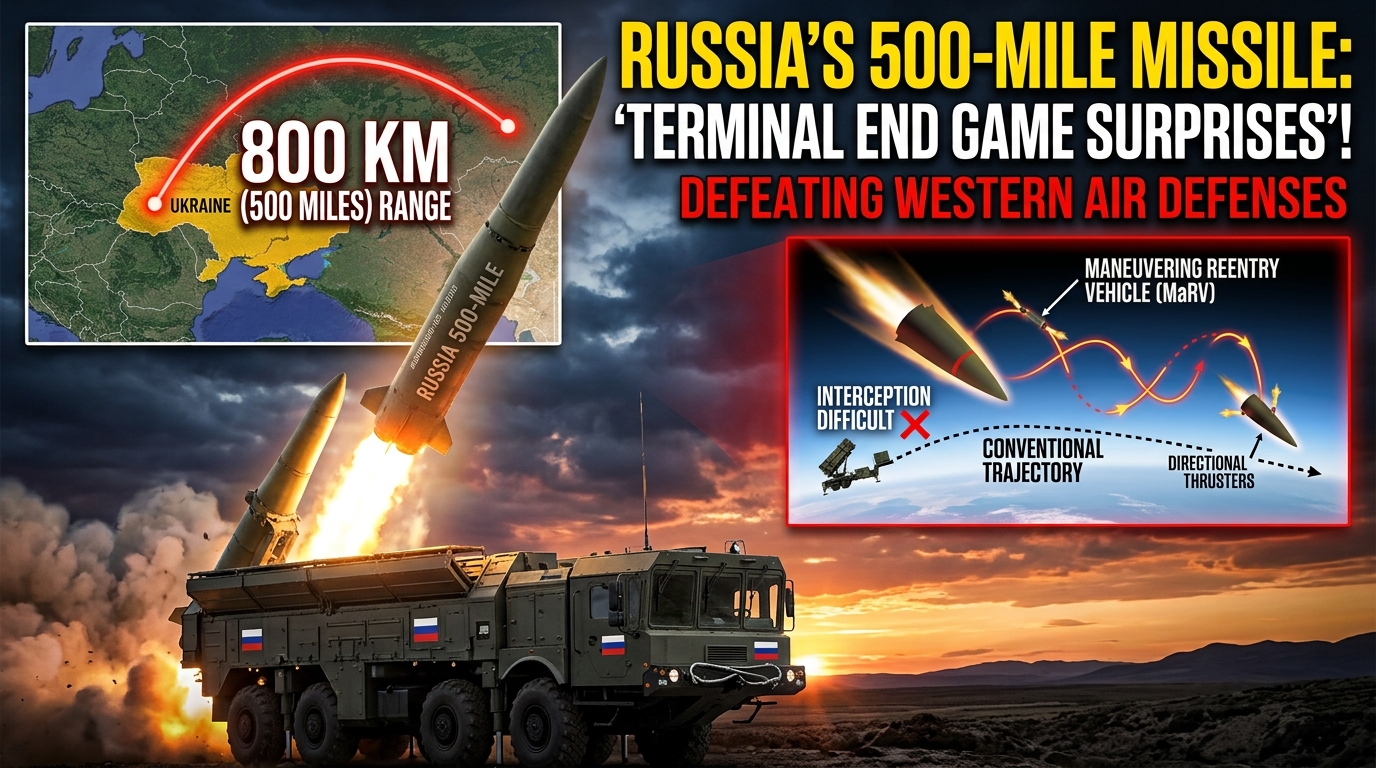
Russia 500-Mile Ballistic Missile Readied as Expert Warns of ‘Terminal End Game Surprises’
Moscow is preparing final tests for a new short-to-medium-range strike platform, commonly referenced by military analysts as a key Russia 500-mile ballistic missile. Disclosed by Ukrainian military intelligence and defense analysts, the upcoming deployment highlights a dangerous shift in missile technology. The weapon features trajectory-altering maneuvers engineered specifically to bypass modern Western-supplied air defense systems.
The announcement was delivered by Vadym Skibitskyi, deputy head of the Defence Intelligence of Ukraine (DIU), during a briefing with the Ukraine-NATO Interparliamentary Council. According to intelligence estimates, Russia aims to complete final operational testing by the end of the year, with the possibility of conducting live-fire combat demonstrations against targets in western Ukraine.
Also Read:
Donald Trump Jr wedding party paid for by Putin ally confirms wife Bettina
+-------------------------------------------------------------------------+
|              NEW RUSSIA 500-MILE BALLISTIC MISSILE SPECS                |
+-----------------------------------+-------------------------------------+
| Operational Range                 | Up to 800 km (500 miles)            |
| Primary Guidance & Flight Path    | Semi-ballistic with terminal MaRV   |
| Key Operational Threat            | High-g evasion & weaving trajectory |
| Treaty Status                     | Post-INF Treaty Category            |
| Interception Difficulty           | High (Requires Patriot PAC-3/SAMP-T)|
+-----------------------------------+-------------------------------------+
Technical Breakdown: Deciphering ‘Terminal End Game Surprises’
Military analysts warn that the development of a new Russia 500-mile ballistic missile represents a broader shift away from conventional, predictable ballistic flight paths. Traditional ballistic missiles follow a predictable parabolic arc, allowing modern defensive radar—such as those used by the U.S.-made Patriot system—to compute the exact point of impact and launch interceptors along a precise vector.
Tom Karako, Director of the Missile Defense Project at the Center for Strategic and International Studies (CSIS), noted that pure ballistic trajectories are becoming obsolete in high-intensity peer conflict. Instead, state actors are outfitting warheads with Maneuvering Reentry Vehicles (MaRVs) and autonomous terminal-phase evasion routines.
“You have things that may be ballistic for a good part of their path, but are also equipped with maneuvering reentry vehicles or some kind of terminal end game surprises,” Karako explained. “This means terminal maneuvers that weave a little bit so that the defender doesn’t quite know where it’s going or what trajectory it will have.”
These rapid trajectory modifications in the final seconds of flight force defensive interceptors like the PAC-3 MSE or SAMP/T to expend kinetic energy quickly, drastically reducing their hit-to-kill probability against an incoming Russia 500-mile ballistic missile.
Strategic Context: The Post-INF Treaty Security Vacuum
The 800-kilometer reach of this Russia 500-mile ballistic missile is particularly significant because it places the weapon squarely inside the boundaries once established by the landmark 1987 Intermediate-Range Nuclear Forces (INF) Treaty.
Signed by U.S. President Ronald Reagan and Soviet General Secretary Mikhail Gorbachev, the INF Treaty banned all ground-launched ballistic and cruise missiles with ranges between 500 and 5,500 kilometers (310 to 3,400 miles). The agreement was a cornerstone of European security for over three decades until the United States formally withdrew, citing persistent Russian non-compliance.
| Feature / Metric | Legacy Iskander-M (9M723) | Russia 500-Mile Ballistic Missile | Standard INF Treaty Limit |
| Max Range | ~500 km (310 miles) | ~800 km (500 miles) | Max 500 km (Banned 500–5,500 km) |
| Launch Platform | Mobile TEL Vehicle | Mobile Ground Launcher | Ground-based prohibited |
| Terminal Evasion | Decoys / Basic Evasion | Advanced MaRV / Weaving | N/A |
| Primary Target Profile | Operational Depth / Frontline | Strategic Rear / Logistics | N/A |
By deploying an 800 km system, Moscow fills a tactical gap in its operational strike arsenal. This range allows Russian forces to station launchers deep inside their own borders—far out of reach of Ukraine’s standard artillery and shorter-range drone capabilities—while retaining the capacity to strike targets across western Ukraine and NATO’s eastern flank.
Strain on Air Defense Arsenals
The introduction of mass-produced, maneuvering ballistic weapons poses a severe challenge to defense forces already contending with interceptor depletion. Russian missile manufacturing has expanded despite Western economic sanctions, with intelligence reports indicating Moscow’s defense sector is producing key munitions at elevated monthly rates.
The main operational issues facing air defense operators trying to counter the Russia 500-mile ballistic missile include:
Interceptor Asymmetry: Advanced hit-to-kill interceptors cost several million dollars each and exist in limited stockpiles compared to mass-produced ballistic airframes.
Diminishing Reaction Windows: High speeds combined with unpredictable terminal maneuvers cut radar tracking times down to seconds.
Live-Fire Testing in Combat: Russia frequently integrates early operational testing of new systems directly into active bombardment schedules, using operational environments to refine weapon algorithms against Western interceptors.
Ukrainian leadership has repeatedly emphasized the need for continuous missile defense resupply, particularly heading into periods when energy infrastructure comes under heavy stress. If Russia fields high-volume, maneuvering intermediate-range missiles, standard point-defense batteries will require greater density and faster radar integration to maintain protection coverage over critical infrastructure.
As the Russian defense industrial base continues its wartime posture, the proliferation of maneuverable weapons marks an intensifying phase of regional security. The arrival of “terminal end game surprises” highlights a permanent shift toward evasive missile warfare, reshaping defense requirements for Ukraine and NATO allies alike.
Frequently Asked Questions (FAQs)
What is the range of the new Russia 500-mile ballistic missile?
The new Russia 500-mile ballistic missile has an estimated operational range of up to 800 kilometers (approximately 500 miles), allowing it to strike deeper strategic targets while launching from safer positions deep inside Russian territory.
What are “terminal end game surprises” in missile technology?
“Terminal end game surprises” refer to unexpected terminal-phase maneuvers, such as high-speed weaving, sudden trajectory shifts, or the deployment of specialized decoys by a maneuvering reentry vehicle (MaRV). These capabilities are designed to confuse defensive radar and outmaneuver interceptor missiles.
How does the Russia 500-mile ballistic missile relate to the INF Treaty?
The missile’s 800-km range falls directly within the 500-to-5,500 km range previously prohibited under the 1987 Intermediate-Range Nuclear Forces (INF) Treaty. Following the treaty’s collapse in 2019, both the U.S. and Russia resumed development of ground-launched systems in this range category.
Disclaimer
This article is for informational and educational purposes only, compiled from public defense intelligence briefings, security analysts, and official statements. Military capabilities and testing timelines remain subject to operational security shifts.