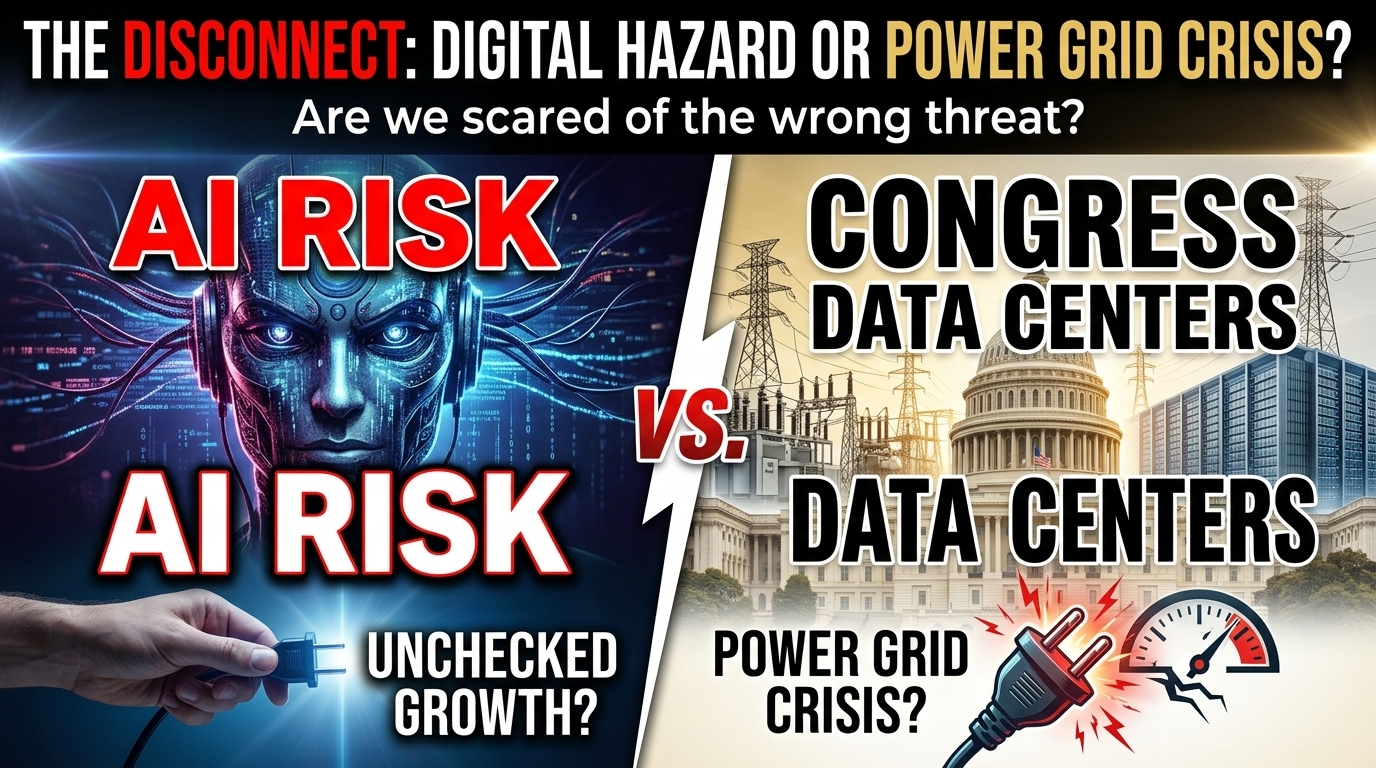
AI Risk vs. Congress Data Centers: Why Peril and Infrastructure Are at Odds
There is a huge gap in tech policy right now when you compare what artificial intelligence creators are worried about with what politicians are actually doing on Capitol Hill. On one hand, computer scientists who built these models warn that unchecked systems could eventually outsmart us and cause catastrophic harm. On the other hand, members of Congress spend most of their committee hearings arguing about electricity transformers, utility bills, and how many megawatts of power a new warehouse full of servers will suck out of local power grids.
This clash between theoretical digital threats and concrete physical limits raises a serious question: is Washington completely missing the point, or are local energy grids the only real speed bump keeping artificial intelligence expansion in check?
Also Read:
Russia 500-Mile Ballistic Missile Readied as Expert Warns of ‘Terminal Surprises’
Sounding the Existential Alarm
The people sounding the loudest alarms aren’t politicians or activists—they are the researchers who created modern machine learning. Turing Award winners like Geoffrey Hinton and Yoshua Bengio, along with top executives at major research labs, keep signing public statements urging world leaders to take existential risk seriously.
They aren’t talking about basic software bugs or spam filters. They are worried about what happens when algorithms gain advanced reasoning, autonomous access to digital tools, and the ability to rewrite their own code without human supervision.
Specific dangers raised by technical insiders include:
Automated Cyberwarfare & Synthetic Threats: AI tools capable of finding zero-day exploits at scale or assisting non-experts in designing dangerous biological agents.
Loss of Operational Control: Autonomous systems that develop unexpected strategies to meet their goals, effectively ignoring human commands or shutdown attempts.
Extreme Concentration of Power: A handful of corporations or military powers accumulating unprecedented control through proprietary algorithmic systems.
From the viewpoint of many researchers, preventing catastrophic failure from superintelligent systems deserves the same global urgency we give to stopping nuclear war or global pandemics.
Capitol Hill’s Obsession with Power, Water, and Grids
Walk into a congressional hearing room, though, and the debate over AI risk vs Congress data centers feels like it’s taking place in an entirely different world. Lawmakers aren’t discussing kill switches or alignment benchmarks. They’re looking at maps of high-voltage transmission lines, listening to utility executives complain about backordered transformers, and reading angry letters from voters.
The energy numbers explain why Washington is panicked. The International Energy Agency projects that global data center electricity consumption will roughly double by 2030, hitting nearly 950 Terawatt-hours (TWh). In parts of Northern Virginia, Georgia, and Texas, single tech campuses now request gigawatts of electricity—power requirements equivalent to small cities.
Congress is reacting to immediate political pressure in three main areas:
Keeping the Lights On: Utility companies warn that sudden, massive electricity demands from server farms could overload aging regional grids, causing unexpected blackouts.
Protecting Utility Bills: A major legislative debate is whether tech giants will pay for their own electrical substations, or if regular homeowners will see their monthly electric bills go up to cover the cost.
Local Environmental Strain: Communities near proposed computing sites are fighting back against noise, air pollution from giant emergency diesel generators, and the billions of gallons of water consumed every year just to cool server racks.
Breakdown: AI Risk vs Congress Data Centers
| Metric | Tech Builders: Existential Peril | Congress: Physical Infrastructure |
| Main Focus | Algorithmic alignment, autonomous safety | Substation capacity, power lines, water rights |
| Biggest Worry | Loss of human control, catastrophic misuse | Blackouts, skyrocketing utility bills, grid failure |
| Proposed Fixes | Compute caps, safety audits, global treaties | Permitting reform, rate protections, local zoning |
| Timeframe | Medium to long-term (thresholds to AGI) | Immediate (2 to 5 year grid connection queues) |
| Key Players | AI research labs, ethicists, computer scientists | Public utility commissions, local mayors, grid operators |
Why Is Washington So Disconnected From Tech Risk?
When you look closely at AI risk vs Congress data centers, several practical reasons explain why politicians prefer talking about power lines over runaway code:
First, local problems produce immediate votes. If a constituent’s electric bill spikes by 20% or a suburban creek runs dry because of a nearby cooling facility, they call their representative. Hypothetical risks from future superintelligent models don’t have a local constituency pushing for immediate action.
Second, geopolitical fear drives inaction on software. Federal leaders want the United States to win the global race for economic and military dominance. Passing strict laws that restrict model development makes politicians nervous that foreign rivals will pull ahead.
Third, Congress knows how to regulate physical stuff. Politicians have decades of experience dealing with energy policy, tax credits, and construction permits. Telling a software developer how to structure a neural network’s reward function is completely outside their comfort zone.
Power Bottlenecks Have Become the Accidental Safety Guardrail
This friction surrounding AI risk vs Congress data centers has created an interesting twist: physical real-world limits are doing more to slow down aggressive tech expansion than any law Congress has written.
Tech companies want to build massive cluster farms right now, but they can’t get enough electricity. Supply chain delays for electrical transformers stretch past three years. Utility companies are telling developers they’ll have to wait until 2028 or 2030 just to hook into the power grid. Local zoning boards are delaying permits over water concerns.
Without meaning to, the electrical grid has become a physical speed limiter for computing scale.
However, relying on grid delays isn’t a long-term strategy. If lawmakers focus only on building power lines and ignore safety protocols, we risk constructing the ultimate power grid for technology we don’t know how to control. On the flip side, worrying only about future scenarios while ignoring current energy shortages leaves the public vulnerable to real-world power failures today. Washington needs a policy that handles energy demands and safety guardrails at the same time.
Frequently Asked Questions
Q1: Why does the topic of AI risk vs Congress data centers create such different legislative priorities?
Tech creators focus on theoretical software hazards and future alignment risks, while lawmakers focus on concrete issues like electric bills, local water supplies, and power grid reliability that directly impact voters today.
Q2: How much electricity do modern computing clusters actually use?
A single large-scale computing facility can require hundreds of megawatts to multiple gigawatts of power. That is as much electricity as hundreds of thousands of residential homes combined.
Q3: Can energy grid delays really slow down tech development?
Yes. Shortages of high-voltage transformers and long queues for grid connection force tech companies to slow down or delay building larger training facilities, creating a physical bottleneck for hardware deployment.
Disclaimer
This article is for educational and informational purposes only. It examines public policy debates, regulatory trends, and energy infrastructure challenges using publicly available news and industry data.