
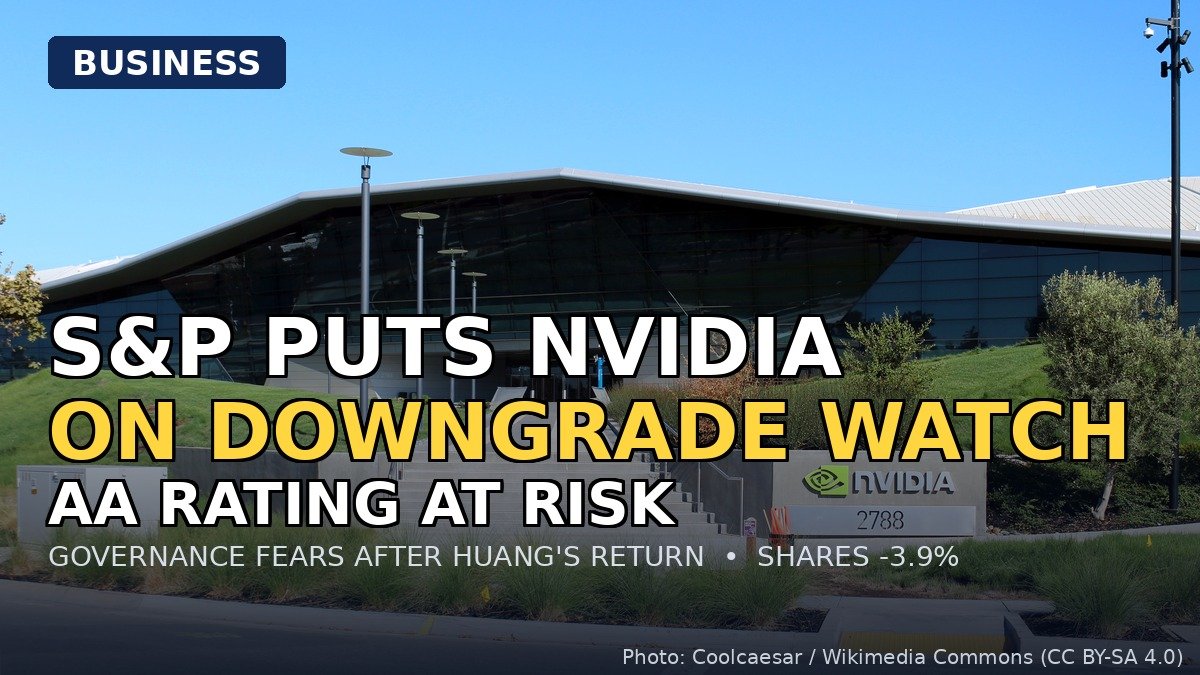
Nvidia CreditWatch Negative is the verdict S&P Global Ratings delivered on Wednesday: the agency placed Nvidia’s AA credit rating on CreditWatch Negative, warning that a downgrade is now likely as it reviews the chipmaker’s management and governance. The decision lands in the middle of one of the strangest fortnights in corporate America — a chief executive forced out, then brought back less than two weeks later — and it shows that Wall Street and the bond market are reading those twelve days very differently.
S&P’s move is not a downgrade. It is a formal warning that one is probable. The agency said it expects to finish its review within about 90 days and, if it acts, to cut the rating by a single notch to AA-, still comfortably inside investment grade. What matters is not the size of the move. It is the reason: S&P says recent events have exposed weaknesses in how Nvidia is run at the very top.
Nvidia CreditWatch Negative: What S&P Actually Did
CreditWatch Negative is S&P’s way of saying a rating is under active review with the balance of risk pointing down. Nvidia currently holds an AA rating from S&P, the third-highest notch on the agency’s scale — one below AA+ and one above AA-. A one-notch cut to AA- would leave the company with a very strong credit profile by any normal measure. But the signal matters more than the notch, because it tells lenders that the agency no longer trusts the governance framework behind one of the world’s most valuable companies quite the way it did a month ago.
“Recent events undermine our view of NVIDIA’s M&G framework,” S&P said, using its shorthand for management and governance. The agency pointed to board independence, oversight, succession planning and internal controls, and said it believes the long tenure of certain board members may have compromised their independence. In its words, the company’s corporate governance practices may not have kept pace with Nvidia’s rapid growth and its role as a critical global technology enabler.
The numbers behind the business remain extraordinary. Nvidia had just reported record quarterly revenue of $115.8 billion and net income of $65.3 billion for the quarter ended 25 October, and guided to about $130 billion for the current quarter. The problem S&P described was not in the income statement. It was in the boardroom.
Twelve Days That Shook the Boardroom
The episode began on 11 November, when Nvidia’s board accepted the resignation of founder and chief executive Jensen Huang as president, chief executive and director, effective immediately. The company named chief financial officer Colette Kress as interim chief executive and said it would search for a permanent successor. It also appointed Harvey Jones, a director since 1993, as its first-ever board chair.
Huang’s departure followed revelations of multiple extramarital affairs, including at least one with a subordinate and another with a woman the US government has investigated for spying on behalf of China. Huang has since apologised to employees and said he is in therapy — a story World Reach Daily covered earlier this week.
Six days after the resignation, Kress presented the record quarterly results. Then, on 23 November, the board voted unanimously to reinstate Huang, less than two weeks after he had left. Shareholders loved it: the stock jumped 31 percent on the news, adding roughly $950 billion of market value in a single session. The reinstatement restored strategic continuity. S&P’s point is that it did not resolve the governance questions.
The agency said the departure and reinstatement “does not sufficiently answer” its questions about board oversight of the executive code of conduct. Critics and lawmakers went further, calling the U-turn a departure from standard corporate governance practice. The newly elected board chair had told investors only the week before that Nvidia would not rehire Huang as chief executive because his personal behaviour was inconsistent with the company’s code of conduct. Days later, the board did exactly that — and in announcing the return, Nvidia omitted any mention of his affairs.
That reversal is now the heart of the governance case against the company. If the board’s own stated standard lasted less than a week, S&P is asking, what does the board actually enforce?
Record Profits, Falling Shares: The Split Verdict
The split between the stock market and the credit market is the most striking feature of the whole saga. Shareholders bid the stock up for the founder. The credit market marked the institution down, if only slightly. Both can be right, because a share price and a credit rating are claims on different things. A share price capitalises future growth. A rating assesses the promises that stand behind debt — and Nvidia now stands behind far more promises than its own.
Nvidia shares ended Wednesday down 3.9 percent at $149.30, about $2.3 trillion below the company’s October peak and down 38 percent since 6 October. The cost of insuring Nvidia’s debt against default jumped too: the five-year credit default swap premium rose as much as 6 basis points to 147.27 basis points a year, an intraday record, according to ICE Data Services. Nvidia has about $32.5 billion of bonds in the US high-grade corporate bond index, so the move reaches well beyond the company’s own shareholders.
S&P is not alone. Moody’s Ratings lowered its outlook on Nvidia’s Aa1 rating — the second-highest investment-grade rating — to stable from positive last week, also citing governance concerns after Huang’s ouster. On Wednesday, Moody’s kept its outlook unchanged, saying Huang’s return eases near-term uncertainty around business execution but that “governance and regulatory uncertainty remains.”
There is also the export-control question hanging over the company. Nvidia is under US scrutiny over its business ties to China and its compliance with advanced semiconductor export controls, and the company’s own filings disclose $118 billion of maximum gross exposure on guarantees as of 25 October. Reuters reported on Wednesday that the US Justice Department did not conduct a formal investigation into Huang before President Donald Trump pushed for his return, concluding instead that there was no evidence he had broken any laws based on ongoing investigations into two Nvidia clients, Super Micro and Megaspeed International, which are suspected of smuggling advanced microchips to China. That determination is subject to change as the probes continue.
What Happens Next: The 90-Day Clock
The next milestones are already set. Huang is scheduled to appear for a closed-door inquiry before three US House committees on 1 December and to testify at a public hearing of the Senate Banking Committee on 3 December. What he says there — and what the committees disclose — could shape S&P’s review as much as anything Nvidia’s board does.
S&P has said it expects any downgrade to be limited to one notch, provided investigations and other disclosures do not harm the company’s reputation or future business prospects. That is a meaningful caveat. A one-notch cut would barely move Nvidia’s borrowing costs. A deeper review, triggered by fresh disclosures, would be a different story.
For investors, the practical lesson is narrower than the headlines suggest. Nvidia’s business — the chips, the customers, the order book — has not changed. What has changed is the market’s confidence that the institution around the founder can govern itself when the founder is the problem. The stock market has decided the founder is indispensable: a 31 percent jump on his return is the market treating a person, not an institution, as the source of value. That is also the key-man risk, stated in one sentence.
S&P’s warning does not settle the argument. It does make it official: the world’s most important chip company now carries a governance question mark from one of the world’s most important rating agencies, and it has about 90 days to answer it.
What It Means for Investors
For shareholders, the immediate effect is limited: an AA- rating would still leave Nvidia among the strongest corporate borrowers in the world. For bondholders, the record cost of default insurance is the market pricing in uncertainty that did not exist a month ago. And for the board, the message is the bluntest it has received in the company’s history — the governance framework must be rebuilt to match a company of Nvidia’s size and importance, not merely restored to how it looked before 11 November.
Whether the board can do that while keeping the founder who built the company is the question S&P, Moody’s, Congress and the market will all be watching over the next 90 days.