
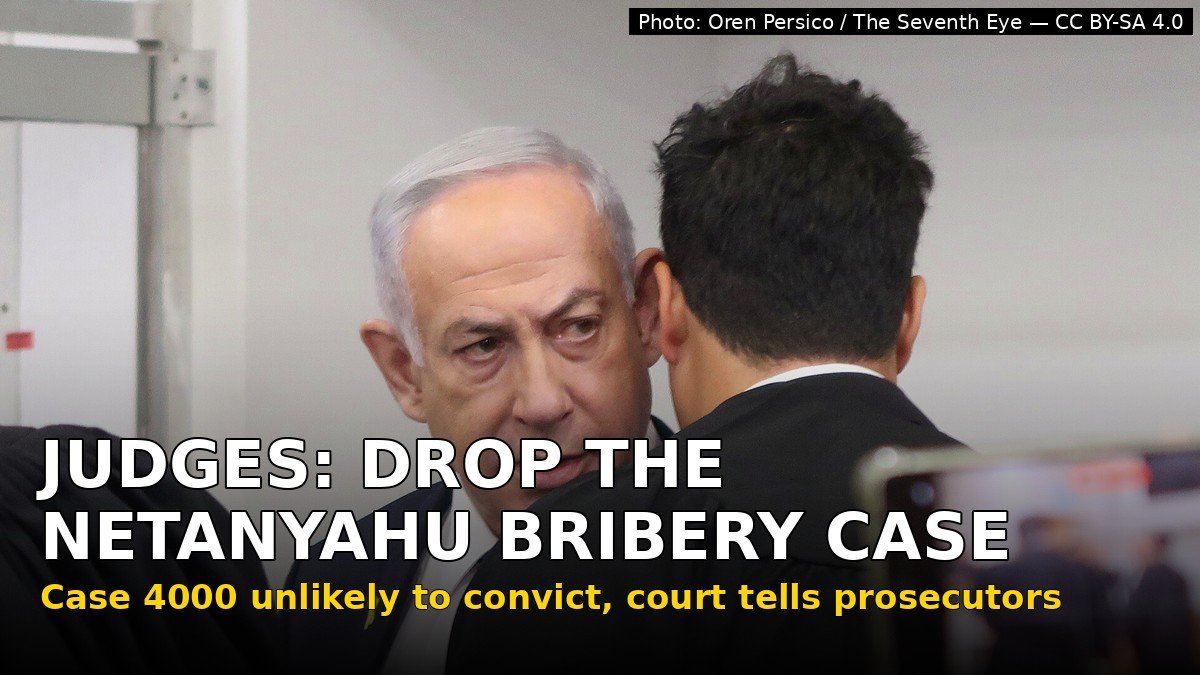
Israeli judges have recommended that prosecutors drop the Netanyahu bribery case at the heart of the prime minister’s long-running corruption trial, telling the attorney general that a conviction is unlikely.
The recommendation, delivered at a Jerusalem District Court hearing on Wednesday, is the most serious setback yet for the prosecution in a trial that has shadowed Benjamin Netanyahu since he was indicted in 2019. The prime minister denies all the charges and has pleaded not guilty.
What the Netanyahu Bribery Case Is About
The case at the centre of Wednesday’s hearing is known as Case 4000, the most serious of the three cases against Netanyahu. Prosecutors allege that, while serving as prime minister and communications minister, he granted regulatory favours worth around 1.8 billion shekels — about $500 million — to Bezeq Telecom Israel. In return, they say, he sought positive coverage for himself and his wife, Sara, on the Walla news website, which was then controlled by former Bezeq chairman Shaul Elovitch. Elovitch has denied wrongdoing.
The trial began in 2020, and the case has run alongside some of the most turbulent years in Israeli politics. Netanyahu’s political position has also been under strain — his bloc fell short of a majority in Israel’s recent election — which makes the court’s intervention all the more consequential.
“A Ray of Light for Truth and Justice”
Judge Rivka Friedman-Feldman, who presides over Case 4000, told Attorney General Gali Baharav-Miara at Wednesday’s hearing that a conviction was unlikely and the case should be dropped. The court later clarified that the recommendation was not a ruling on the case, and Baharav-Miara said she would review the court’s statements with the prosecution.
Netanyahu welcomed the development in a televised address on Wednesday, calling it a “ray of light for truth and justice”. He said: “Ten years of suffering for dozens of my close ones who were dragged into interrogation rooms, where they were blackmailed with criminal acts, humiliated, and the lives of many of them were ruined, just so they would give false testimony against me.”
He has long maintained that the cases against him are fabricated and politically motivated, and on Wednesday he demanded that the trial end immediately.
Case 2000 Also in Doubt
The judges also recommended that prosecutors reconsider a second case, known as Case 2000, because of doubts that Netanyahu’s actions constituted a criminal offence. In that case, prosecutors allege that Netanyahu negotiated a deal with Arnon Mozes, the owner of Israel’s Yedioth Ahronoth newspaper, under which he would receive better coverage in return for legislation to slow the growth of a rival newspaper.
A third case, Case 1000, which concerns luxury gifts Netanyahu is alleged to have received, was not part of Wednesday’s recommendation.
What Happens Next
The decision now rests with the attorney general. Baharav-Miara has said she will review the judges’ recommendation with the prosecution team before deciding whether to drop Case 4000, reconsider Case 2000, or press on regardless.
If prosecutors accept the recommendation, it would remove the most serious charge hanging over the prime minister and reshape a trial that has dominated Israeli public life for six years. If they refuse, the case will continue — but with the trial judges on record as doubting that a conviction is possible, the prosecution’s position would be badly weakened either way.
For now, Netanyahu remains on trial, and the judges’ words — not a verdict, but a clear signal — have already changed the terms of the debate. According to Reuters, the recommendation came after years of hearings in which the prosecution’s central claims were tested in open court.
Image: Oren Persico / The Seventh Eye, CC BY-SA 4.0.