
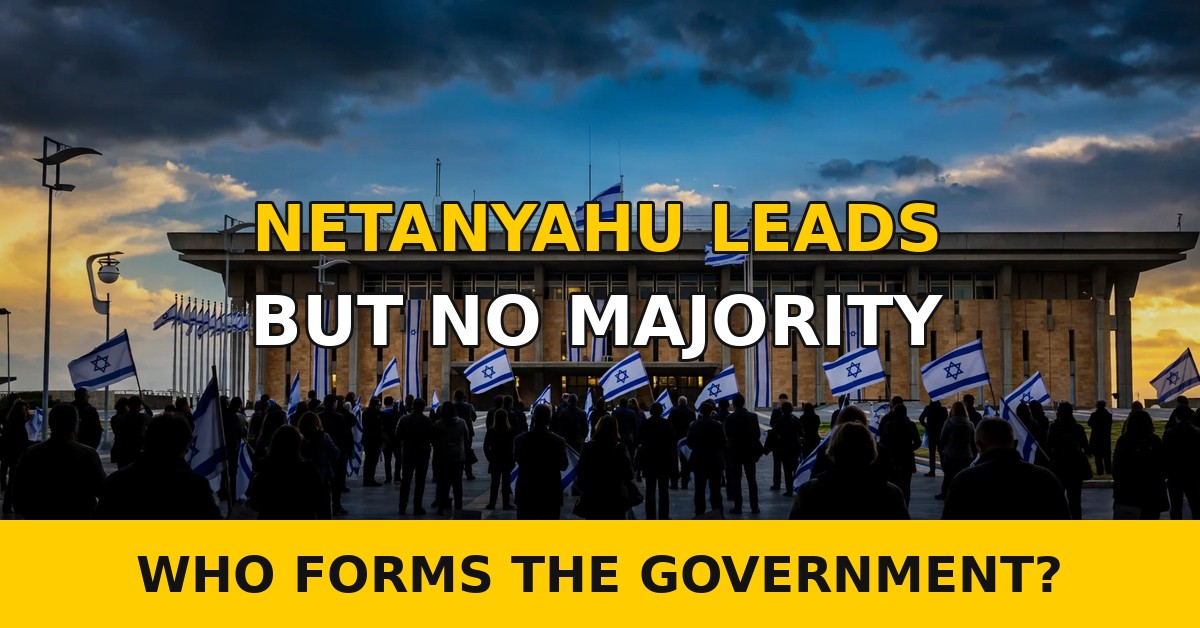
The Netanyahu election result left Israel’s longest-serving prime minister on top — and still short of the prize he wanted.
With about 86% of votes tallied after Tuesday’s voting and Wednesday’s count on October 28, 2026, Prime Minister Benjamin Netanyahu’s bloc of right-wing, far-right and ultra-Orthodox parties was projected at 53 seats in the 120-seat Knesset. Rival Gadi Eisenkot’s opposition bloc was projected at 48. Neither side reached the 61 seats needed to govern alone.
Turnout hit a record high, and the surge came from an unexpected quarter. Arab Israelis, who make up 21% of the population, turned out in unprecedented numbers, handing parties representing Arab Israelis a projected 19 seats — and potentially decisive influence over whatever government comes next.
For a bloc long kept on the margins of coalition talks, that is a striking shift, and it explains why nobody in Jerusalem is calling this a done deal yet.
“Maybe it’s hard to say it or to see it, but he’s the winner,” former Netanyahu adviser Aviv Bushinsky said, calling the comeback a political “resurrection”. The remark captures the odd shape of this result: Netanyahu did not win a majority, but he survived an election many expected to end his career, and survival, in Israeli politics, counts for a lot.
What the Netanyahu Election Numbers Actually Mean
Fifty-three seats is a lead, not a mandate. Five seats short of 61, Netanyahu cannot form a government from his own bloc alone. Eisenkot, at 48, is further back, but the arithmetic gives both men the same problem: they need partners who did not run on their ticket, and the most obvious pool of extra seats sits with the Arab parties at 19.
Netanyahu stays on as caretaker prime minister while Israel’s president decides whom to ask to form a government. The president’s choice, and the weeks of bargaining that follow, will decide whether this election produces a stable coalition, a fragile patchwork, or another trip to the ballot box.
Two broad paths are now open. One is a broader unity government led by Netanyahu, potentially bringing in Eisenkot or former prime minister Naftali Bennett. The other is another election — an outcome Israeli voters know well after a string of inconclusive votes.
Bushinsky sees a unity government as the most realistic outcome, particularly if US President Donald Trump presses Netanyahu to bring rivals in and sideline far-right ministers Itamar Ben-Gvir and Bezalel Smotrich.
A Survivor, Not Quite a Victor
Regional analyst Danny Citrinowicz put the result in blunter terms: “He won by not losing. He managed to survive.” That verdict fits the campaign Netanyahu fought.
He entered the election burdened by a long-running corruption trial, resistance to an independent inquiry into the October 7, 2023 Hamas attacks, escalating settler violence in the occupied West Bank, and a bitter battle over military service exemptions for ultra-Orthodox Jews. Any one of those could have sunk a prime minister. Together, they made his first-place finish look less like a triumph and more like an escape.
Netanyahu himself framed it differently. In a post-election speech, he called for a “strong right-wing national government” and said Israel faces a “singular historical opportunity, together with our partner President Trump, to remove the existential threat of Iran once and for all.” Trump, who had urged Israelis to keep Netanyahu in power, said the prime minister had done “very well” and credited his own endorsement.
Eisenkot, 66, struck a different note. The former military chief, who lost a son and two nephews in the Gaza war, told security chiefs that Netanyahu headed a transitional government that had lost public confidence. “Stand strong and firm against any attempt to challenge you,” he said. It was a warning, not a concession — a sign that the opposition intends to fight the coalition talks as hard as it fought the campaign.
Why Arab Voters Changed the Equation
The story of this election may turn out to be less about Netanyahu’s survival than about who now holds leverage over him. Arab Israelis have often voted at lower rates than Jewish Israelis, and their parties have rarely been treated as coalition material by either major bloc. This time, the record turnout flipped that script.
Nineteen projected seats is enough to tip the balance for either side, and that gives Arab party leaders a seat at a table they have long been kept away from.
What they do with that leverage is the great unknown of the weeks ahead. Joining a Netanyahu-led government would be a historic break, and a politically costly one for parties whose voters have deep grievances with his governments. But the mere fact that both blocs may need to court them marks a change in Israeli politics, and one that will be watched closely well beyond Israel’s borders.
The pressure is not only political. Markets fell on the uncertainty, with the shekel down about 2% and Tel Aviv’s benchmark index down around 3%. Definitive results were expected Thursday, but the final seat count is unlikely to settle the bigger question — who can actually assemble 61 votes.
What Happens Next in Jerusalem
Once definitive results are in, the president will consult party leaders and ask one candidate to try to form a government. That candidate will then have weeks to stitch together a coalition, trading ministries and policy promises for signatures. If the first candidate fails, the mandate can pass to someone else. If everyone fails, Israelis go back to the polls.
Trump’s role adds a twist that past coalition talks did not have. Bushinsky’s argument — that American pressure could push Netanyahu toward a unity government and away from his far-right partners — rests on a real relationship: Trump backed Netanyahu publicly during the campaign, and Netanyahu’s own speech leaned heavily on the partnership with the US president. Whether that translates into pressure to sideline Ben-Gvir and Smotrich remains to be seen.
For now, Israel has a winner who cannot govern alone, a runner-up who has not conceded the future, and a group of Arab parties holding more power than they have ever held before. That is a recipe for hard bargaining, and possibly for a government that looks very different from the one either bloc campaigned for.
Sources and Resources
Reuters report on the election outcome
Reporting credit: This article is based on Reuters reporting on Israel’s October 2026 election results and projections.
More world news from WorldReach Daily.
Frequently Asked Questions
Who won the Netanyahu election?
Nobody won a majority. Netanyahu’s bloc led with a projected 53 seats against 48 for Eisenkot’s opposition bloc, but both fell short of the 61 seats needed to form a government in the 120-seat Knesset.
How many seats does Netanyahu need to govern?
He needs 61 seats, and his bloc is projected at 53 — five short. That means he must bring in partners from outside his bloc, which is why coalition talks will decide who governs.
Why are Arab parties so important this time?
Parties representing Arab Israelis are projected at 19 seats after an unprecedentedly high Arab turnout. Arab Israelis make up 21% of the population, and 19 seats is enough to tip the balance for either major bloc in a hung parliament.
Will there be another election in Israel?
It is possible, but it is only one of two broad paths. The other is a broader unity government led by Netanyahu, potentially bringing in Eisenkot or Naftali Bennett. Former adviser Aviv Bushinsky sees a unity government as the most realistic outcome.
What did the markets do after the result?
The shekel fell about 2% and Tel Aviv’s benchmark index fell around 3%, as investors reacted to the uncertainty of a hung parliament and weeks of coalition bargaining ahead.
Conclusion
Israel’s election gave Benjamin Netanyahu the lead, the survival story, and a problem he cannot solve alone. Fifty-three seats is enough to claim victory in a speech; it is not enough to govern.
The record Arab turnout has handed 19 seats — and real leverage — to parties long shut out of power, and the president’s choice of who tries to form a government will set the course for weeks of hard bargaining. Whether that ends in a unity government, a narrow coalition, or another election, one thing is already clear: the man who won by not losing still has the hardest part ahead of him.
The Netanyahu election will be watched closely in Jerusalem and Washington. The Netanyahu election matters because 53 seats is a lead, not a governing majority. The Netanyahu election also tests whether Arab parties can turn 19 seats into real leverage. The Netanyahu election is not settled by the count alone, but the Netanyahu election will shape the coalition talks that follow.
For now, the Netanyahu election is the clearest test of coalition politics in Israel. The Netanyahu election will frame the president’s choice, and the Netanyahu election will decide whether a unity government or another vote follows.
The Netanyahu election, the Netanyahu election, the Netanyahu election: the count is only the start. The Netanyahu election will be decided in the coalition talks, and the Netanyahu election will be remembered for the Arab parties’ new leverage.