
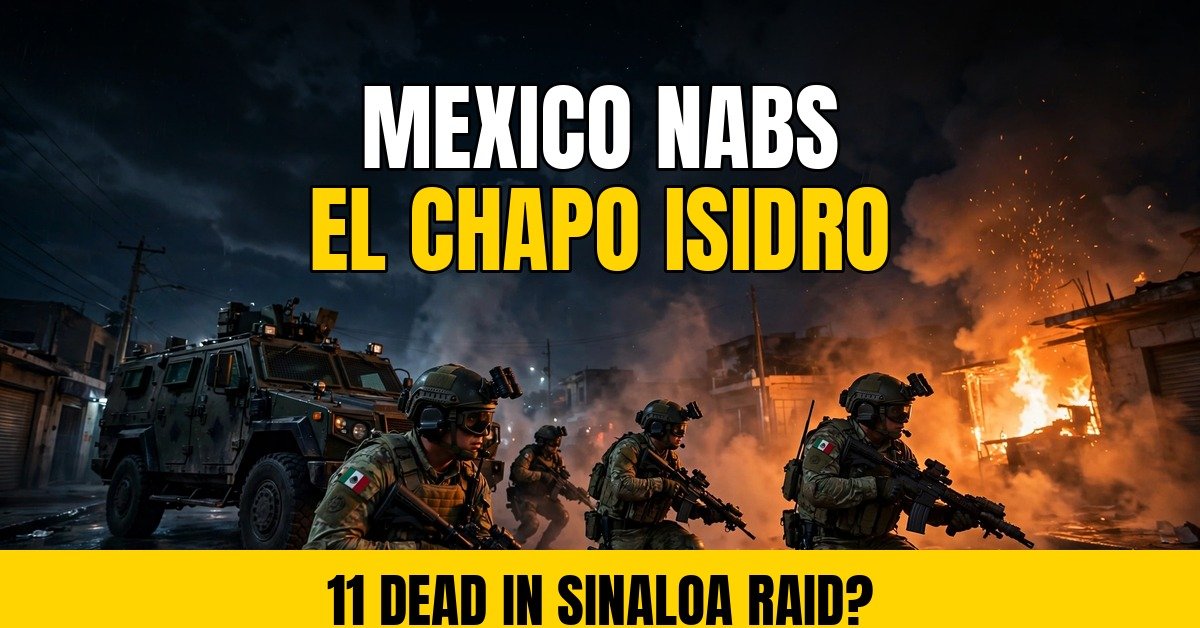
Mexican military forces captured Fausto Isidro Meza Flores, known as El Chapo Isidro, in a major operation in the state of Sinaloa on Friday night — taking one of the FBI’s 10 most wanted fugitives off the streets after more than two decades on the run.
Mexico’s security chief announced the arrest on Saturday morning, calling it one of the biggest blows yet against the country’s drug cartels. Two other leaders of the same trafficking organization were arrested alongside him, including his No. 2 and the cartel’s alleged financial operator.
The raid set off a wave of violence across Sinaloa. Gun battles between Mexican security forces and cartel gunmen killed at least 11 people, and cartel members set up flaming roadblocks across parts of the city. Baseball fans fled a game as the shooting spread.
Who Is El Chapo Isidro?
El Chapo Isidro was one of the most feared drug lords in Mexico, and one of the longest-running fugitives on the FBI’s list. For over twenty years, according to the U.S. State Department, he and his criminal organization smuggled vast amounts of heroin, methamphetamine, cocaine, and marijuana into the United States.
He was considered one of the leaders of the Beltran Leyva cartel, a group that had reportedly allied with the Los Mayos faction of the powerful Sinaloa Cartel. That alliance put him at the center of the drug trade that has flooded American streets with meth and cocaine for years.
The nickname — “Shorty Isidro” — marked him out as a boss in his own right, not just a lieutenant. U.S. authorities had pursued him for years, and his name sat on the FBI’s top ten most wanted list alongside the most dangerous fugitives in the world.
A Night of Gunfire in Sinaloa
The operation unfolded overnight on Friday in Sinaloa, the cartel heartland in northwestern Mexico. Mexican military forces moved in on the target, and the raid quickly turned into a running battle.
Cartel gunmen fought back hard. They set up flaming roadblocks across parts of the city, torching vehicles to block the military’s movements. At least 11 people were killed in the clashes, though officials have not yet said how many of the dead were cartel members, soldiers, or bystanders caught in the crossfire.
By Saturday morning, the military had its man. The arrests of his deputy and his alleged money man suggest the operation was aimed at the cartel’s leadership and its finances at the same time.
Pressure From Washington
The capture comes as Mexico has arrested or killed a string of high-profile suspected drug traffickers in recent months, under intense pressure from Washington.
U.S. President Donald Trump has repeatedly threatened to take unilateral military action inside Mexico if President Claudia Sheinbaum’s administration does not do more to crack down on the cartels. The threats have put Mexico’s government in a tight spot — caught between its own sovereignty and an American president who has made the drug war a central part of his foreign policy.
Mexican officials acknowledged that U.S. intelligence helped in the operation, a rare public admission of how closely the two countries are working together on cartel targets, even as the political relationship stays tense.
The capture fits a clear pattern: Mexico is moving fast against the biggest names on Washington’s list, and each arrest is presented as proof that the pressure is working.
The question now is whether the arrest changes anything on the ground. Mexico has captured kingpins before, and the cartels have kept going. The Beltran Leyva organization has survived the loss of leaders in the past, and the Sinaloa Cartel’s factions have a deep bench of replacements.
What Happens Next?
El Chapo Isidro now faces the long arm of American justice. As one of the FBI’s most wanted fugitives, he is almost certain to face extradition to the United States, where he would stand trial on drug trafficking charges that carry decades in prison.
Extradition cases in Mexico can drag on for months or years, but the U.S. government has made capturing and extraditing cartel bosses a top priority.
For Sinaloa, the short term looks grim. The killing of at least 11 people in the raid is a reminder that every big arrest in Mexico comes with a violent backlash, and the city’s residents will be the ones caught in the middle.
For Washington, the arrest is a win it can point to — proof that its hard line on Mexico is producing results. For Mexico, it is a win too, but one that comes with a body count and a reminder of how much of the country the cartels still control.
Sources and Resources
Frequently Asked Questions
Who is El Chapo Isidro?
El Chapo Isidro is Fausto Isidro Meza Flores, a leader of the Beltran Leyva cartel and one of the FBI’s 10 most wanted fugitives. U.S. authorities say he smuggled heroin, methamphetamine, cocaine, and marijuana into the United States for over twenty years.
How was El Chapo Isidro captured?
Mexican military forces captured him in a major operation in Sinaloa on Friday night. Two other cartel leaders — his No. 2 and the group’s alleged financial operator — were arrested with him.
How many people died in the raid?
At least 11 people were killed in gun battles sparked by the operation, and cartel members set up flaming roadblocks across parts of the city. Baseball fans fled a game as the violence spread.
Why does the U.S. want El Chapo Isidro?
He is one of the FBI’s most wanted fugitives, accused of running a drug trafficking organization that smuggled vast amounts of heroin, meth, cocaine, and marijuana into the United States over more than two decades.
Will El Chapo Isidro be extradited to the United States?
He is expected to face extradition to the U.S., where he would stand trial on drug trafficking charges, though the process can take months or years. Mexico acknowledged U.S. intelligence help in the operation that captured him.
Conclusion
The capture of El Chapo Isidro is one of the biggest arrests in Mexico’s drug war in years — a fugitive hunted for over two decades, taken in a single night of gunfire that left at least 11 dead. It shows Mexico moving hard against the cartel bosses on Washington’s list. But Sinaloa has seen kingpins fall before, and the cartels have always carried on. The real test is what comes next.