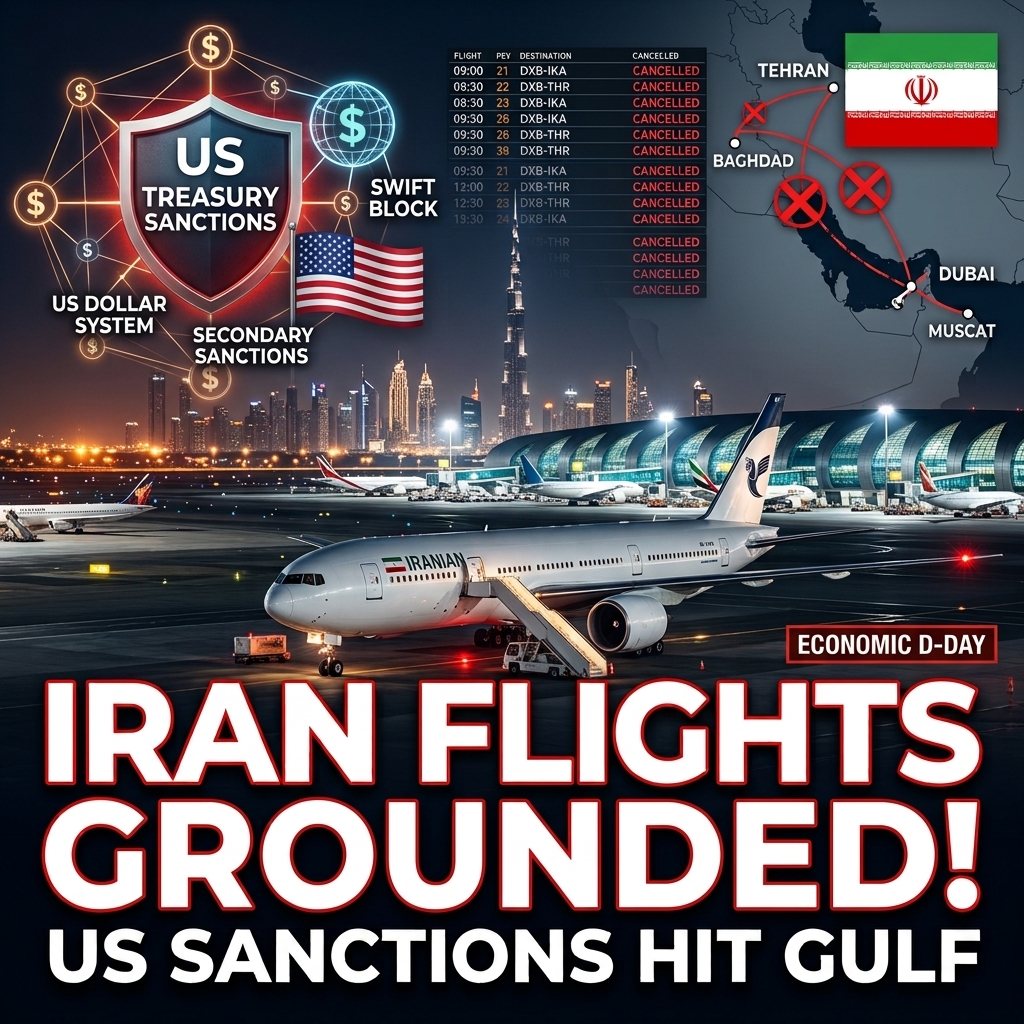
Iranian Flights Canceled Economic D-Day: US Sanctions Hit Gulf Hubs
Iranian flights canceled economic D-Day measures have plunged Middle Eastern aviation into immediate chaos following the expiration of a critical United States deadline. The ultimatum from Washington required foreign airports, refueling companies, and ground-handling agents to sever all operational ties with Iranian commercial air carriers or face complete exclusion from the U.S. dollar financial system.
The move marks a major escalation in what President Donald Trump has designated as an “economic D-Day” campaign—a sweeping initiative designed to enforce maximum financial pressure on Tehran by shutting down its global transport and commercial conduits.
Also Read:
Trump Hunt for New Press Secretary: Inside Escalating Media Clashes
1. The US Ultimatum: Targeting the Financial Lifeblood of Aviation
The primary catalyst behind the wave of canceled flights was a mandatory directive issued by the U.S. Department of the Treasury. Under secondary sanctions protocols, foreign aviation service providers operating in third-party countries face severe legal and financial penalties if they interact with Iranian airlines.
Rather than targeting the airlines directly within Iranian airspace, the secondary sanctions mechanism targets the international infrastructure required to keep aircraft flying:
Aircraft Refueling: Foreign fuel suppliers are barred from supplying jet fuel to Iranian planes at international terminals.
Ground Handling & Maintenance: Airport personnel are prohibited from providing baggage handling, ramp management, or routine maintenance to Iranian jets.
Ticketing & Banking Clearances: Foreign travel agencies and financial clearinghouses cannot process bookings or process payments for Iranian carriers.
                 [ U.S. "Economic D-Day" Secondary Sanctions ]
                                       |
         +-----------------------------+-----------------------------+
         |                                                           |
         v                                                           v
[ Foreign Airport Service Providers ]             [ The Compliance Dilemma ]
* Fueling, Maintenance, Gate Access               * Servicing Iranian planes = Loss of U.S. Dollar System
* Ticketing & Ground Logistics                    * Canceling Routes = Full U.S. Sanctions Compliance
         |                                                           |
         +-----------------------------+-----------------------------+
                                       |
                                       v
          [ Mass Route Cancellations Across Dubai, Muscat, & Baghdad ]
Because major international transit hubs like Dubai International Airport (DXB) depend on U.S. banking networks and global aviation supply chains, terminal operators complied immediately to avoid catastrophic enforcement actions.
2. Regional Fallout: Dubai, Baghdad, and Gulf Flight Groundings
Aviation tracking platforms confirmed an immediate collapse in Iranian commercial flight departures to neighboring Gulf states. State-owned flag carrier Iran Air, alongside major private operators such as Mahan Air, Qeshm Air, and Varesh Airlines, saw their international landing rights revoked or suspended across key regional destinations.
The United Arab Emirates served as the focal point of the disruption. As a primary global transit hub housing millions of expatriates and international business travelers, the halt in flight operations severed vital connection points between Tehran and the wider world.
| Destination Country | Key Airport Hubs | Sanctions Compliance Action | Affected Iranian Carriers |
| United Arab Emirates | Dubai (DXB), Abu Dhabi (AUH) | Immediate suspension of landing slots and refueling. | Iran Air, Qeshm Air, Varesh Airlines |
| Iraq | Baghdad (BGW), Najaf (NJF) | Direct prohibition on commercial capital flights. | Iran Air, Mahan Air |
| Oman | Muscat International (MCT) | Refusal of ground handling and terminal access. | Mahan Air, Iran Airtour |
| Georgia & Azerbaijan | Tbilisi (TBS), Baku (GYD) | Blanket restriction on Iranian passenger traffic. | Regional private Iranian carriers |
Travel agencies across Tehran reported overwhelming backlogs of stranded passengers, while dual nationals and students living abroad faced sudden travel cancellations without immediate alternative air routes.
3. Tehran’s Warning: Threats to Regional Aviation Infrastructure
The reality of Iranian flights canceled economic D-Day consequences brought an immediate and hostile reaction from government and military authorities in Tehran. The Iranian Civil Aviation Organization condemned the restrictions as an illegal blockade of civilian transport, attempting to negotiate emergency bilateral corridors through secondary regional airports.
Concurrently, Iranian defense leaders issued stern warnings to neighboring Gulf governments that complying with Washington’s mandates would carry strategic costs:
Airspace Countermeasures: Senior Iranian security officials warned that Tehran could enforce reciprocal airspace bans against any foreign nation that restricts access for Iranian civilian aircraft.
Infrastructure Security Risks: Government spokespersons signaled that if regional states assist in enforcing an economic blockade, Iran reserves the right to declare regional civilian aviation facilities “unsafe or unusable.”
Humanitarian Appeals: Iranian diplomats appealed to international civil aviation bodies, arguing that denying landing rights and fuel to passenger flights violates international civil aviation conventions.
4. Economic D-Day: Escalating the Maximum Pressure Strategy
The enforcement against civil aviation is part of a broader, multi-sector offensive. The Trump administration’s “economic D-Day” strategy seeks to paralyze Iran’s economy by simultaneous targeting energy exports, maritime shipping routes, foreign currency exchanges, and commercial transport.
By closing off transit hubs in Dubai and Istanbul, the U.S. Treasury aims to halt the physical movement of foreign currency cash and high-value commercial shipments into Iran. However, energy market analysts warn that aggressive enforcement in the Persian Gulf risks driving up global energy prices. Following the enforcement deadline, crude oil prices experienced upward pressure, with Brent crude rising past $107 per barrel amid fears of broader regional supply disruptions and retaliatory maritime incidents.
5. Strategic Outlook for Gulf Transit and Trade
As long as secondary sanctions remain strictly enforced, foreign airport authorities have little economic incentive to risk their access to Western financial markets for the sake of maintaining Iranian flight schedules.
Unless diplomatic negotiations open temporary humanitarian exemptions, the disruption of Iranian air links with Dubai and other Gulf hubs will likely persist, further isolating Iran’s economy and fundamentally altering transit dynamics across the Middle East.
Frequently Asked Questions (FAQs)
What caused the Iranian flights canceled economic D-Day situation?
The flight cancellations were triggered when a U.S. secondary sanctions deadline expired, requiring foreign airport service providers, refueling companies, and ground crews to stop servicing Iranian aircraft or lose access to the U.S. financial system.
Which transit hubs are most affected by the flight cancellations?
Dubai International Airport (DXB) in the UAE, along with major airports in Baghdad, Muscat, Tbilisi, and Baku, experienced major suspensions of Iranian commercial flights.
What does “economic D-Day” mean in this context?
“Economic D-Day” is the term used by President Donald Trump to describe an aggressive, comprehensive U.S. economic campaign designed to isolate Iran across aviation, shipping, banking, and energy sectors.
How has Iran responded to the flight groundings?
Iran condemned the action as an illegal air blockade, threatened reciprocal airspace restrictions, and warned neighboring countries against complying with U.S. sanctions directives.
Disclaimer
This article is an independent analytical news report compiled from public diplomatic readouts, international aviation metrics, and open-source news briefings. It is intended strictly for educational, informational, and news reporting purposes.