
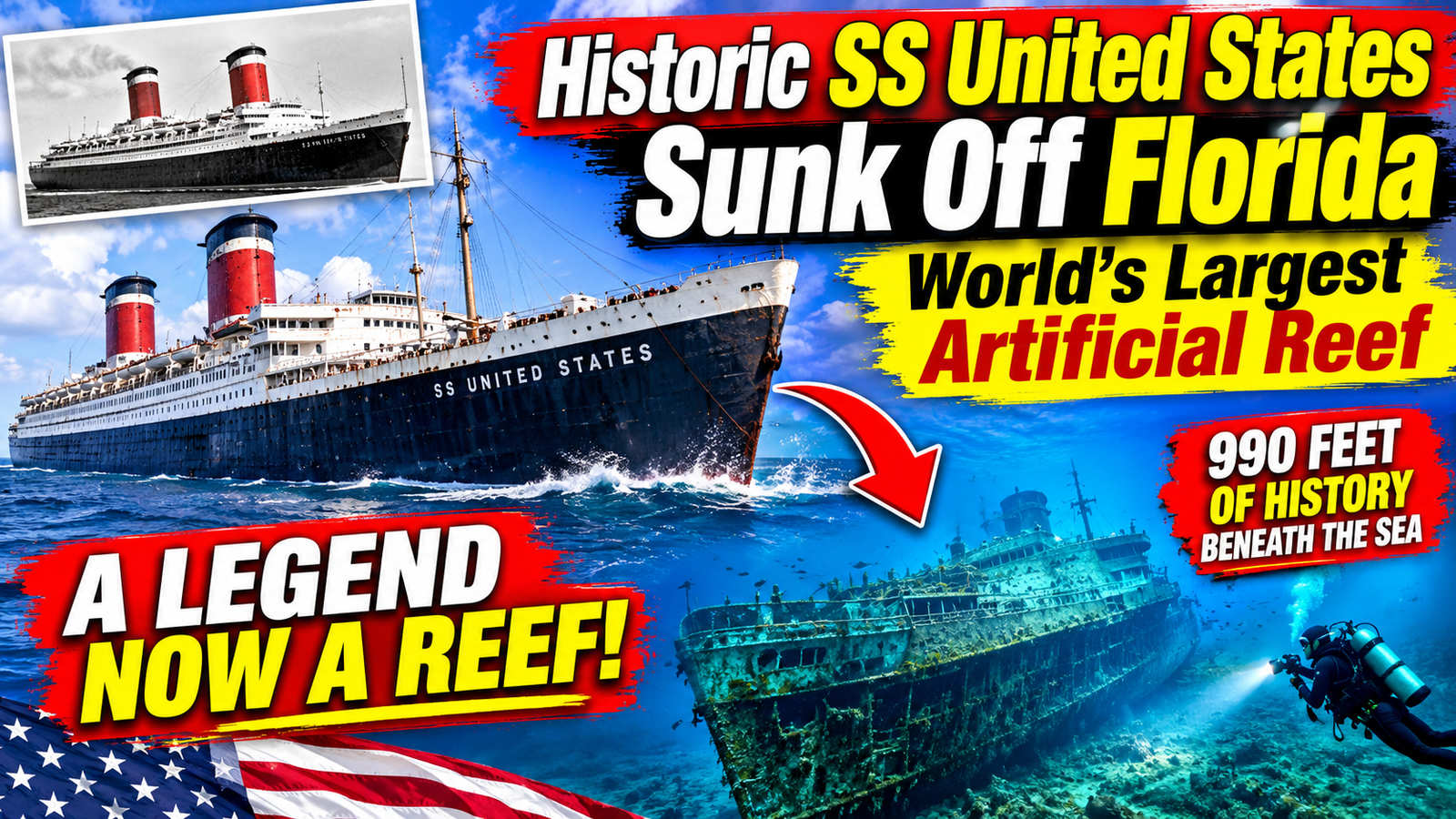
Historic SS United States Sunk Off Florida as World’s Largest Artificial Reef
Maritime history entered a new chapter beneath the waves of the Gulf on Wednesday, November 11, 2026, as the historic SS United States sunk off Florida to become the world’s largest artificial reef. After decades spent docked in Philadelphia and months of intensive environmental preparation in Mobile, Alabama, the storied 990-foot ocean liner was deliberately scuttled roughly 22 nautical miles (25 statute miles) southwest of Destin-Fort Walton Beach.
Originally scheduled for November 12, Okaloosa County officials and maritime contractors moved the deployment up by a day ahead of approaching inclement weather. Using a carefully engineered, explosive-free flooding process, crews opened intake valves to slowly sink the legendary vessel—surpassing the 911-foot aircraft carrier USS Oriskany to claim the global record for the largest artificial reef ever created.
Also Read:
GTA 6 Tops $1 Billion in Pre-Orders, Most Pre-Ordered Game Ever
A Storied Legacy: From Transatlantic Speed Champion to Reef
Before the historic SS United States sunk off Florida, the vessel stood as one of the greatest engineering achievements in American naval architecture. Designed by famed naval architect William Francis Gibbs and constructed in Newport News, Virginia, the ship made its maiden voyage on July 3, 1952.
During that inaugural transatlantic crossing from New York to Europe, the SS United States shattered the eastbound speed record held by Britain’s RMS Queen Mary, averaging more than 35 knots (nearly 41 mph) even while battling a severe full gale. To this day, the vessel retains the prestigious Blue Riband for the fastest transatlantic crossing by a passenger liner. Remarkably, the ship was also engineered to strict U.S. Navy standards so it could be rapidly converted into a troopship capable of carrying up to 14,000 soldiers during wartime.
At 990 feet in length, the SS United States stretches 108 feet longer than the RMS Titanic. Throughout its active commercial career from 1952 to 1969, “America’s Flagship” carried more than one million passengers, including four U.S. presidents—Harry Truman, Dwight Eisenhower, John F. Kennedy, and a young Bill Clinton—as well as cultural icons such as Grace Kelly, Elizabeth Taylor, and Salvador Dalí.
After being retired from service in 1969 due to the rise of commercial jet travel, the liner changed hands multiple times. For nearly three decades beginning in 1996, the rusting hull sat moored along the Delaware River in Philadelphia while preservationists fought to save it from the scrapyard. When no financially viable waterfront redevelopment plan materialized, Okaloosa County purchased the vessel in 2024 to give it a permanent second life supporting marine ecosystems and coastal tourism.
How Crews Prepared and Sunk the SS United States
Transforming a 990-foot mid-century ocean liner into a safe, environmentally compliant marine habitat required over a year of specialized remediation work. After being towed from Philadelphia to Mobile, Alabama, contractors stripped away hazardous materials, fuel residues, loose wiring, and non-structural fittings to meet strict federal Environmental Protection Agency (EPA) and U.S. Coast Guard regulations.
To ensure the ship settled upright on the sandy seafloor and remained accessible to marine life and scuba divers, crews made several critical modifications:
Explosive-Free Scuttling: Federal environmental rules prohibited the use of explosives. Instead, workers removed internal seawater cooling tanks and cut large 10-foot by 10-foot openings in the decks alongside more than 400 removed portholes, allowing seawater to flood the hull evenly when valves were opened.
Preserving Iconic Smokestacks: Before deployment, workers carefully removed the liner’s two iconic 65-foot red, white, and blue funnels. These historic smokestacks will serve as the centerpiece of a land-based museum in Destin-Fort Walton Beach dedicated to celebrating the ship’s history.
What the New Artificial Reef Means for Divers and Marine Life
Now that the historic SS United States sunk off Florida, the vessel rests upright on the Gulf floor in approximately 180 feet of water at coordinates 30° 07.148′ N, 86° 46.755′ W. Because the massive superstructure rises roughly 120 feet off the seabed, its upper decks sit around 55 to 60 feet below the surface.
This depth profile makes the wreck uniquely versatile for the global diving community:
Recreational Divers: Open-water and advanced recreational divers will be able to explore the expansive upper promenade decks and superstructure within standard recreational depth limits.
Technical Wreck Divers: Experienced technical divers equipped with decompression and trimix gear will be able to descend deeper to inspect the lower decks, massive hull, and engineering spaces down to 180 feet.
Situated just 12 nautical miles from the USS Oriskany reef off Pensacola, the SS United States anchors Northwest Florida’s reputation as one of the premier wreck-diving destinations in the world. Within weeks, algae, barnacles, sponges, and corals will begin colonizing the steel hull, attracting schools of snapper, grouper, amberjack, sea turtles, and pelagic fish.
Frequently Asked Questions (FAQs)
When and where was the SS United States sunk? The SS United States was sunk on Wednesday, November 11, 2026, in the Gulf approximately 22 nautical miles southwest of Destin-Fort Walton Beach, Florida, at coordinates 30° 07.148′ N, 86° 46.755′ W.
Why is the SS United States now the world’s largest artificial reef? Measuring 990 feet in length, the SS United States surpasses the previous record holder—the 911-foot former aircraft carrier USS Oriskany, which was sunk off Pensacola, Florida, in 2006—making it the largest vessel ever intentionally deployed as an artificial reef.
How deep is the SS United States wreck for scuba divers? The ship rests on the seafloor in about 180 feet of water, while its upper decks sit approximately 55 to 60 feet below the surface, making the top portion accessible to recreational divers and the lower hull ideal for technical divers.
Were explosives used to sink the SS United States? No. Federal environmental regulations prohibited the use of explosives. Crews used an explosive-free scuttling method by cutting strategic holes in the decks and opening seawater valves to flood the hull.
What happened to the SS United States’ famous smokestacks? Organizers removed the two 65-foot funnels prior to sinking so they can be preserved and displayed as the centerpiece of a new land-based museum in Florida honoring the ocean liner’s legacy.
Disclaimer
This article is for informational and news reporting purposes only. Scuba diving at the SS United States artificial reef site is subject to official safety clearances, local maritime advisories, and certification requirements issued by Okaloosa County and the U.S. Coast Guard; divers should verify current site openings and conditions before visiting.