
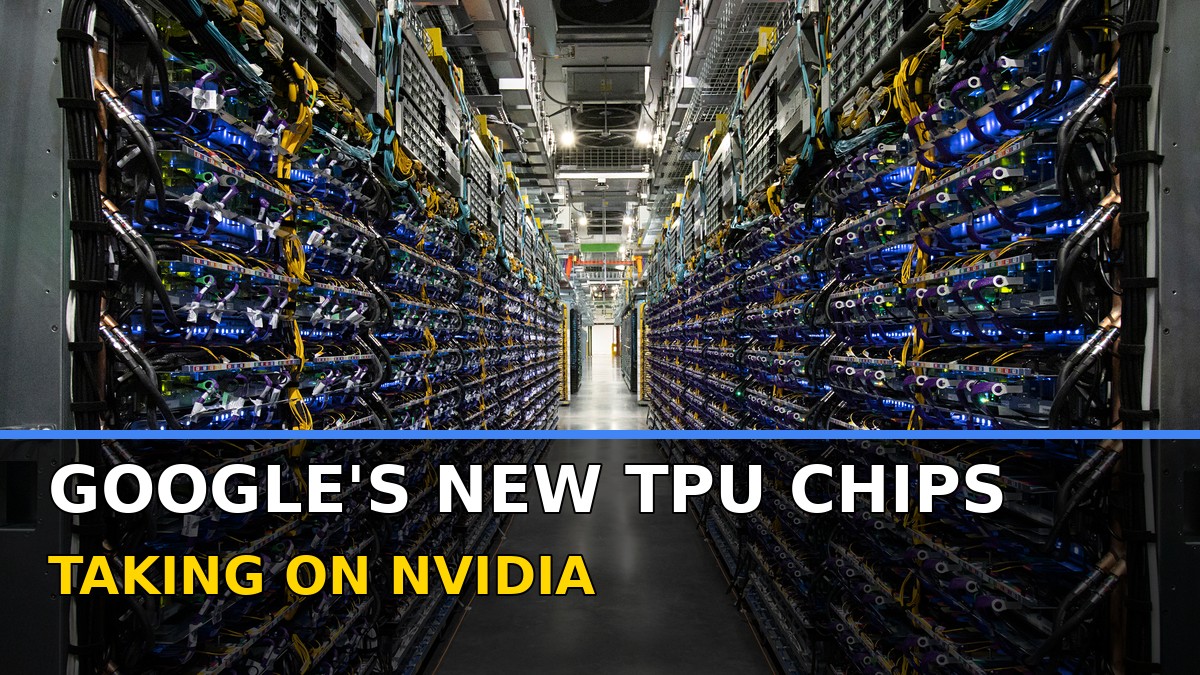
Google TPU chips are now at the centre of Alphabet’s boldest push yet into the artificial intelligence hardware market. On Monday, Google introduced two new versions of its in-house tensor processing units, the TPU 8tx and the 8i Max, in a direct challenge to Nvidia’s dominance in the booming market for AI chips.
The announcement landed well with investors. Alphabet shares rose more than 3% in early trading on Monday, as the market read the launch as a sign that Google’s years of quiet investment in its own silicon are starting to pay off in a serious way.
For most of their life, Google’s TPUs have worked behind the scenes. They power Search, YouTube and the Gemini AI models, doing the heavy lifting inside Google’s own data centres. But in recent years Google has also been selling TPU capacity through its cloud business, pitching it to companies that want to train and run large AI models without buying Nvidia hardware. That bet is now showing up in the numbers: Alphabet said TPU sales made a meaningful contribution to results in the September quarter, when Google Cloud revenue more than doubled to $30.71 billion.
What the two new Google TPU chips actually do
The two new chips are not brand-new designs built from scratch. They are redesigned versions of existing processors, each tailored for a specific kind of customer, according to the company. Bloomberg News first reported the development on Monday.
The 8tx is aimed at government agencies and companies in regulated industries that need to keep sensitive data protected while it is being processed. It pairs Google’s chip technology with AMD processors and encrypts data at the hardware level, delivering up to twice the speed of the previous version with virtually no trade-off in performance, the company said. That combination — confidential computing without the usual speed penalty — is aimed squarely at banks, healthcare providers and public-sector customers that have so far been cautious about moving sensitive AI workloads into the cloud.
The 8i Max, meanwhile, is built for AI applications that need to process very large amounts of information at once. It combines two chips into a single package to provide additional memory and computing power, making it well suited for coding assistants, mathematical reasoning and drug-discovery tasks — the kind of work where the size of the “context window”, the amount of information a model can consider at once, is often the limiting factor.
Why this matters in the fight with Nvidia
Nvidia has dominated the AI chip market for years, and its graphics processors remain the default choice for training the largest AI models. But that dominance has created an opening. Nvidia’s chips are expensive and, at times, hard to get hold of, and the biggest cloud companies have all been building their own alternatives.
Google is further along than most. It has been designing TPUs for a decade, and the scale of its cloud business gives it a ready-made customer base. Analysts at Bloomberg Intelligence expect TPU sales to top $135 billion by 2028, a figure that would make Google’s chip business a serious rival to Nvidia rather than a niche alternative.
The timing is also significant. Demand for AI computing is still surging, and cloud providers are racing to add capacity. Google’s pitch is that customers who already run their AI workloads on Google Cloud can now get more specialised hardware for the jobs that matter most to them — secure processing on one side, and huge-context reasoning on the other — without leaving Google’s platform.
What to watch next
The real test for the new chips will be adoption. Google has not said which customers are already using the 8tx or the 8i Max, or how quickly it can manufacture them at scale. Rivals are not standing still either: Amazon and Microsoft both have their own AI chips, and Nvidia continues to release new hardware of its own.
But the direction of travel is clear. The AI chip market is no longer a one-company story, and Google’s latest move shows it intends to be a central player in it. For Nvidia, the challenge is no longer just about keeping up with demand — it is about holding market share against cloud giants that now design, build and sell their own silicon.
Reporting by Anhata Rooprai in Bengaluru for Reuters; editing by Jonathan Ananda. First reported by Bloomberg News.