
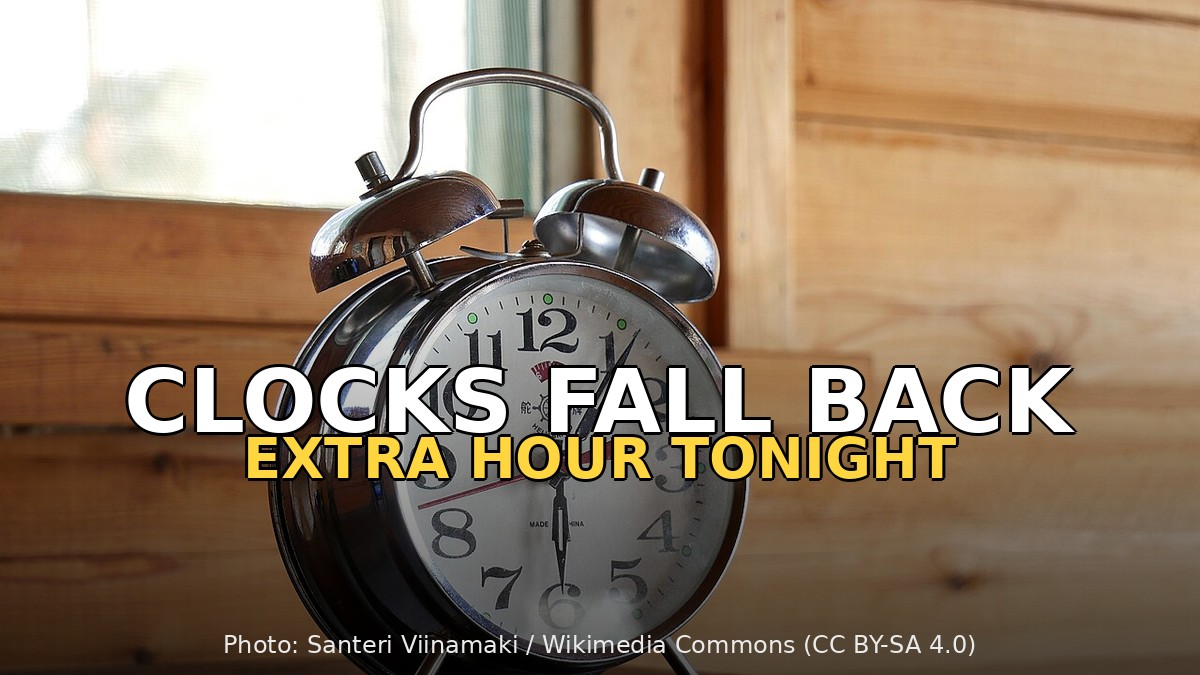
If your Saturday night plans include Halloween fun, don’t forget to give your clocks a little attention before bed. Daylight saving time ends at 2 a.m. local time on Sunday, November 1, 2026, when clocks across most of the United States “fall back” one hour to 1 a.m. — the moment America returns to standard time for the fall and winter.
The good news: you get an extra hour of sleep once daylight saving time ends. The trade-off: sunsets will come noticeably earlier starting Sunday evening.
What happens when daylight saving time ends
At 2 a.m. local time on Sunday, clocks turn back to 1 a.m. in every state that observes daylight saving time. The extra hour repeats the 1 a.m. to 2 a.m. stretch overnight, which is why smartphones, tablets and computers that update automatically will simply do the job on their own. Anything analog — wall clocks, wristwatches, the clock in your car or on the microwave — still needs a manual turn backward.
From Sunday onward, both sunrise and sunset arrive one hour earlier than the day before. Mornings get brighter sooner, but darkness will settle in earlier each evening, a pattern that continues through the winter months. Under current federal law, daylight saving time begins on the second Sunday in March and ends on the first Sunday in November. This year’s stretch ran from March 8 to November 1.
Who does not change their clocks
Not everyone participates. Hawaii stays on standard time year-round, as does most of Arizona — the Navajo Nation in northeastern Arizona does observe the change. The U.S. territories of Puerto Rico, Guam, American Samoa, the Northern Mariana Islands and the U.S. Virgin Islands also skip the switch entirely.
Why the clock change is still happening
For months, there was real hope this fall’s switch might be the last. President Donald Trump spent much of the year pushing Congress to end the twice-yearly clock changes and keep the country on daylight saving time year-round, arguing Americans were tired of the ritual.
The push got further than most years. The Sunshine Protection Act, introduced by Rep. Vern Buchanan of Florida, cleared the U.S. House in July by a wide bipartisan margin of 301 to 117. If signed into law, it would make daylight saving time permanent and eliminate the fall and spring changes altogether.
But the bill ran into trouble after moving to the Senate. It was referred to the Senate Committee on Commerce, Science, and Transportation, where it stalled — and with senators out of Washington until after the November 3 election, there is no realistic chance of action before clocks turn back.
Only Congress can change the system. The Uniform Time Act of 1966, signed under President Lyndon B. Johnson, sets the framework for daylight saving time, and the Department of Transportation oversees its administration while the National Institute of Standards and Technology keeps official time. If the Senate does not act before the current Congress concludes in early January 2027, the legislation would expire and have to start over.
What Americans actually want
Polling suggests most Americans would happily ditch the switch. A YouGov survey conducted in March 2026 found that 64 percent of Americans want to stop changing clocks twice a year — though they split on the fix, with 43 percent preferring permanent daylight saving time and 28 percent preferring permanent standard time.
The disagreement is not just preference. A study published October 29 in the journal Current Biology, by researchers at the University of Washington, estimated that permanent daylight saving time could add at least two billion more dark morning commutes to school for K-12 children nationwide, since winter sunrises would arrive much later. That safety concern has been central to the opposition.
Sen. Tom Cotton of Arkansas has been the most vocal holdout, arguing that permanent daylight saving time would push winter sunrises to what he called an absurdly late hour, sending children to school in the dark. Trump has publicly blamed the Senate — and Cotton in particular — for letting the bill die, urging supporters to pressure lawmakers.
Christopher Barnes, a professor at the University of Washington’s Foster School of Business who studies sleep and productivity, told USA Today that daylight saving time’s appeal often comes down to brighter evenings, when people picture outdoor dinners and late-evening activities. But he warned that permanent daylight saving time could create long-term circadian misalignment for many Americans, with bodies at odds with the clock for months.
A quick checklist before bed Saturday
- Turn analog and manual clocks back one hour before going to sleep.
- Check car dashboards, ovens, microwaves and coffee makers — these usually do not update on their own.
- Smartphones, tablets, computers and smartwatches will adjust automatically as long as they are set to the correct time zone.
- School, work and appointment times will all be one hour earlier by the clock starting Sunday, so plan morning routines accordingly.
For the record, this year’s timing is a fun quirk of the calendar: Halloween fell on a Saturday and daylight saving time ends on the Sunday right after, the last time the two will coincide until 2037.
When does daylight saving time come back?
Barring a last-minute move by Congress, the ritual will repeat in reverse in a few months. Daylight saving time returns at 2 a.m. local time on Sunday, March 14, 2027, when clocks “spring forward” one hour — taking back that hour of sleep and pushing sunsets later into the evening.