
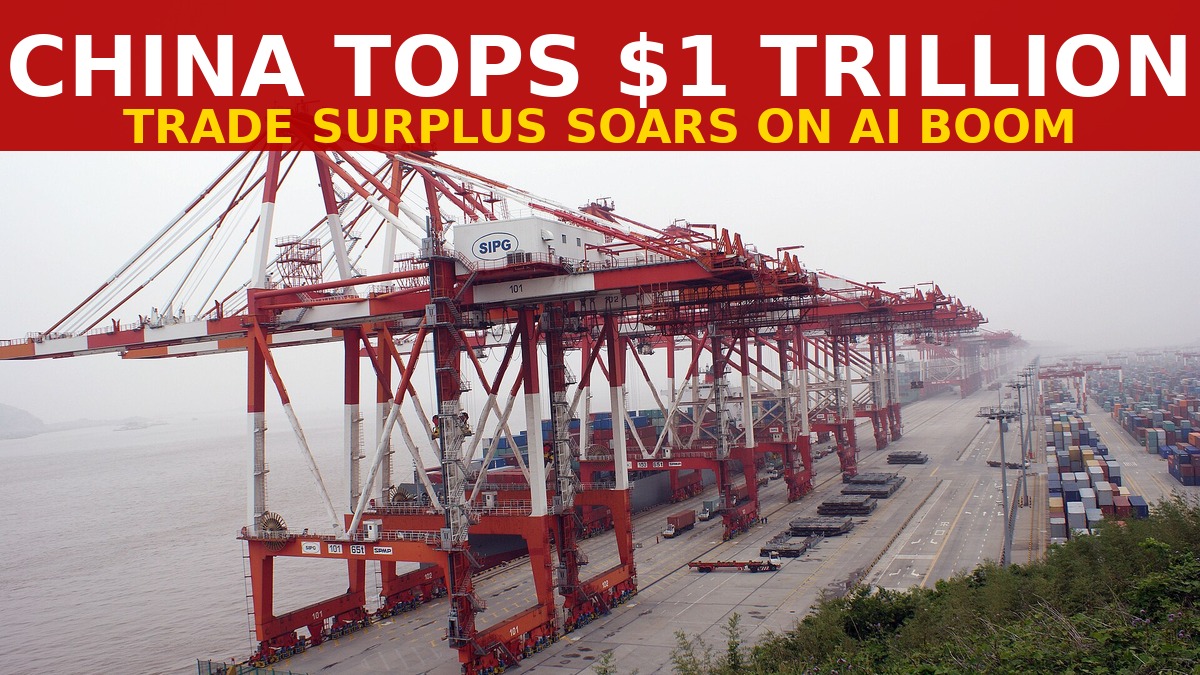
China’s trade surplus has surged past $1 trillion in the first 10 months of 2026, with the China trade surplus $1 trillion milestone reached a month earlier than last year as a global race to build artificial intelligence infrastructure powers demand for the country’s high-tech goods.
Customs data published on Tuesday showed exports rising 35.2% in October from a year earlier in US dollar terms — only slightly slower than September’s 36.3% jump, and ahead of economists’ forecast of a 33.5% increase. The figures lifted the January-to-October surplus to $1.04 trillion, topping $1 trillion for a second consecutive year.
Imports grew even faster, rising 41.6% in October and beating the median forecast of 32% in a Reuters poll, after a 31% increase in September.
Exports jumped 35.2% as AI demand powered the China trade surplus $1 trillion past
The strength of the export numbers reflects how central China has become to the global AI buildout. Factories are shipping the servers, components and high-tech equipment that data centres around the world need, and that demand has helped offset weak spending at home, where consumers remain cautious and the property market is still working through a long downturn.
Much of the strength in exports this year has been fuelled by the global push to expand AI infrastructure, and analysts expect the momentum to last a while longer. Macquarie analysts wrote that the outlook for exports depends on how long the AI boom will last, and they expect China’s exports to accelerate further in the fourth quarter before starting to slow from the first quarter of 2027.
The boom has arrived at a useful time for Beijing. The figures highlight a growing reliance on overseas demand to support an economy hobbled by subdued consumption and a protracted property slump — a dynamic that works while global demand holds, but leaves China exposed if it cools.
Why the surplus is making trading partners nervous
A surplus of this size rarely goes unnoticed, and this one is already sharpening tensions with major trading partners. The European Union is the most exposed: leaders in Brussels have called for more trade curbs on China after reaching an agreement with Beijing to limit Chinese exports of hybrid vehicles to the bloc over the next few years.
Because those measures have yet to take effect, factories are expected to bring shipments forward, bolstering exports in the near term — but the underlying friction is not going away. “The risk of additional tariffs and other trade barriers will remain elevated in 2027, particularly as Chinese manufacturers continue expanding their presence in overseas markets,” said Joe Peissel, lead macroeconomist at Trivium China.
The warning matters beyond Europe. A second straight year above $1 trillion gives China’s trading partners fresh grounds to argue that the playing field is tilted, and it raises the odds of new barriers just as Chinese manufacturers are pushing harder into overseas markets.
The US truce — and what comes next for China trade
China on Monday officially announced the extension of its trade truce with Washington by two months. The truce had been due to expire on November 10. Beijing said last week, however, that expanding its purchases of US farm goods would hinge on the implementation of the two sides’ agreed reciprocal tariff-reduction arrangement — a reminder that the truce is a pause, not a settlement.
The diplomacy continues in person. The Asia-Pacific Economic Cooperation summit takes place next week in Shenzhen, the southern tech and innovation hub, where Chinese President Xi Jinping and US President Donald Trump are expected to meet for the third time this year. The meeting will be watched closely for any sign of whether the truce can be extended into something more durable.
For context on how the AI hardware race is reshaping the wider technology market, see our report on Google’s new AI chips and the challenge to Nvidia’s dominance: https://worldreachdaily.com/google-tpu-chips-nvidia-ai-dominance/
Weak spending at home remains the weak spot
For all the strength abroad, the domestic picture is far less impressive. Consumers remain reluctant to spend, constrained by a property market downturn that has battered household wealth and dented confidence in the economic outlook.
The imbalance is visible in the car industry. China’s car exports maintained a solid pace of growth in October, while domestic vehicle sales recorded a 12th straight month of declines, according to separate data released by an industry association. Sluggish demand at home has pushed Chinese automakers to seek sales in overseas markets instead.
Greater reliance on exports, however, leaves China’s economy increasingly exposed to any slowdown in global demand — the same demand that is currently doing the heavy lifting.
What to watch next
Three things will decide whether the surplus keeps growing. First, how long the AI investment boom lasts — if spending on data centres cools, the export engine slows with it. Second, whether the EU’s planned curbs bite once they take effect, and whether other partners follow. And third, whether the Xi-Trump meeting in Shenzhen produces anything beyond the two-month truce extension.
For now, the numbers speak for themselves: $1.04 trillion in ten months, exports up more than a third, and a milestone reached a month earlier than last year. The question is no longer whether China can sell to the world — it is whether the world will keep letting it sell this much.
Source: CNN reporting on China’s customs data, November 10, 2026 — https://www.cnn.com/2026/11/09/business/china-trade-surplus-1-trillion-intl-hnk?cid=external-feeds_iluminar_meta