
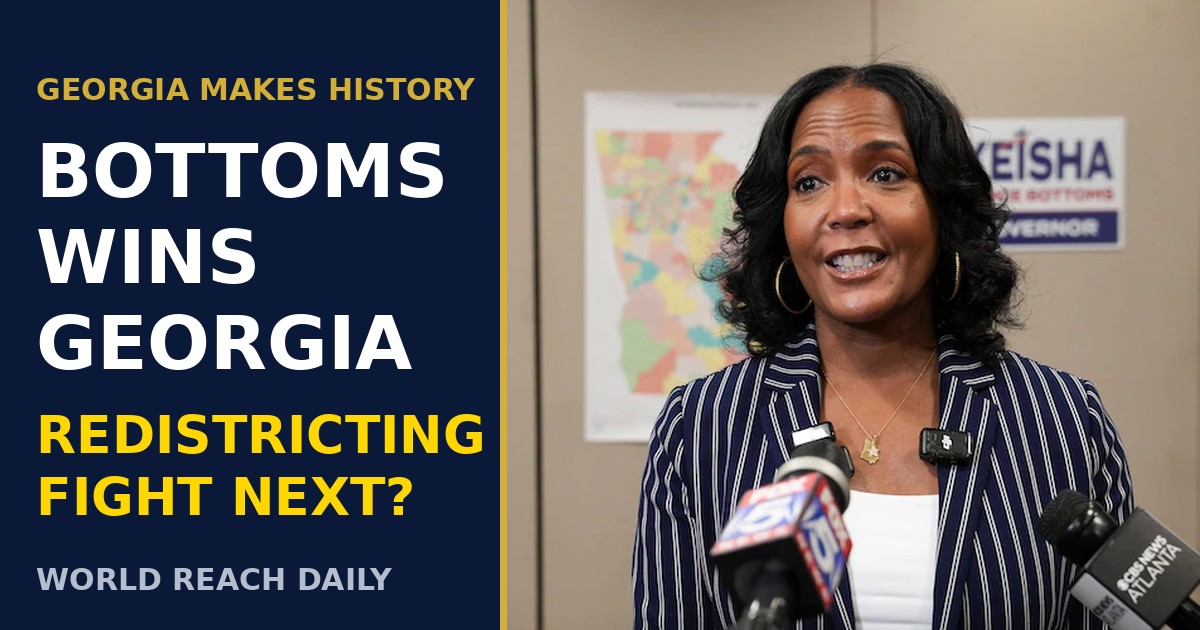
Keisha Lance Bottoms wins Georgia governor — she will be the next governor of Georgia, and her victory is historic on more than one count.
Bottoms is the first Black governor in Georgia’s history, the first Black woman to be elected governor of any state in America, and the first Democrat to win the Georgia governor’s office since 1993. She defeated Republican healthcare executive Rick Jackson after the two entered election day locked in a statistical tie in the polls.
By Wednesday morning, Bottoms had secured 54.31 percent of the vote — more than 360,000 votes ahead of Jackson. It was a decisive result in a race many expected to be decided by a whisker.
But before she can swear her oath of office in January, a major fight may be waiting for her in the state house — one that could reshape Georgia’s political map before she ever takes power.
Bottoms wins Georgia governor as a redistricting push is shelved — for now
The fight centres on redistricting: the redrawing of Georgia’s legislative and congressional maps.
State legislators called a special session in June to consider new maps, after a Supreme Court decision in Louisiana weakened the protections of the Voting Rights Act. Georgia was just one of several Southern states where lawmakers moved quickly to redraw districts in the wake of that ruling.
The push ran into fierce resistance. Democratic lawmakers and voting rights groups pushed back hard, and large protests filled the state capital. In the end, Republicans in the state house decided to scrap the effort — for the time being.
Georgia House Speaker Jon Burns put it in writing to Republican Governor Brian Kemp, saying that changes to the maps should only happen once lawmakers and ordinary citizens had been given a proper chance to gather the facts, give their input and take part in a meaningful discussion. “For this reason, we will not be taking up congressional or legislative redistricting for the 2028 election cycle during this special session,” he wrote.
That was June. The political landscape has changed since then — and the shelved plan may not stay shelved for long.
Why the fight is likely to come back after Bottoms wins Georgia governor
Bottoms wins Georgia governor, and other Democrats are on track to take majority control of the Georgia House of Representatives. That changes the arithmetic for Republicans, who still hold the legislature and the governor’s mansion until January.
The expectation in Atlanta is that redistricting will be back on the table — pushed through the legislature and signed by Kemp before he leaves office.
“I would not be surprised if there is a special redistricting session,” Andra Gillespie, a political scientist and professor at Emory University in Atlanta, told USA Today before election night. “I think if (Bottoms) wins, there will absolutely be a special session that they’ll try to get done while Brian Kemp is still in office.”
The window is narrow. Once Bottoms is sworn in and a new legislature is seated, the chance to redraw the maps on Republican terms is gone. That is what makes the weeks between now and January so consequential.
What the rest of the country could teach Georgia
Results from other parts of the country may give Georgia lawmakers pause before they act.
Gillespie pointed to the redistricting battles in heavily gerrymandered states such as Texas, and perhaps Florida, where aggressive map-drawing was meant to lock in Republican seats. If those efforts backfire in the congressional results, Georgia’s Republicans may think twice.
“I think the lesson of this is we’ll have to pay attention to how redistricting kind of pans out in terms of congressional results in places that were heavily gerrymandered, like Texas in particular, and Florida perhaps. If you see redistricting efforts backfire that might give Georgia lawmakers some pause,” Gillespie said.
There is a second worry for Republicans. The districts they hoped to draw as safely Republican may not be as Republican as they assumed, after an election night that turned into a sweeping Democratic victory.
“They may be skittish about doing it if it turns out that some of these districts that got drawn in Texas that they were hoping were going to be Republican turn out not to be Republican because of the backlash to the Trump Administration,” Gillespie said. “It could very well be that they may decide it’s an outlier, but it might be an outlier that gives people pause to wait until 2031 to actually do a redistricting.”
Which districts could actually change?
Even if Republicans do move, their room to manoeuvre is limited — and the map itself is the reason.
Atlanta’s metropolitan area is simply too large and too Democratic to be carved up into rural, Republican-leaning districts. Any attempt to split the city would run into the sheer concentration of Democratic voters there.
“Where they can credibly redistrict is limited,” Gillespie explained. “I think it’s going to be really, really, really hard to do just given the size of metro Atlanta and then just given the concentration of Democrats. I’m sure there’s some way somebody could creatively figure out a way to gerrymander a district to try to divide Democrats (but it’s not) really feasible.”
The most likely seat to be lost in a redistricting effort is the one currently held by U.S. Representative Sanford Bishop, in Georgia’s southwest corner. It remains one of the last Black-majority congressional districts in the South also held by a Black leader — and if it were divided among the surrounding conservative districts, it could fall back into Republican hands. Bishop won re-election in the 2nd district with 60.87 percent of the vote on election night.
Republicans could also target the 13th congressional district in Atlanta. The seat was created in 2003 after the 2000 census and was held by the late Representative David Scott until his death earlier this year. Democrat Jasmine Clark won it on Tuesday night with 79.83 percent of the vote.
What happens next
Bottoms wins Georgia governor by a margin nobody had predicted. The question now is whether the outgoing Republican majority will use its final weeks in power to redraw the map before she takes office — or whether the backlash to redistricting elsewhere, and the limits of Georgia’s own geography, will persuade them to wait.
Either way, after Bottoms wins Georgia governor, the first Black woman ever elected governor in America will take office in January facing a legislature that may already have tried to redraw the ground beneath her.
Source: USA Today, November 4, 2026.