
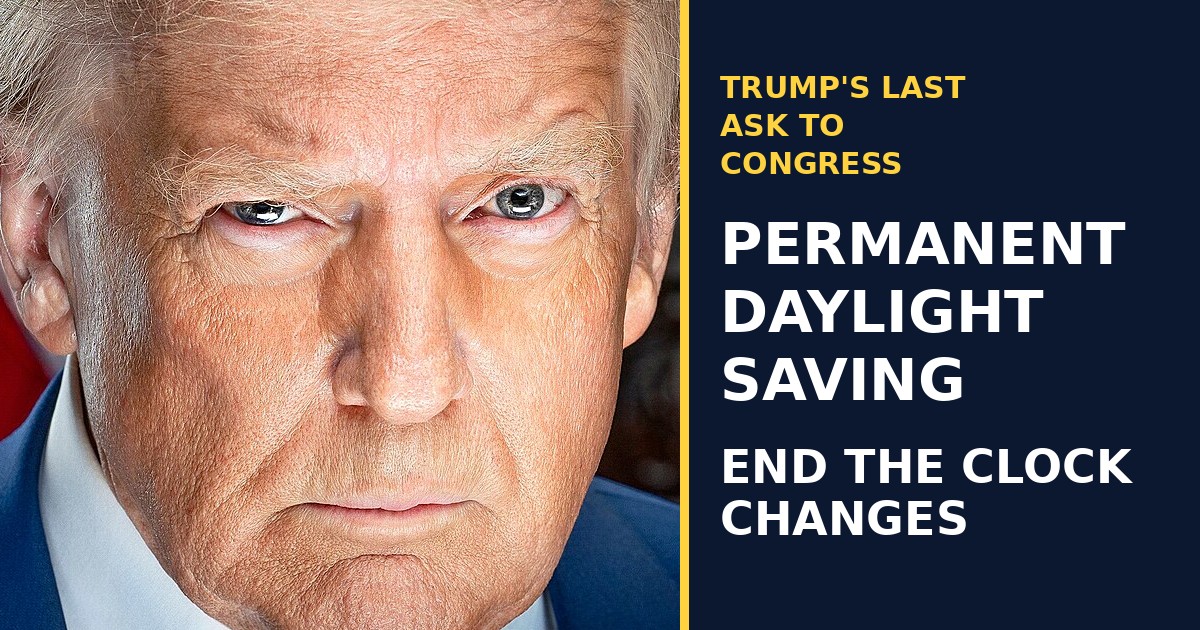
President Donald Trump has one last item on his wish list for the outgoing Republican Congress: end the twice-yearly clock change for good.
A day after the midterm elections, Trump called on Republicans to use their remaining weeks in control of Congress to pass the Sunshine Protection Act — the bill that would make daylight saving time permanent across the United States. He has even given it a new name of his own: the “I Don’t Want to Change My Clocks Anymore Act.”
The timing, Trump made clear, is no accident. Republicans are about to lose their grip on Capitol Hill, and he wants the bill passed before Democrats take over in January.
“I didn’t want to make a big deal out of this prior to the election”
In a statement issued as darkness fell on Wednesday, Trump said he had deliberately held back on the issue during the campaign.
“I didn’t want to make a big deal out of this prior to the Election because I didn’t want to have certain Senators lose their Race, in a landslide, but it is too bad they can’t get it done,” the president said. “We have far bigger priorities, but I will keep fighting for this!”
His frustration was plain. The clocks had just gone back, the evenings had turned dark almost before the working day was over, and Trump was not shy about saying so.
“It’s so dark outside, so early (Sunset was 5:06 P.M., and it was dark by 5:31 P.M. — Isn’t that ridiculous?),” Trump said. “Just a few days ago it was so nice and sunny at this same time. In addition, everyone’s been running around changing their clocks all over the place.”
A bill stalled by the election recess
The Sunshine Protection Act would do away with the spring-forward, fall-back ritual altogether. Instead of turning the clocks back in the autumn and forward again in the spring, the country would stay on daylight saving time all year round.
The idea has been gathering support for years, and it enjoys growing public backing. But the bill stalled while the Senate was in an extended election recess, and it never reached a vote.
That delay is what Trump is now trying to undo — with the clock, quite literally, running out on the Republican majority.
Why the window is closing
The urgency comes from the midterm results. Democrats trounced incumbent Republicans in what is being seen as a repudiation of Trump’s handling of the country during the first two years of his second term. As of 7 p.m. ET on Wednesday, Democrats had flipped seven Senate seats and 32 seats in the House, according to USA Today.
Once the new Congress is seated in January, the balance of power shifts, and with it the chances of a Republican-led bill reaching the president’s desk. Trump is asking his party to act while it still can.
Whether Republicans will take up the cause in the lame-duck session remains to be seen. They have a crowded agenda for their final weeks in charge, and the president himself conceded that there are “far bigger priorities” on the table. But he has made his position clear: he wants the clock changes gone, and he wants it done now.
Who can actually change the clocks?
One reason the bill matters is that only Congress has the power to make this change. The current law on daylight saving time, the Uniform Time Act of 1966, was enacted under President Lyndon B. Johnson’s administration, and it is Congress alone that can amend it. The Secretary of Transportation oversees its administration under federal law, but the decision itself belongs to lawmakers.
For now, neither has changed it — and Americans will keep changing their clocks twice a year until Congress acts.
What happens next
The question now is whether the lame-duck Congress will listen. Trump has put the issue squarely in front of Republican lawmakers and given them a deadline that needs no explaining: the end of their majority.
If they do not act, the Sunshine Protection Act will have to wait for a new Congress — one in which Democrats hold the power — and its fate will be in very different hands.
For a president who has just watched his party lose control of Capitol Hill, it is a small, almost personal request: one last vote, before the lights go out on the Republican majority, to stop changing the clocks.
Source: USA Today, November 4, 2026.