
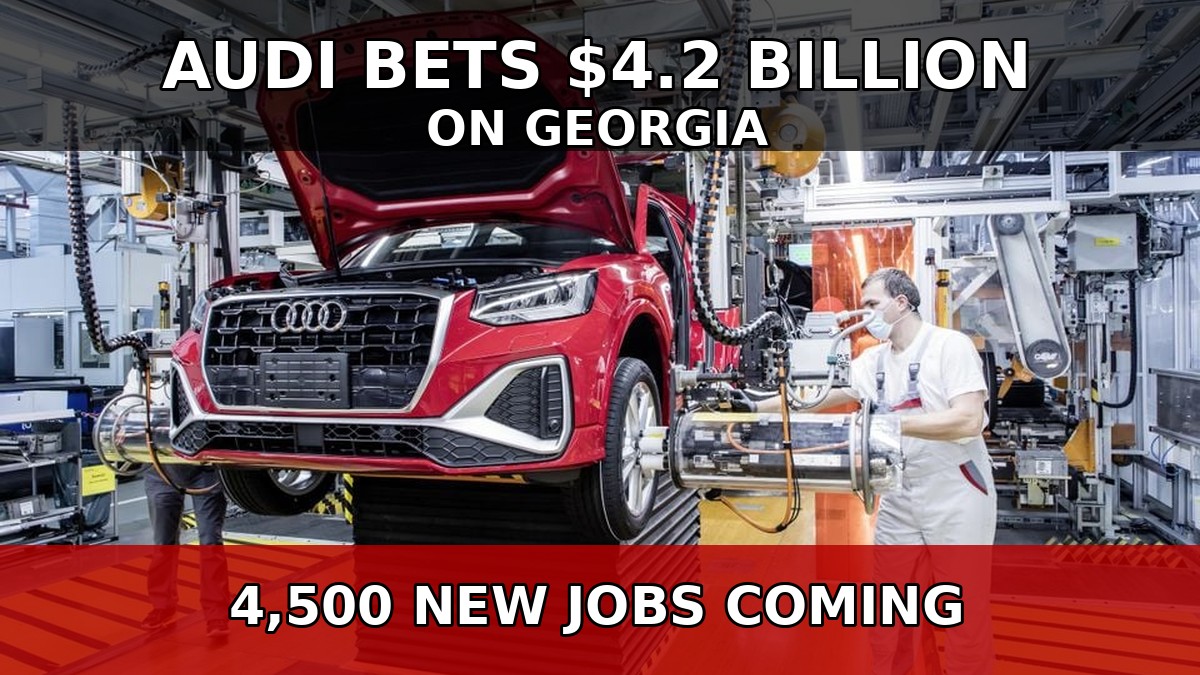
Audi has chosen Georgia for its first-ever factory in the United States, and the numbers behind the announcement are big enough to reshape the job market in the middle of the state. President Donald Trump revealed the plan on Saturday, October 24, at a campaign rally in Perry, Georgia, telling the crowd that Audi will invest $4.2 billion near Macon and build a plant capable of turning out 200,000 cars a year.
Audi itself has put the investment at around $4 billion and the workforce at about 4,500 jobs. The small gap between the two figures is normal for announcements of this size — the headline number quoted on stage and the figure in the company’s own statement rarely match to the decimal — but the scale is not in doubt. This is one of the largest single manufacturing commitments Georgia has ever landed, and it gives Audi something it has never had before: a factory on American soil.
Why this plant matters for Georgia workers
For years, Audi stood out among German carmakers precisely because it did not build cars in America. Volkswagen, BMW and Mercedes-Benz all run large plants across the American South. Audi, by contrast, imported nearly everything it sold in the United States from Germany, Mexico and elsewhere in Europe. That left it exposed when tariffs on imported cars rose, and it left Georgia without a prize its neighbours already enjoyed.
The new plant changes that equation. It will sit at the Middle Georgia Megasite near Macon, a large, investment-ready site that Georgia officials have spent years preparing for exactly this kind of project. Governor Brian Kemp said the state was proud Audi had chosen Georgia for its first U.S. plant, and that the site had been bought and expanded with a carmaker in mind.
The jobs will not all arrive at once, and they will not all look the same. A modern car plant needs production workers on the line, but it also needs engineers, maintenance technicians, quality inspectors, logistics staff and supervisors. Around it, suppliers, trucking firms, restaurants and housing all tend to grow. That ripple effect is why state officials fight so hard for these announcements — the 4,500 jobs inside the fence are only the beginning of the story.
What the plant will build, and when
Audi says the Georgia plant will be designed around its biggest and most premium SUVs, built for North American customers. Reports citing the company point to models in the Q7, Q8 and Q9 class, with annual capacity of up to 200,000 vehicles once the plant is fully running.
The timeline needs a careful reading, because two versions of it are circulating. On stage in Perry, Trump told the crowd that construction would begin next month. Audi’s own statement, however, puts site work and construction in 2027, with production starting in the early 2030s — some reports put full capacity in 2031. Readers should treat the company’s written timetable as the working plan and the rally remark as stage language, not a revised schedule. Either way, nobody should expect finished cars rolling out of Macon next year. This is a long project, and the hiring will ramp up in stages as construction, equipment installation and trial production proceed.
Audi chief executive Gernot Döllner joined Trump on stage and framed the move as a long-term bet on the American market. “This is a long-term investment, because we believe in the American market,” he said. The company has also described North America as a third pillar of its global production network, alongside Europe and China.
The tariff argument behind the announcement
Trump credited his tariff policy directly for the decision, telling the crowd in Perry: “Without tariffs, they wouldn’t be coming in.” The argument is that making imported cars more expensive pushes foreign carmakers to build inside the United States instead.
There is a real commercial pressure behind that claim, whatever view readers take of tariffs themselves. Tariffs cost Audi about €1.2 billion last year, according to company reporting, and a similar hit has been expected this year. Audi raised prices to offset some of that burden, and its U.S. sales have fallen this year. Building in Georgia would remove the tariff cost on the cars made there and shorten the supply chain to its American buyers. For a company whose global sales have now declined for two consecutive years, and whose deliveries in China — its largest single market — have also dropped, a lower-cost American base is a business decision as much as a political one.
Critics of tariffs will note, fairly, that the costs of the policy fall on buyers in the meantime, and that a plant announced in 2026 will not cut a single car price until the early 2030s. Supporters will answer that the jobs and the factory are the point. Both things can be true at once: the announcement is genuinely significant for Georgia, and it does not settle the wider argument about tariffs.
A rally announcement, ten days before the midterms
The setting matters too. Trump was in Perry to campaign for Republican Representative Mike Collins, who is running to unseat Democratic Senator Jon Ossoff, and for Rick Jackson, the Republican candidate for governor against former Atlanta Mayor Keisha Lance Bottoms. The announcement landed ten days before the November 3 midterm elections, in a state where both races are closely watched.
The New York Post reported that Ossoff leads Collins by eight points, 48% to 40%, in the latest Atlanta Journal-Constitution poll, with 12% undecided. Trump used the rally to attack Ossoff, calling him a “far-left extremist” — a claim Ossoff’s campaign would dispute, and one that belongs in the campaign debate rather than in the jobs figures themselves. Voters in Georgia will decide the politics; the factory, if it is built on the timetable Audi has published, will outlast the campaign that announced it.
What to watch next
Four things will tell Georgians whether this announcement becomes the plant it promises to be. First, site work at the Middle Georgia Megasite: grading, roads and utilities in 2027. Second, supplier announcements, since a car plant is only as strong as the parts network around it. Third, workforce training — Georgia’s technical colleges and training programmes will need to prepare thousands of workers for jobs that did not exist in the state before. And fourth, the model plan: confirmation of exactly which SUVs the plant will build, and when the first production car is scheduled.
For now, the headline stands on its own. Audi, the one major German brand without an American factory, is coming to Georgia. About $4.2 billion is on the table, about 4,500 jobs are promised, and a town near Macon is about to become one of the most important new addresses in the American car industry.
Sources: New York Post report on the October 24 Perry rally; Wall Street Journal reporting on Audi’s first U.S. factory; Audi company statement as reported by multiple outlets.